
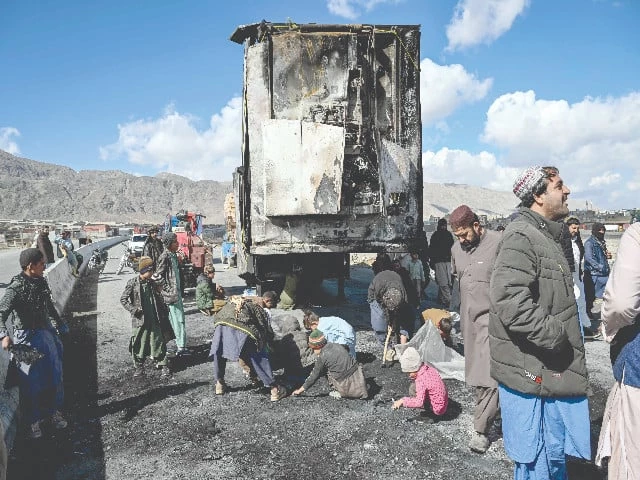
People gather as others collect recyclable items next to a burnt vehicle along a road on the outskirts of Quetta, a day after coordinated terrorist attacks in Balochistan. Photo: AFP
QUETA:
Balochistan witnessed one of its most intense counter-terrorism operations in recent years as security forces killed at least 145 terrorists in a span of 40 hours, foiling a wave of coordinated attacks, Chief Minister Sarfraz Bugti said on Sunday.
At a press conference in Quetta, Bugti described the operation as one of the largest intelligence-led actions carried out in such a short period of time, following multiple attacks claimed by the banned Balochistan Liberation Army (BLA).
According to Inter-Services Public Relations, terrorists launched coordinated attacks at several locations on Saturday, targeting security installations and civilian areas in Quetta, Mastung, Noshki, Dalbandin, Kharan, Panjgur, Tump, Gwadar and Pasni.
Security forces responded with sustained clearance operations and clashes, killing 92 terrorists, while 18 civilians lost their lives. The army said 15 security personnel “fought bravely and embraced martyrdom” during the operations.
At the press conference, Bugti said intelligence agencies had intercepted information indicating that attacks were imminent, allowing preventive actions to begin a day earlier in northeastern Quetta, Panjgur and Sherani.
“We had intelligence reports that this was being planned, so we started operations a day early,” Bugti said, adding that early intervention prevented attacks in sensitive areas of northeast Quetta.
He said forces remained on high alert elsewhere, carrying out more than 5,800 intelligence-based operations over 40 hours. “So far we have 145 bodies. We managed to kill 145 terrorists, the highest number in 40 hours,” he said.
Bugti accused the militants of deliberately attacking civilians and exploiting vulnerable populations. Referring to an incident in Gwadar, he said five women and three children were killed in a family labor colony despite pleading for their lives.
He also revealed that terrorists damaged surveillance infrastructure, including Safe City cameras in Quetta, although, he added, the system had since been upgraded and expanded to strengthen urban monitoring and response capabilities.
The prime minister said terrorists used children as human shields during the Quetta attacks, complicating operational decisions. “They brought an 11-year-old boy with them. Should the police kill an 11-year-old boy?” asked.
Bugti insisted that no town had been invaded and said daily life in most parts of Quetta continued uninterrupted. “No town was taken. I myself was moving through Quetta,” he said, adding that only one town was temporarily affected.
It alleged that the attacks were planned from Afghan territory and executed on instructions from India, and described the militants as an external proxy seeking to destabilize Pakistan during periods of regional tension.
“We are a responsible state: police and army. We do not want to be lethal,” Bugti said. “But we will not let them go so easily. Our blood is not so cheap,” he said. Don’t call them Baloch. Baloch are not terrorists. “They kill Baloch women and then exploit Baloch identity.”
The prime minister said terrorists tried to seize sensitive facilities and create hostage situations, especially in Noshki, but failed. “Noshki is now completely clear. It has taken time, but we have clarified it,” he added.
According to provincial authorities, 17 personnel of law enforcement agencies, including the police and the Border Corps, along with a naval officer, were martyred. At least 31 other people were injured in the attacks.
Meanwhile, amid heightened security concerns, the Balochistan government imposed Section 144 across the province for a month, starting February 1, citing recent attacks and the prevailing law and order situation.
An official notification stated that the display and use of weapons, including brandishing, aerial shooting and carrying weapons in public or private spaces, all classified as serious crimes, had been completely prohibited.
The order also prohibited riding with a passenger on motorcycles, with possible exemptions for women and children under consideration, and banned tinted windows, unregistered vehicles and gatherings of five or more people without prior approval.
Covering one’s face in public with masks, scarves or cloth was also prohibited except for medical or legitimate reasons, and violators faced action under section 188 of the Pakistan Penal Code.
Police, Revenue, Border Force and other agencies have been authorized to enforce the restrictions, which officials said were necessary to protect lives, support counter-terrorism efforts and prevent further incidents.


