
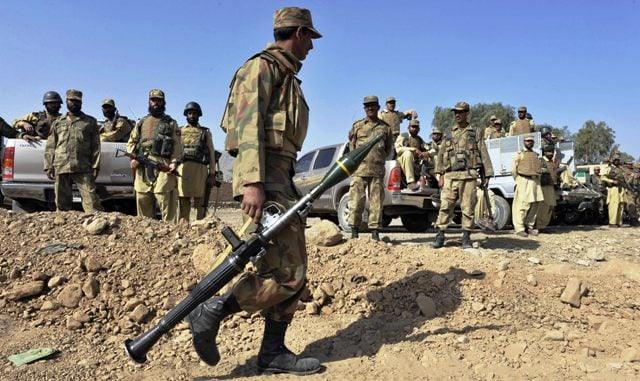
At least 51 people, including 40 civilians and 11 military personnel, were killed during the cross -border attacks of India against Azad Jammu and Kashmir and Pakistani territory, said Pakistan’s army, calling the attacks “not caused and rebuilt.”
The victims occurred during a military escalation on May 6 and 7 during which the Indian forces deliberately attacked residential areas, including women, children and the elderly, public relations between services (ISPR) said Tuesday.
“These barbarian attacks resulted in the martyrdom of 40 civilians, including 7 women and 15 children,” said the ISPR. At least another 121 were injured, including 10 women and 27 children.
The ISPR said that 11 personnel from the Pakistan armed forces were also killed in action while defending the region. Seventy -eight others were injured.
“The Armed Forces set up a resolved response … Delivering precise reprisals and measures,” the statement added.
The army released the names of fallen personnel, which included members of the Air Force and the Land Unit:
Naik Abdul Rehman, Lance Naik Dilawar Khan, Lance Naik Ikramullah, Naik Waqar Khalid, Sepoy Muhammad AIKBAR, SEPOY Nisar Nisar, Mubrash leader of Squadron Múbash, Chief Technician Aurengzeb, Senior Najeeb coach, Farooq body technique and senior senior Muashir.
“His noble sacrifice is a durable symbol of unwavering courage, devotion and patriotism, forever recorded in the memory of the nation,” said Ispr.
The statement continued: “The Armed Forces, together with the people of Pakistan, pay tribute to martyred civilians and military personnel, and offer sincere prayers for the rapid recovery of the injured.”
He concluded with a warning, stating that any attempt to challenge Pakistan’s sovereignty “will encounter a quick and decisive spectrum, Inshallah.”
Previously, the senior military officials of Pakistan and India celebrated on Monday their first round of conversations through a direct line and agreed to keep the fire agreed on Saturday after the five -day war.
As part of the Alto El Fuego Agreement, negotiated by the United States, the military operations of the Director General (DGMO) of Major General of Pakistan, Kashif Abdullah, and his Indian counterpart, Lieutenant General Rajiv Ghai spoke to each other.
The high the fire of India-Pakistan follows the climb, but the fragile calm persists
A high and immediate fire between India and Pakistan was announced on May 10 after days of intense military exchanges that took both neighbors with nuclear weapons to the edge of the war.
The announcement was made for the first time by the president of the United States, Donald Trump, and then confirmed by Pakistan Prime Minister, Shehbaz Sharif, the Vice Prime Minister Ishaq Dar, the Minister of Foreign Affairs of the India, S. Jaishankar, and the Secretary of State of the United States Marco Rubio.
Tensions exploded after a April 22 attack in Pahalgam, India illegally occupied Jammu and Kashmir (Iiojk), which left 26 dead civilians.
India blamed the elements based in Pakistan without presenting any evidence, Islamabad rejected the accusations. In response, India closed the border with Wagah, revoked the visas and suspended the Treaty of Indo’s waters, moves Pakistan called a “act of war.”
The conflict intensified with the missile attracks and the drone raids of India, since it developed its operation Sindoor.
Pakistan’s army launched Operation Bunyan-Un-Marshals in retaliation, and announced that it had demolished five Indian airplanes, including raffles, and intercepted 77 Harop drones made by Israeli.
After the diplomatic intervention directed by Washington, both parties agreed to stop military activity in land, air and sea. However, hours after the truce, fresh skirmishes were reported along both sides of the control line.
Explosions were heard in Srinagar and officials cited fire exchanges on both sides, which generated concerns about the durability of the high fire.
The Foreign Ministry of Pakistan reiterated its commitment to the high fire while accusing India of violations.
DG ISPR LT Gen Ahmed Sharif Chaudhry emphasized that Pakistan had not requested the truce, stating that India initiated the request to stop the fire after the retaliation strikes of Pakistan. He described the war between two nuclear powers as “inconceivable” and “an absurd.”
Chaudhry confirmed that no Indian pilot was in Pakistani custody, dismissing viral claims such as misinformation.
He called Operation Bunyan-Un-Marsosos a unified national response to Indian aggression, noting that Pakistan had fulfilled his commitments to respond decisively and proportionally.
The cities of all Pakistan observed Yom-E-Tashakkur (day of thanks) on Sunday to mark what was acclaimed nationally as a successful defense of national sovereignty.


