
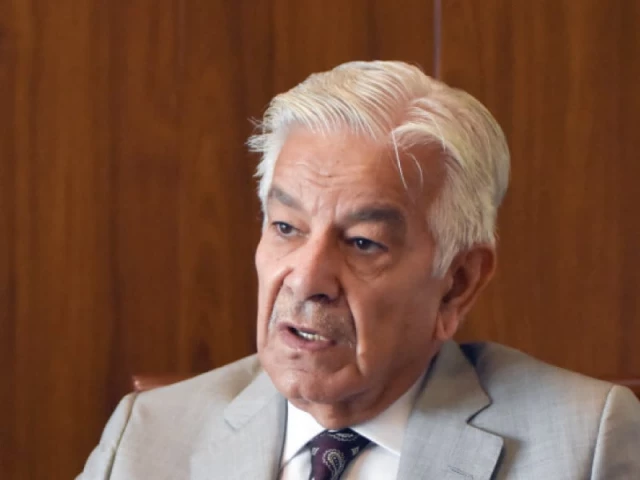
Asif accuses the Taliban of dragging Afghanistan into a new conflict to protect the government and economy in times of war
Defense Minister Khawaja Asif warned that if necessary, Pakistan could defeat the Taliban regime and set an example to the world.
Commenting on the failed talks in Istanbul, Khawaja Asif said the Afghan Taliban regime had repeatedly sought negotiations with Pakistan through “brotherly countries”, and Pakistan had accepted the offer in the interest of peace. He added that some “venomous” statements by Afghan officials suggested growing discord and duplicity within the Taliban leadership. Express News reported.
He said Pakistan did not need to use all its strength to dismantle the Taliban or force them into hiding. “If necessary, we could defeat them in places like Tora Bora and set an example for people everywhere,” he said, calling it “a spectacle that the international community would watch with interest.”
He accused the Taliban of dragging Afghanistan into another conflict to preserve its wartime government and economy.
Pakistan and Afghanistan agreed to an immediate ceasefire during talks in Doha, both sides said on October 19, after a week of fierce border clashes, the worst violence between the South Asian neighbors since the Taliban seized power in Kabul in 2021.
Read: Pakistan-Afghanistan peace talks stalled
The two countries met again in Istanbul on October 25 to address “detailed issues.” However, talks between Pakistan and Afghanistan in Istanbul have failed to make any progress on Islamabad’s key demand for a clear action plan to dismantle terrorist infrastructure operating from Afghan soil.
Federal Information Minister Ataullah Tarar confirmed on his social media platform X account on Tuesday that the Pakistan-Afghanistan dialogue in Istanbul had failed.
“Therefore, the dialogue failed to achieve any viable solution. We thank the governments of Qatar and Turkiye, and other friendly states, for their support and sincere efforts to achieve a peaceful solution to the problem of terrorism,” the minister wrote.
Read more: Talks in Istanbul collapse as Taliban refuse to act against terrorist groups
Asif said Taliban officials, aware of their weaknesses and the reality behind their war claims, were “beating the drum of war” in a failed attempt to save their reputation among Afghans. “If the Afghan Taliban remain determined to destroy Afghanistan and its innocent people, so be it; whatever happens, happens,” he said. He also rejected the notion that Pakistan was an “empire”, saying Islamabad did not see itself in those terms.
The defense minister said that Afghanistan, because of the Taliban, had become little more than a graveyard for its own people. Although it has historically been nicknamed the “graveyard of empires,” he said the country had long served as a stage for great power rivalry. He warned militants seeking to profit from regional instability that they had misjudged Pakistan’s resolve.
“If the Taliban regime tries to fight, the world will see that its threats were mere bluster,” Asif said. “Pakistan will not tolerate any terrorist or suicide attack on its territory, and any adventurism will receive a firm and bitter response.”
He urged the Taliban to be aware of their destiny and warned that testing Pakistan’s resolve and capabilities would prove very costly.
Also read: Explained: Pakistan-Afghanistan border conflict
According to sources familiar with the discussions during the talks in Istanbul, the Afghan delegation repeatedly displayed obstructionist behavior and avoided direct answers. Some members reportedly used provocative, derogatory and even insulting language during the meetings, leaving Turkish and Qatari mediators surprised by their stance.
Tensions rose after unprovoked shooting by the Afghan Taliban regime
Tensions along the Pakistan-Afghanistan border escalated on October 11, when clashes broke out after Afghanistan opened unprovoked fire at multiple locations in Khyber Pakhtunkhwa (KP) and Balochistan, prompting a swift and forceful response from the Pakistan Army. Several Afghan posts were destroyed and dozens of Afghan soldiers and militants were killed.
“Pakistan army responded immediately and decisively,” security sources said. “The counteroffensive effectively attacked and destroyed multiple Afghan posts on the border. Dozens of Afghan and Khwarij soldiers were killed in retaliatory fire.”
A 48-hour ceasefire was agreed upon at the behest of the Afghan Taliban regime after Pakistan’s “precision strikes” against the Taliban and terrorist hideouts in Kandahar and Kabul.
According to the Ministry of Foreign Affairs, the decision was made at the request of the Taliban and with the mutual consent of both parties. Both sides should maintain constructive dialogue and make sincere efforts to find a “positive solution to a complex but solvable problem,” the ministry said.


