
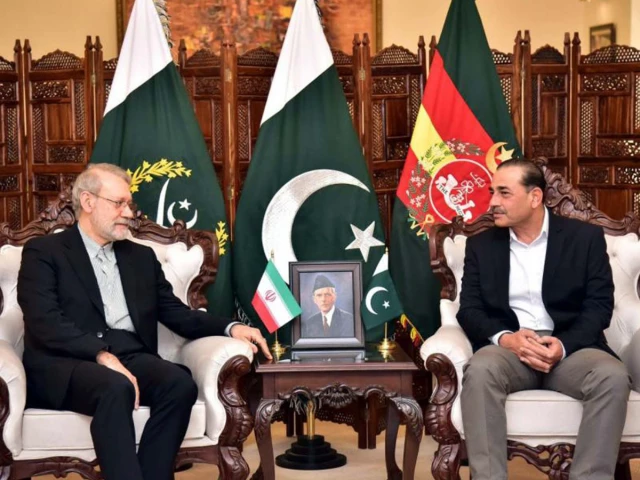
Secretary of Iran’s Supreme National Security Council met with Field Marshal Asim Munir at Rawalpindi headquarters.
Chief of Army Staff Field Marshal Syed Asim Munir met with Ali Ardeshir Larijani, Secretary of Iran’s Supreme National Security Council, at General Headquarters on Wednesday, November 26, 2025. Photo: APP
Pakistan and Iran signaled a renewed willingness to work together against terrorism when Chief of Army Staff Field Marshal Syed Asim Munir met Ali Ardeshir Larijani, Secretary of Iran’s Supreme National Security Council, at the General Headquarters in Rawalpindi on Wednesday.
COAS Munir reiterated Pakistan’s dedication to regional peace and underlined the importance of “closer collaboration with Iran to combat terrorism”, citing evolving geopolitical realities as a driver for deeper strategic ties.
Meanwhile, Larijani praised Pakistan’s role in regional security and expressed Iran’s willingness to improve bilateral relations through continuous dialogue and coordinated security efforts.
Key points discussed
Counter-terrorism cooperation: Both sides emphasized coordinated efforts to address militant threats affecting the border regions and the broader neighborhood.
Strategic and security ties: given the changes in regional geopolitics, both nations committed to strengthening their collaboration in defense and intelligence.
Regional Peace and Stability through Diplomacy: Larijani underlined the importance of dialogue and sustained partnership between Pakistan and Iran to address shared challenges.
Read: Pakistan-Saudi Arabia joint military exercise ‘Al-Battar II’ concludes
The relationship between the two neighbors has seen a marked improvement in 2025. In May, Munir visited Tehran and held talks with Major General Mohammad Bagheri, Chief of Staff of the Iranian Armed Forces, with the aim of intensifying military-to-military cooperation, improving border security mechanisms and exploring better trade connectivity between the border regions.
During the visit of Iran’s Foreign Minister to Islamabad in January 2024, both countries agreed to establish a joint coordination mechanism and station military liaison officers on the shared border, a confidence-building measure aimed at preventing future escalation and improving border management.
The new proposal comes at a time of heightened regional instability with cross-border militancy, shifting alignments and continued pressures across South and West Asia. For both Islamabad and Tehran, transforming sporadic tactical coordination into a structured strategic partnership could help proactively manage security threats and stabilize their shared border.
Furthermore, deeper cooperation (military, intelligence and diplomatic) could pave the way for broader collaboration on border management, trade and regional diplomacy. This recent meeting reflects the continuation and deepening of a renewed strategic commitment.


