
- IBM triples system capacity to support increased data demands from supercomputing and AI
- New flash enclosure enables larger caches designed for dense multi-tenant cluster workloads
- The expanded hardware is aimed at operators scaling parallel processing pipelines on massive data sets.
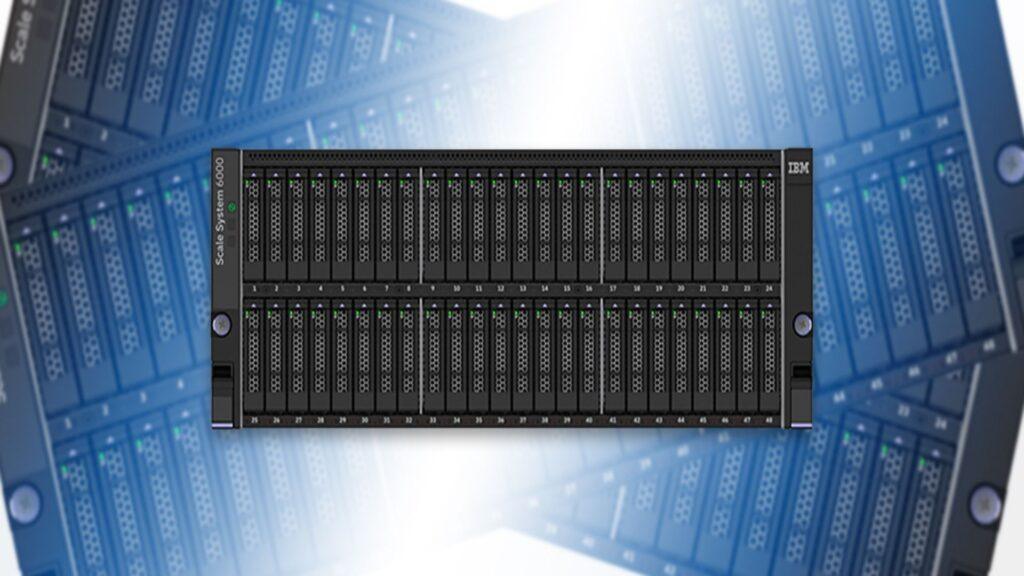
IBM has expanded the Storage Scale System 6000 to support a full rack capacity of up to 47PB, following the introduction of new All-Flash expansion enclosures equipped with 122TB QLC flash drives.
This update represents a triple jump from previous limits and is aimed at environments that handle high-volume data operations.
The system is positioned for organizations working with supercomputing tasks, large artificial intelligence pipelines and provision of cloud computing services.
Hardware designed for higher performance
The company claims that the new design can support workloads that rely heavily on consistent performance and high availability.
It also claims that the larger platform simplifies scaling for operators maintaining large clusters.
The all-flash expansion enclosure provides support for larger caches that enable multi-tenancy at multiple levels within a cluster.
IBM claims that operators can run multiple data-intensive workloads without creating bottlenecks across the entire file system.
The enclosure can house up to four Nvidia BlueField-3 DPUs and twenty-six dual-port QLC flash drives within a 2U unit, enabling the system to meet requirements related to AI training, simulation workloads, and extensive parallel processing.
Support for Nvidia’s Spectrum-X Ethernet switches is also included, allowing for shorter checkpoint times in model training processes.
IBM positions these hardware links as essential in environments where rapid data movement is needed to maintain active GPU fleets and complex programming.
IBM has updated its Storage Scale System software to align with the increase in total storage.
Version 7.0.0 adds support for higher capacity modules and includes broader erasure coding with a 16+2 configuration aimed at improving efficiency.
Write performance has also been increased to match the improvements in performance and IOPS, with previous figures from the four-rack configuration putting the system at around 2.2PB of capacity, up to 13 million IOPS, and read speeds of up to 330GB per second.
The 2025 update raises the IOPS limit to 28 million and increases read performance to 340 GB per second.
These adjustments are intended to ensure that expanded hardware does not introduce new delays when workloads increase.
The enclosure acts as a high-density option for operators that rely on an SSD layer as a primary storage base while continuing to use cloud storage for distribution beyond the central data center.
IBM says the increased volume allows its global caching layer to keep larger active data sets closer to the GPUs, eliminating separate islands of data and keeping pipelines stable.
The architecture is designed to serve clusters that need predictable movement of information between nodes, especially in situations where CPU utilization increases during intense computing windows.
The company’s message frames the update as a triple-level improvement that combines greater density, better data management and broader workload support.
That said, the long-term impact will depend on how consistently the system performs at full capacity once deployed at scale.
Via HPCWire
Follow TechRadar on Google News and add us as a preferred source to receive news, reviews and opinions from our experts in your feeds. Be sure to click the Follow button!
And of course you can also follow TechRadar on TikTok for news, reviews, unboxings in video form and receive regular updates from us on WhatsApp also.


