
PPP chief says 18th Amendment cannot be reversed; Vows to protect parliament from institutional overreach
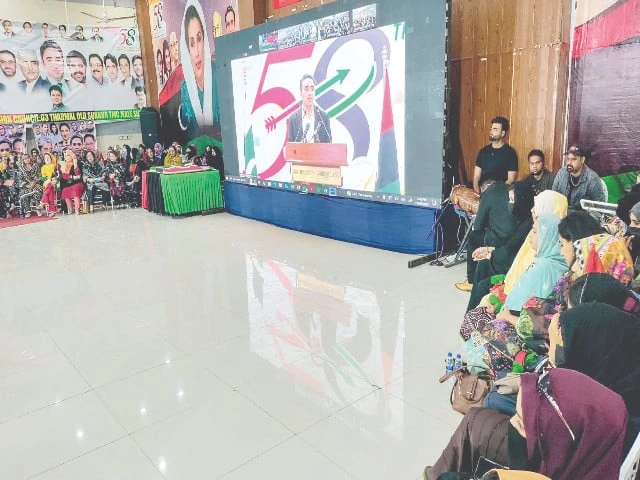
PPP Chairman Bilawal Bhutto Zardari addresses a public meeting in Sukkur via video link. Photo: PPI
KARACHI:
Pakistan People’s Party (PPP) Chairman Bilawal Bhutto-Zardari warned that any attempt to dilute provincial rights enshrined in the 18th Amendment or tamper with the National Finance Commission (NFC) Award would endanger the federation itself.
The Bhutto scion, whose party is a key coalition ally of the PML-N at the Centre, warned that forces seeking to roll back fiscal and administrative autonomy were effectively “playing with fire”.
Addressing the PPP’s 58th Foundation Day rally via video link from Bilawal House on Sunday, Bilawal said recent proposals put forward by the PML-N during deliberations on the 27th Amendment signaled a dangerous push to take back devolved powers, reverse gains made under the 18th Amendment and weaken provincial financial protections.
“Those people who are trying to play with the NFC Award or the 18th Amendment or other similar issues, or are thinking about doing so, it’s like they’re playing with fire.”
“If provincial financial protections had been removed, Punjab, Sindh, Khyber Pakhtunkhwa and Balochistan would have suffered massive economic losses,” he said, crediting the PPP for blocking those measures.
The PPP president pledged to continue safeguarding NFC allocations, provincial autonomy and democratic rights. “Pakistan’s economy depends on each province, on the gold of Balochistan, on the coal of Thar, on the trade of Karachi, on the farmers of Punjab, on the labor of Peshawar and on the youth of Lahore. We will honor these sacrifices and expand their rights,” he said.
“They (PML-N) wanted to recover the system of executive judiciary; they wanted to recover the issues of education and population control that had been transferred to the provinces in the 18th Amendment. [ ] Likewise, the government had other wishes,” he said.
“I have been protecting their rights and, God willing, I will continue to do so,” he said, adding that the PPP was willing to support a decision that would strengthen the federation. “But the PPP can never support a decision that would weaken the federation or through which the rights of the province would be usurped.”
“The PPP believes that there were many fault lines in this country and they persist,” Bilawal said, stating that his party had historically sought to repair those fractures by assuring the provinces of their rights, ensuring adequate representation and reviving democratic norms.
The PPP chairman also vowed to defend parliament’s authority to legislate and review constitutional decisions.
He warned that institutional overreach and extra-parliamentary interventions had historically damaged the federation, the economy and public trust.
“No institution outside parliament can overrule this area. When institutions interfere in parliamentary jurisdiction, the federation and its people suffer. We will defend this space,” he stated.
Bilawal warned that Pakistan’s internal vulnerabilities, including political discord and festering grievances, could once again be exploited by hostile forces, and urged the state to combine military force with “soft power” to defeat terrorism and defend national cohesion.
He praised the armed forces for shooting down seven Indian aircraft during the May War and said Pakistan had improved its global stature while India, despite military humiliation, continued to “conspire against Pakistan”.
Noting that Pakistan faces a renewed wave of terrorism driven by increasing distances from Afghanistan and external interference, he warned that political divisions, if used as weapons, could fracture the state from within, allowing enemies to exploit “Pakistan’s fault lines.”
The PPP remains the only party that pursues a “positive policy” aimed at stabilizing the federation and strengthening democracy, he added.
He also highlighted that Pakistan’s economic revival required delegating powers and resources rather than centralizing them. “The country will progress when powers are transferred to the lower levels.”
Bilawal termed the establishment of the constitutional court, under the Charter of Democracy, a “historic success” that fulfilled an unfulfilled promise of Benazir Bhutto and ensured equal provincial representation.
He added that this corrected long-standing judicial imbalances dating back to the “judicial assassination” of Zulfikar Ali Bhutto, a trauma that scarred both the federation and the judiciary.


