
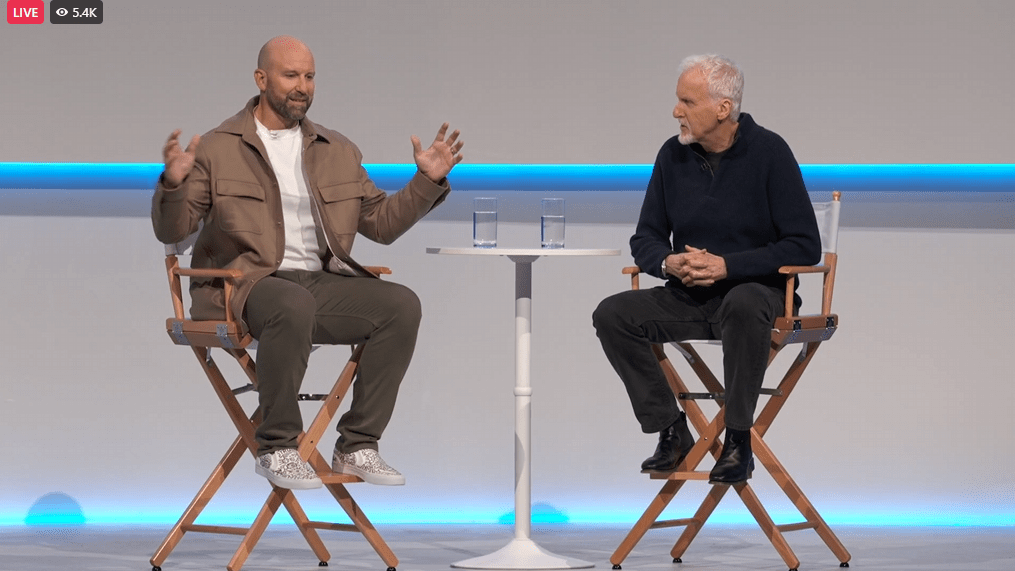
- James Cameron warned that AI-generated actors are “horrible” and threaten real performance
- The comment came after the launch of all-digital actor Tilly Norwood.
- The arrival of AI artists has sparked a backlash from SAG-AFTRA and Hollywood stars.
James Cameron, a director synonymous with digital magic, has seen the future of cinema and wants no part of it. “Horrible,” he called it during a recent interview on CBS. I wasn’t talking about killer robots or Titanic sequels; he was referring to generative AI and, specifically, its increasing ability to generate entire actors from scratch.
“Now, let’s go to the other end of the spectrum,” said Cameron, contrasting his use of motion capture and CGI in Avatar with the current AI trend, “and we have generative AI, where they can invent a character. They can invent an actor. They can invent a performance from scratch with a text message. It’s like, no. That’s horrible to me.”
Cameron’s view on AI performance marks a clear departure from his usual techno-optimism. Their discomfort is not with computers themselves; It is the elimination of the human being at the center of art that worries him. And for once he’s not being metaphorical.
At the center of the industry’s current digital anxiety is Tilly Norwood, an AI-generated photorealistic actress created by Eline Van der Velden’s company Particle6. Norwood was presented in September at the Zurich Film Festival.
Although he has not starred in a film or even moved in front of a camera outside of digital mockups, he has received a lot of criticism from the film industry. The Screen Actors Guild (SAG-AFTRA) issued a scathing statement denouncing Norwood as a synthetic imitation trained on the stolen work of real artists.
Future of AI performance
This is not just a question of the actors’ union. It is a question of authorship, of emotional trust. When you cry during a scene, a part of you is responding to the person behind the performance. If that person is replaced by an algorithm trained on thousands of microexpressions, voice samples, and motion clips, it may still work on the screen, but what exactly are you connecting with?
Cameron’s warning resonates because he is far from a technophobe. He has spent decades combining human actors with sophisticated CGI systems. The terminator to Avatar, but the crucial difference, as he points out, is that motion capture preserves the human core. A server farm couldn’t imagine Sigourney Weaver’s Na’vi face on Avatar; It was still her.
Although Tilly Norwood might just be a gimmick, it’s still a sign of what’s developing. When background actors can be scanned once and used forever, and studios are negotiating the right to replicate voices and portraits forever, the foundation for fully AI-driven productions is already here.
For now, even the most innovative deepfakes or digital doubles are often combined with real actors to provide an emotional anchor. But give it time and you will see attempts to eliminate the human factor. It’s less certain that people will enjoy the resulting films.
Cameron remains unequivocally on Team Human. And while his discomfort may seem romantic or even dramatic, it’s not out of place. Because once AI-generated performers can pass for real people, viewers will be able to stop asking who is really behind the eyes. By then, it won’t really matter. All that will remain will be a story, efficiently told by no one.
Follow TechRadar on Google News and add us as a preferred source to receive news, reviews and opinions from our experts in your feeds. Be sure to click the Follow button!
And of course you can also follow TechRadar on TikTok for news, reviews, unboxings in video form and receive regular updates from us on WhatsApp also.
The best business laptops for every budget


