
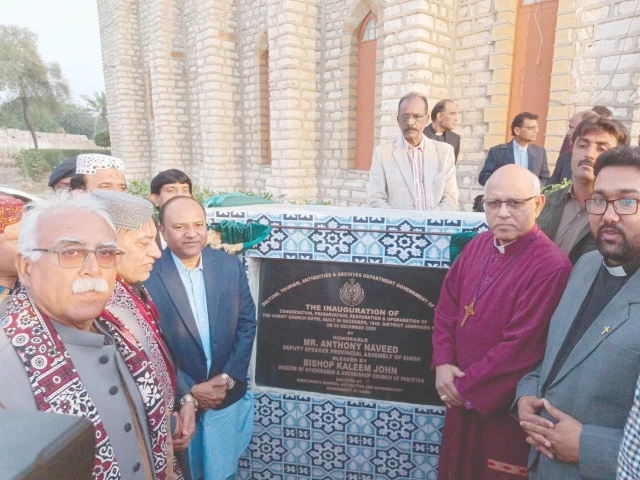
Sindh Assembly Deputy Speaker Anthony Naveed, Archeology Department Director General Abdul Fattah Sheikh and Bishop Kaleem John of Hyderabad Diocese inaugurate the Kotri Church renovation project. Photo: Express
HYDERABAD:
As the Christmas season fills the air with joy and anticipation, a historic church in the Kotri Railway Colony is being carefully restored to its original grandeur. Built in 1846, Kotri Railway Line Church is one of the oldest places of worship in Sindh. Almost 179 years later, its renovation has begun, an endeavor that is of immense importance to the Christian community in and around Hyderabad.
For local Christians, restoration is more than just bricks and mortar. It is a reaffirmation of their heritage, their faith and their place in the diverse social fabric of Pakistan. The moment, which coincides with Christmas, adds to the symbolism: a season of hope, renewal and unity. Families preparing for holiday celebrations see the revival of this church as a gift that strengthens their spiritual bond and preserves a legacy for future generations.
The project was formally inaugurated by Sindh Assembly Deputy Speaker Anthony Naveed along with Director General of Archaeology, Abdul Fattah Sheikh, Bishop Kaleem John of Hyderabad Diocese and other community leaders. Their presence underscored the government’s commitment to protecting minority rights and preserving cultural monuments. Naveed highlighted that Sindh has long been a beacon of interfaith harmony, where people of all religions live with respect and dignity. He described the restoration of the church as “a practical test of religious freedom and solidarity with minority communities.”
Officials shared that the renovation will be completed in approximately 150 days, without compromising on quality. The project, which will cost around Rs 30 crore, will also include basic facilities like toilets and improved infrastructure. According to Director General of Archaeology, Abdul Fattah Sheikh, Sindh has more than 3,200 registered heritage buildings, of which nearly 200 have already been restored, including several churches. The Kotri Railway Line Church, however, has special importance due to its antiquity and historical value.
Community members expressed joy at the initiative and noted that the church had long required attention. For them, restoration is not just about preserving a building but also about safeguarding a space where generations have gathered for worship, weddings and Christmas services. The revival of this sacred site during the holiday season is seen as a powerful message of inclusion and respect.
Beyond the Christian community, the renewal resonates in society at large. It reflects Pakistan’s commitment to ensuring that minorities enjoy freedom of religion and equal opportunities.
As Vice President Naveed noted: “True progress is only possible when every citizen is provided with dignity, equality and protection.” The restoration of Kotri Church is therefore more than a heritage project: it is a symbol of peace, love and brotherhood.


