
The KP government claims that its share should increase between 6% and almost 20% after the merger with the tribal districts.
ISLAMABAD:
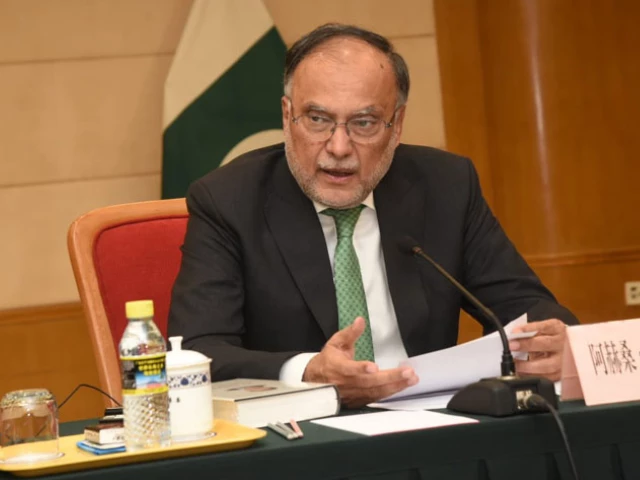
While the inaugural meeting of the National Finance Commission will highlight the performance of provinces, Khyber-Pakhtunkhwa in particular, Planning Minister Ahsan Iqbal has proposed multiple options to redistribute resources that would benefit the Center and smaller federated units.
Despite giving more weight to variables that strengthen the fiscal position of smaller provinces, KP’s share would increase from 1% to 3% in the range of 15.7% to 17.1%, details of the proposals presented to Prime Minister Shehbaz Sharif showed.
The KP government claims that its share should increase between 6% and almost 20% after the merger of the former tribal districts.
Under these options, the federal government would have to cut between 4.7% and 6% of the undistributed divisible fund in advance due to various expenses and then distribute 57.5% of the remaining taxes among the provinces.
To increase the flow of resources to smaller provinces, the minister proposed reducing the population proportion from 82% to 60% and increasing the revenue collection proportion to 20% to force them to generate their own resources.
The federal government today (Thursday) convened the inaugural meeting of the NFC, which will be chaired by Finance Minister Muhammad Aurangzeb. This meeting will lay the foundations for devising a new formula to distribute fiscal resources between the Center and the federative units.
But the focus will be on Khyber Pakhtunkhwa Chief Minister Sohail Afridi, who is also the provincial finance minister. The federal government wants to hold the KP government accountable for not effectively using fiscal resources.
In addition to its 14.62% stake in the NFC, the KP government also receives 1% of the divisible fund as compensation for losses due to the war on terrorism. According to some estimates, the total additional resources transferred to the province amounted to 700 billion rupees since 2010.
However, despite the additional support, promised improvements in public safety, policing and post-conflict recovery remain largely unrealized, according to federal authorities. A comprehensive public audit has been called to show precisely how these funds were used, as the provincial government claims it has not been adequately compensated for the price it is paying as a frontline state.
According to federal authorities, the KP government also benefited from direct transfers, oil and gas royalties, Hydel profit allocations and amalgamated area rehabilitation allocations.
Poor contribution from the provinces
Federal government sources said that during substantive discussions, provinces showed some willingness to share federal expenditures, but were not ready to take a direct hit on their revenues.
“While the NFC Award envisaged a shared responsibility towards revenue generation, provincial revenues have also not expanded in line with the objectives of the NFC Award,” according to the Ministry of Planning report.
There is a massive and guaranteed inflow of financial resources from the federal fund to the provincial governments, but they have shown little effort to mobilize their own income.
Provincial tax and non-tax revenues in terms of the size of the economy remained at only 1.1%, which is insignificant compared to its potential. This has created a culture of dependency, leaving provincial finances vulnerable to federal revenue shocks and highlighting the need to modernize their tax generation mechanism.
Federal Wallet
Given this background, the Ministry of Planning has proposed changes in the vertical distribution of resources between the Center and the provinces and the horizontal distribution between the four provinces.
Under the first vertical option, the Ministry of Planning has proposed that the federal government deduct in advance 4.7% of the undistributed fund for the war against terrorism, water security, expenditure on civilian armed forces and participation in special areas and federal territory.
He proposed the second vertical option: deducting in advance 6% of the expenses of the Benazir Income Support Program and the Higher Education Commission, according to the proposals presented to the Prime Minister.
If the federal government retains 4.7% of the undistributed fund, it would slightly ease federal fiscal space. However, in the case of a 6% deduction, by 2030 federal resources will be 12% higher than in the base scenario of the seventh NFC award.
Share between provinces
According to the current NFC Award, population dominates with a weight of 82%, but poverty, income generation and inverse population density are only marginally important. The Planning Ministry has proposed some major changes in the formula, which would reduce Punjab’s share by about 10% and Sindh’s share would also reduce half a percentage.
However, KP’s share would increase in the range of 1% to 2.6% and Balochistan’s share could rise up to 3%. Islamabad Capital Territory can get up to 5% share for the first time.
Under the first option, population weight can be reduced to 78% with modest increases for other factors such as inverse population density, fertility, and forest cover. Under the second option, the distribution becomes more balanced as the population weight falls to 68% while 10% is allocated to income generation, 2% to the inverse fertility rate and 2% to forest cover.
Under the third option, the distribution would even be altered, as the population weight falls to 60%, while 20% is allocated to income generation, 5% to the inverse fertility rate and 5% to forest cover. This transition towards a broader approach reflects the intention to recognize fiscal effort, social results and ecological contributions together with the population.
The Planning Ministry stated that a strategic recalibration of the NFC Award was a political necessity rather than a choice. He added that defense, debt service, subsidies and strategic domestic investments, such as water security, energy transition and climate resilience, are inherently federal responsibilities and require sustained and predictable fiscal capacity at the center.
The ministry has also proposed that the federation should retain the ability to respond to large-scale national crises, whether natural disasters, global commodity cycles or external security challenges.
Without adequate fiscal space, the State’s ability to preserve stability and unity is put at risk, with consequences that affect all federative units equally, he added.


