
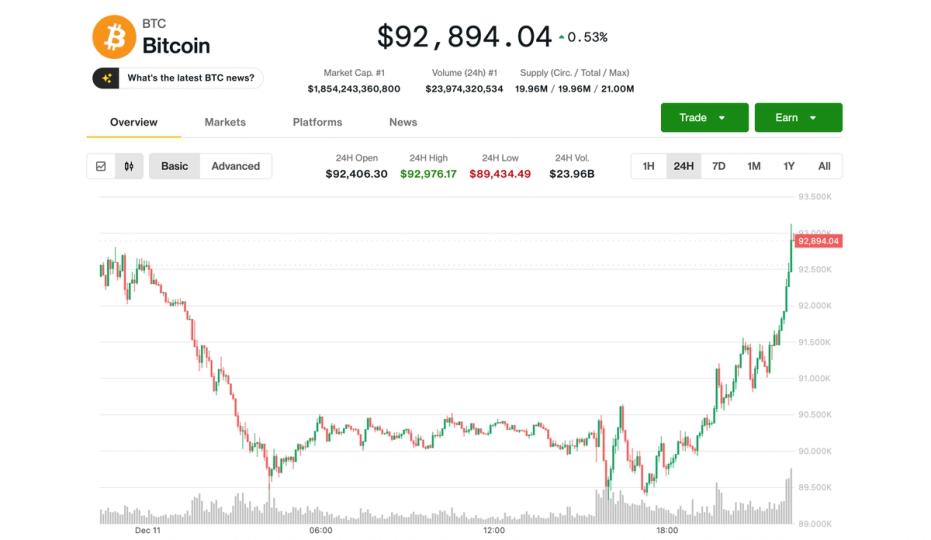
bitcoin It regained $93,000 on Thursday as traders digested the Fed’s decision, but most altcoins did not join the rebound.
Bitcoin, which fell to $89,000 after Wednesday’s rate cut from the Federal Reserve and a sharply lower opening for US stocks, was recently trading at $93,000, up marginally in the past 24 hours.
Most altcoins maintained their initial losses, with Cardano ADA and Avalanche’s AVAX (AVAX) leads the declines, down 6% to 7%. Ether was 3% lower on the day, holding above $3,200.
Bitcoin’s bounce over the past day came alongside similar action in US stocks, with the Nasdaq managing to close down just 0.25% after being as much as 1.5% lower. The S&P 500 closed modestly in the green and the DJIA gained 1.3%.
The day’s biggest rally came from precious metals, with silver rising 5% to a new all-time high of $64 an ounce and gold rising more than 1% to near $4,300. The advance was helped by the US Dollar Index (DXY) falling to its weakest level since mid-October.
Cryptocurrency exchange Gemini stood out among cryptocurrency stocks, gaining more than 30% on news of gaining regulatory approval to offer prediction markets in the US.
Cryptocurrencies differ from stocks
Jasper De Maere, desk strategist at trading firm Wintermute, said Thursday’s action reinforced the growing decoupling of cryptocurrencies from stocks, especially around macro catalysts.
“Only 18% of sessions last year saw BTC outperform the Nasdaq on macro days,” he noted. “Yesterday fit that pattern: stocks rose while cryptocurrencies sold off, suggesting the rate cut was already fully priced in and marginal easing is no longer supportive.”
De Maere added that in the first half of 2026 the first signs of concern about stagflation are emerging, and markets are beginning to shift the focus of Fed policy towards US crypto regulation as the next big driver.
Bitcoin Selling Pressure Is Easing
Analytics firm Swissblock noted that downward pressure on bitcoin is losing steam, and the market is stabilizing but not out of the woods yet.
“The second wave of sales is weaker than the first and selling pressure is not intensifying,” the company said in an X publication. “There are signs of stabilization… but not confirmation.”


