
Indus Water Commissioner reports sharp drop in Chenab levels; the flow stood at just 1,800 cusecs as per data recorded on December 16.
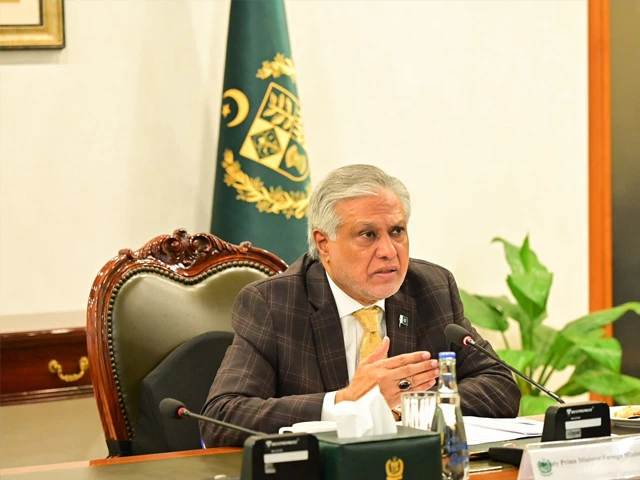
Foreign Minister Ishaq Dar during a meeting in Islamabad on September 30. Photo: x.com/Archive
Deputy Prime Minister and External Affairs Minister Senator Ishaq Dar accused India of violating the Indus Waters Treaty (IWT), warning that New Delhi’s alleged manipulation of water flows to Pakistan could trigger a humanitarian crisis as water levels in the Chenab River continue to fall.
The warning comes amid fluctuating water patterns in the river system. On December 8, reports indicated that India had released a surge of water into the Chenab River, raising the flow to 58,300 cusecs. However, Pakistani officials said levels have since plummeted.
A day earlier, Foreign Ministry spokesperson Tahir Hussain Andrabi criticized India for “continued violations” of the treaty, expressing serious concern over what he described as an “abrupt variation” in the river’s flow, an issue that has attracted national media attention.
Read: Pakistan accuses India of manipulating the flow of the Chenab River
Indus Water Commissioner Mehr Ali Shah told reporters on Friday that a significant decline in Chenab levels had been detected, adding that Pakistan formally raised the matter with its Indian counterpart.
He said the river’s flow was recorded at just 1,800 cusecs on December 16, accusing India of withholding advanced hydrological data in violation of the treaty.
Shah said Pakistan had fully fulfilled its obligations and warned that India’s lack of cooperation was a “serious matter”.
Meanwhile, the Indus River System Authority (IRSA) on Friday reported a total release of 75,600 cusecs from the border stations against an inflow of 37,800 cusecs. Data released by IRSA showed that the Indus River at Tarbela Dam was at 1,486.39 feet, 84.39 feet above dead level, with an inflow of 18,900 cusecs and an outflow of 27,000 cusecs.
At Mangla Dam, water levels were recorded at 1,202.40 feet (152.40 feet above dead level), with inflows and outflows of 3,300 cusecs and 33,000 cusecs, respectively.
The releases in Kalabagh, Taunsa, Guddu and Sukkur were recorded at 33,500 cusecs, 24,500 cusecs, 27,800 cusecs and 1,400 cusecs, respectively. From the Kabul River, 7,700 cusecs were released at Nowshera, while 1,900 cusecs were discharged into the Chenab at Marala.
Earlier, addressing members of the diplomatic corps, Dar expressed concern over what he described as “unusual and abrupt” variations in Chenab flows twice this year: between April 30 and May 21, and again from December 7 to 15.
Read also: UN experts highlight legal violations in May attacks and actions related to India water treaty
He said India’s alleged manipulation of water during critical phases of Pakistan’s agricultural calendar threatened lives, livelihoods and food security.
It accused India of halting the sharing of advanced information, hydrological data and joint monitoring required under the treaty, warning that the disruption exposed Pakistan to potential floods and droughts. Dar also argued that India’s conduct violated international law, including Article 26 of the Vienna Convention on the Law of Treaties.
According to him, Pakistan’s Indus Water Commissioner had already sought clarification from India under the treaty mechanisms, urging New Delhi to stop what he called “unilateral manipulation” of river flows.
Dar further alleged that India was trying to undermine the treaty through hydropower projects like Kishanganga and Ratle, claiming that they violated IWT specifications. He said increasing India’s water storage capacity by building dams posed serious economic risks to Pakistan and endangered livelihoods.
The deputy prime minister also accused India of leaving the treaty in “illegal and unilateral suspension”, saying this amounted to turning water into a weapon. He stated that Pakistan has recorded a severe reduction in Chenab flows and is awaiting India’s response to an official communication on the matter.
Dar noted that the Permanent Court of Arbitration had recently reaffirmed the validity of the treaty and its dispute resolution framework, saying Pakistan would not accept Indian non-compliance “with impunity”.
Read: Pakistan and Australia to boost trade, cooperation and collective action against terrorism
He recalled that Pakistan’s National Security Committee had termed any measure to divert or stop the flow of rivers into Pakistan as an “act of war”. Dar urged the United Nations Security Council and world capitals to pressure India to restore full implementation of the treaty and stop the “weaponization of water.”
He reiterated Pakistan’s commitment to peaceful dispute resolution, but said the country would not compromise its “existential water rights.”
It may be recalled that in April, India unilaterally suspended the Indus Waters Treaty after an attack on tourists in Pahalgam, occupied Kashmir, in which 26 people were killed, an incident that New Delhi attributed to Pakistan. Islamabad denied the allegation and stated that withholding its share of water under the treaty would constitute an “act of war”, noting that the agreement contained no provision for a unilateral suspension.


