
There were no margin hearings on market structure legislation last week. Lawmakers are still keeping their firm positions secret. The question is changing from “will we get a market structure law this year” to “will Congress have enough time to push this bill over the finish line?”
You’re reading State of Crypto, a CoinDesk newsletter that discusses the intersection of cryptocurrency and government. Click here to register for future editions.
the narrative
The Senate Banking Committee revealed this week that it would not hold a margin hearing on its market structure bill, confirming what many had suspected: that lawmakers simply did not have enough time to get this bill over the finish line this year.
Why is it important
The fact that the market structure bill is extended until 2026 makes it much more likely that it will not pass at all. For it to become law, lawmakers will have to hit the ground running after the holidays and try to complete the entire process before leaving for the 2026 midterm elections. During that time, they will have to navigate another possible government shutdown, the complication that the market structure bill has two parts coming from two different committees, and deal with the fact that the different parts are becoming even more entrenched, according to several people following the process.
breaking it
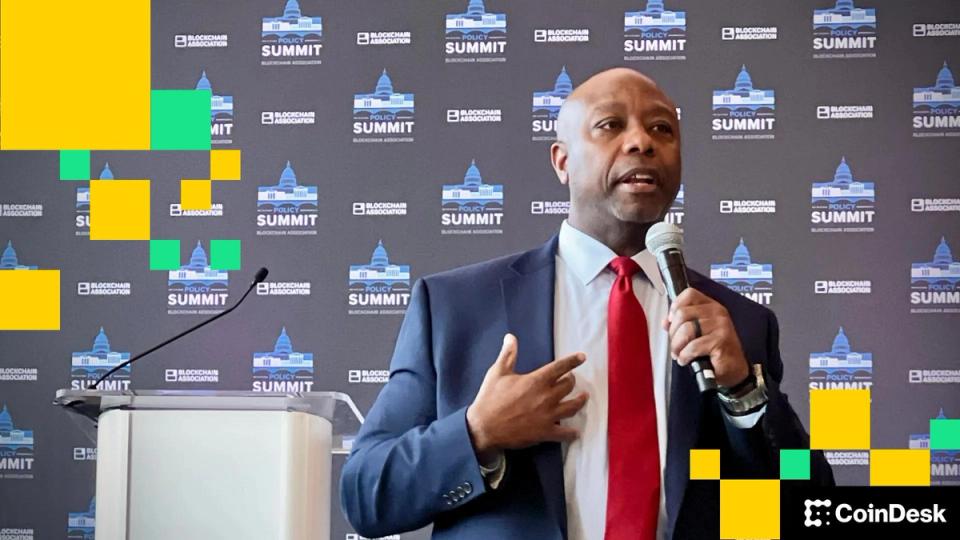
The Senate Banking Committee had hoped to hold a hearing of some sort, if not an actual margin, late last week, but last Monday Chairman Tim Scott’s office issued a statement confirming that this would not happen and saying he expected further collaboration in 2026.
“From the beginning, Chairman Scott has been clear that this effort must be bipartisan,” a committee spokesperson said in a statement. “It has consistently and patiently engaged in good faith discussions to produce a strong bipartisan product that provides clarity for the digital asset industry and also makes the United States the crypto capital of the world. The Committee continues to negotiate and expects a profit margin in early 2026.”
There are some major sticking points, as four people following the process described to CoinDesk: how decentralized finance (DeFi) might be defined and regulated; how the performance of stablecoins should be treated; whether major regulatory agencies like the Securities and Exchange Commission or the Commodity Futures Trading Commission will have a bipartisan slate of commissioners; and whether lawmakers can force President Donald Trump into some kind of ethics agreement. These are not just political questions that legislators should only debate; Some of them, such as how DeFi is regulated, have technical ramifications for parts of the broader crypto industry, and a poor definition of “decentralization” could be difficult to modify in future law.
These are not new problems either. As CoinDesk has repeatedly reported, these points have been at the center of negotiations for months, although lawmakers had been trying to get to a place where they could hold a crucial margin hearing before Congress recessed for the holidays. A markup is a formal hearing in which lawmakers offer amendments to change legislation before voting on whether to advance it to the rest of the chamber for a broader vote.
Being off the table may end up being a blessing in disguise, two of the people said. Maintaining a margin would leave the bill’s text open to attacks from opponents in the coming weeks, or force a more partisan bill than could survive the Senate overall.
“It’s better that there was no margin at all, because there simply wasn’t enough time, given the shutdown and other factors, to get both sides to a compromise where the margin would have been bipartisan,” one of the people said. “If there had been a markup this year, I think it almost certainly would have been along partisan lines, which would have really hurt the bill’s chance of getting enough support on the floor.”
It is clear that there is an appetite for bipartisan cooperation on this legislation. The House already passed its own market structure bill with an overwhelming bipartisan majority, although the Senate largely ignored that bill’s existence and spent the past five months cobbling together its own version, albeit with substantial echoes of the House Digital Asset Market Clarity Act.
Decentralized finance
Although the crypto industry is pushing for very limited DeFi regulations to be included in the bill, this is not a realistic outcome, two of the people said. Senators like Mark Warner, who is the top Democrat on the Senate Intelligence Committee and has national security concerns, will want to see some sort of guardrail for DeFi before voting in favor of the bill. Specifically, Warner wants anti-money laundering concerns to be firmly addressed.
“There are some real questions about what the federal government’s ability is to blacklist protocols and wallets or whatever, and to establish some sort of regulatory perimeter around DeFi,” one of the people said. “We’re looking at both: What do we want to do and what can we do? If there’s not something, then at the very least, we’re not going to have Democratic support.”
There are also concerns about regulatory arbitrage by traditional financial companies, although one of the people said that these concerns may be driven more by an anti-competitive stance (in the sense that these companies do not want to compete with DeFi) than by actual consumer protection views. Still, traditional businesses are lobbying lawmakers on this legislation, and their concerns may be addressed in any final bill.
Another person said concerns about DeFi could well be what blows up the bill. Although there are Democrats who want to support a cryptocurrency bill, their left flank will not want them to do so and will pressure more moderate lawmakers, they said. But on the other hand, any strict regulation of DeFi would lose the support of the industry.
“People will be very angry about any deal, because one party doesn’t want DeFi to exist, the other wants DeFi to be fully unregulated,” this person said. “The middle ground will be some regulation of what we call DeFi. To reach an agreement, everyone has to be somewhat dissatisfied.”
The role of the president
Trump also remains a wild card in these negotiations. Asked during a White House event whether he would appoint Democrats to regulatory agencies like the Securities and Exchange Commission and the Commodity Futures Trading Commission, which should have bipartisan commissioners, he suggested the answer might be no.
“Well, do you think they would appoint Republicans [if it] Were they up to them?” Trump said. “So, you know, we’ll look at it. “We want to be fair, but they usually don’t appoint Republicans.”
Democratic presidents have traditionally appointed Republicans to the SEC and CFTC; Commissioner Hester Peirce, for example, was originally nominated by former President Barack Obama.
“There are certain areas that we do look at, and there are certain areas where we share and share power, and I’m open to that,” Trump said.
The broader issue may be Democrats’ ethical concerns. Democrats have made clear for months that they want to put up barriers against Trump’s family ties to cryptocurrencies. Although the White House maintains there are no concerns about conflicts of interest, Senator Cynthia Lummis, speaking at the Blockchain Association’s annual summit earlier this month, said she had been negotiating with the White House on behalf of Democrats to try to get the White House to agree to an ethics provision.
“The White House responded and said, ‘You can do better than this,’ so it was unacceptable to the White House,” he said on stage.
There will need to be some kind of compromise. While there are Democrats who want to support this bill, they will have to be able to show voters that they were able to impose some type of restriction on the business interests of Trump and his family or, again, risk facing attacks from their left flank, two of the people said. This is an especially serious concern ahead of the election and as candidates for the 2028 presidential election prepare to formally announce their candidacies.
One of the people said that if Congress can resolve the other outstanding issues, they could convince the White House to support some kind of ethics provision, framing it as a chance to actually win the bill instead of letting the work slip away.
Timeline restrictions
Two of the people said there will be a markup next month on at least one of the drafts. What is less clear is the bill’s path to the Senate floor. Both the Banking Committee and the Agriculture Committee must mark up their respective bills and then reconcile differences between the drafts. The Senate can vote on the omnibus bill, which would then go to the House, which will likely approve it, and then to the White House for Trump’s signature.
If the bill doesn’t get any sort of margin by the end of January, “I think the chances of progress on its overall passage are greatly diminished,” one of the people said. Another of the people said they were hesitant to put a firm timeline on when the margins might occur, but said the bill must pass the Senate in April, or its chances of becoming law in 2026 were very slim.
Complicating matters is the fact that Congress will focus on funding the government when it returns from vacation; The continuing resolution that ended the last government shutdown expires on January 30. If Congress fails to agree on a new resolution or budget, the government risks shutting down again, further delaying any progress on market structure legislation.
As CoinDesk’s Jesse Hamilton also points out, the further into 2026 and the congressional elections, the more likely it is that lawmakers will choose to postpone any legislation until they see the results of next November’s survey. If Democrats gain control of the House of Representatives, any bill would have to respect their priorities.
The bill is not dead by any means. A January markup is very possible: White House cryptocurrency and AI czar David Sacks said in a tweet Thursday night that Senators Scott and John Boozman “confirmed a Clarity markup will occur in January,” although one has not yet been scheduled, and a vote on the Senate floor would follow soon after, especially if both committees ramp up at the same time.
This week
If you have any ideas or questions about what I should discuss next week or any other comments you would like to share, please feel free to email me at [email protected] or find me on Bluesky @nikhileshde.bsky.social.
You can also join the group conversation on Telegram.
See you next week!


