
ISLAMABAD:
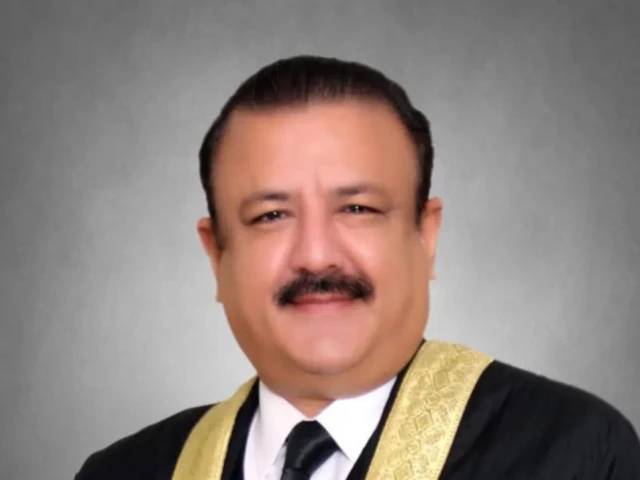
Although sacked judge Tariq Mahmood Jahangiri retains the right to appeal to the newly created Federal Constitutional Court (FCC) against the Islamabad High Court (IHC) order removing him from office, the prevailing circumstances indicate that his prospects of obtaining substantial relief in the near future are dim.
Since the passage of the 26th Constitutional Amendment in October last year, the judicial terrain has fundamentally changed as the executive has increasingly gained the reins to assert its weight over the judiciary in multiple ways. Litigants with grievances against state institutions find it more difficult to obtain redress from higher courts.
Furthermore, things have been further complicated by the 27th Constitutional Amendment, which led to the creation of the FCC as the supreme court, with its first six judges appointed at the discretion of the government of the day.
Under the law, Jahangiri has 30 days to challenge the IHC division court’s verdict before the FCC.
One lawyer believes that while the fired judge has a strong case on several legal grounds, the likelihood of immediate relief remains low in the current climate. In such circumstances, it may be prudent to file the petition and wait for a more opportune time to pursue the case.
Meanwhile, Islamabad-based lawyer Waqas Ahmad says the jurisprudence in the country has not been consistent and has instead evolved with the changing circumstances and political landscape. At times, courts have taken a pro-executive approach, while at others the jurisprudence has been more assertive, redress-oriented and tilted against executive actions, he noted.
Inconsistency in jurisprudence
Pakistan’s higher judiciary has long displayed an uneven and changing jurisprudential record. At different times, courts have validated extraconstitutional actions that were later declared unconstitutional, exposing marked breaks rather than continuity in legal reasoning.
There was also a period when the higher judiciary was accused of encroaching on the executive and legislative spheres. Instead, the perception that prevails today is that the balance has tipped in the opposite direction, as other institutions exert influence on the judiciary and judges are considered to be aligned with executive thinking and occupy a dominant position.
The case of former Islamabad High Court judge Shaukat Aziz Siddiqui illustrates these fluctuations. During the tenures of former Chief Justices Saqib Nisar, Asif Saeed Khosa, Gulzar Ahmed and Umar Ata Bandial, Siddiqui repeatedly failed to get relief.
However, this changed during the government of former CJP Qazi Faez Isa, when his dismissal was eventually declared unconstitutional.
A similar reversal is evident in the interpretation of Article 62(1)(f) of the Constitution. During CJ Nisar’s tenure, disqualification of legislators under this provision was considered for life. That position was later overturned under CJ Isa, marking another clear departure from previous jurisprudence.
Jahangiri was due to retire on July 10, 2027. He was appointed additional judge of the Islamabad High Court in December 2020 during the Pakistan Tehreek-e-Insaf (PTI) government. Prior to this, he served as Deputy Attorney General during the PPP government and later held the position of Advocate General for Islamabad Capital Territory (ICT) during the PML-N government.
There has also been a perception that Mr Jahangiri was not considered one of the good guys in the current regime. He was among the judges who signed a letter to the Supreme Judicial Council (SJC), seeking guidance on alleged agency interference in judicial matters.
He was subsequently appointed to an electoral tribunal to hear petitions relating to three seats in the National Assembly in Islamabad. However, during the course of these proceedings, the executive made an exception and a legislative amendment was introduced to remove the cases from its court.
In the current circumstances, getting relief appears difficult for Jahangiri as powerful sections are seen as keen to use his case to set a precedent for other members of the judiciary.
Lawyers believe that the removal of a judge through a quo warranto order has a chilling effect on the judiciary. However, it is also a fact that more than 100 judges were dismissed by the ruling of July 31, 2009.
Advocate Azhar Sadiq says the removal of Justice Tariq Jahangiri by a quo warranto order lacks legal authority, is coram non judice and is void ab initio.
“Article 193 of the Constitution exhaustively prescribes the qualifications for appointment as a judge of a high court, and only requires that a person be a citizen of Pakistan and have ten years’ experience as a lawyer of a high court or ten years’ service in the judicial service of Pakistan,” it notes.
“It is indisputable that Justice Jahangiri remains a registered lawyer and his license to practice has not been suspended or canceled by any competent bar council,” the lawyer says.
Azhar Sadiq further states that the Constitution does not prescribe any additional academic qualifications or disqualify a judge for an alleged defect in an educational credential.
Consequently, the essential jurisdictional condition for the issuance of a writ of quo warranto – the absence of a constitutional qualification – was never met.
Even otherwise, allegations relating to a “false title”, assuming they are correct without admission, do not constitute a disqualification under Article 193 and cannot lawfully form the basis for the removal of a sitting Judge of the High Court by judicial jurisdiction.
Any question of misconduct, misrepresentation or incapacity of a judge falls exclusively within the constitutional ambit of Article 209 and the Supreme Council of the Judiciary, and no other forum is competent to assume such jurisdiction.
Therefore, the impugned ruling amounts to a usurpation of constitutional authority, undermines judicial independence and is tainted by legal bad faith; Consequently, it is a nullity and can be annulled for lack of jurisdiction and for directly violating articles 193 and 209 of the Constitution, says Azhar Sadiq.
Lawyers are also debating the possible outcome of the misconduct complaint filed by Tariq Jahangiri against IHC CJ Sardar Muhammad Sarfraz Dogar.
Advocate Salahuddin Ahmed, Jahangiri’s lawyer, says the complaint against Justice Dogar before the SJC is still relevant.
The fate of the complaint is also crucial for Tariq Jahangiri’s case.
As for the options available, Abdul Moiz Jaferii’s advocate says that legally, Tariq Jahangiri can file a contempt case against the University of Karachi for not disclosing how its decision to declare this degree invalid was stayed by the Sindh high court.
“You can also appeal this decision to the Federal Constitutional Court, while challenging notifications subsequent to the decision that canceled your notification.”
Jafferi further states that in practice, Justice Jahangiri should focus on exposing this system and proceed with the Supreme Judicial Council’s referral against Justice Dogar. “This was not a court hearing. It was a chaotic execution and must be exposed as such. The regime’s robed hatchet men must be exposed,” he adds.


