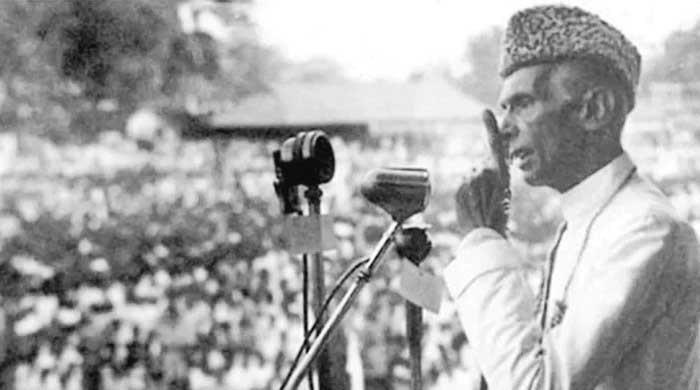
When the ruling elites are no longer willing to commit to constitutional values, we will no longer be able to guarantee the constitutionally promised life of dignity that Jinnah’s Pakistan promised.
The impact of the 26th and 27th amendments has led to the resignation of two judges of the Supreme Court and a judge of the Lahore High Court, who protested the erosion of protection of fundamental rights of citizens, which has effectively disfigured the social contract between citizens and the State. The resignation letters are most instructive when read as part of a broader critique of government policy and the judiciary itself. A public debate is required to reverse a course that has left the State and society adrift institutionally and normatively. But what has led us to this unfortunate situation?
While we continue to revere Quaid-i-Azam Mohammad Ali Jinnah as the founder and great leader of Pakistan, we have conveniently abandoned a critical feature of his thought: his concept of Pakistan as a moral or dignified state with defining characteristics of rule of law, equity, freedom of conscience and representative democracy.
Jinnah’s speeches and letters set out the founding narrative and include ideals that address various aspects of state design, governance and foreign policy. Instead of being a “living” source of inspiration, the Quaid has gone down in history with the salutary portrait hanging in our hallowed halls of power and halls.
What defines a decent or moral state are the generally accepted moral norms and aspirations to which both society and the State are committed, which are usually contained in the constitution. On this, Jinnah maintained: “Islam and its idealism have taught us democracy. They have taught us the equality of man, justice and fair play.”
The judiciary has played a vital role in institutionalizing the separation between Pakistan as a mere fact and the State as a moral entity. In KB Ali v State (1975), the Supreme Court rejected “standards of reason or morality” as a definition of valid law. Although it is essential to ensure social cohesion, provide good governance and guarantee a decent life for all, he maintained that valid law is that dictated by “a competent legislator.” After granting almost unbridled powers to the legislature and the executive, the judiciary has found it very difficult to control governance within constitutional constraints.
Such judicial reasoning has reduced Jinnah to a historical figure whose task was completed with the administrative-legal recognition of a formal State: a historical fact. By doing this, we have effectively removed Jinnah’s moral ideals from the State’s legal thinking, policies and practices.
Although the judiciary has a constitutional mandate to protect and interpret constitutional norms and values, it has now diverted the course of the State towards secular power-based statecraft.
This jurisprudence has not only eroded the moral basis of politics, legislation and interpretation but has also predisposed Pakistan towards authoritarianism. An “empowered” legislature and executive have in various ways encroached on the independence of the judiciary. The result: a grotesque performance of elite interests and power politics that exposes the State for what it has become: an oligarchy.
In the context of a fractured judiciary (under the 26th Amendment) and weak democratic norms, the recent amendments were passed without rigorous public scrutiny and without consensus on the expected moral and strategic advantages. According to the ICJ, “it is alarming [that] “A constitutional amendment of great importance and public interest was approved so quietly and in less than 24 hours.”
The amendments were also passed leaving aside the founding narrative and two substantive tests that protect the moral content of the Constitution. One, that laws that are incompatible with fundamental rights or that repeal them will be void (article 8) and, second, that no law will be promulgated that is repugnant to the commands of Islam (article 227).
Our rule of law is therefore an excellent combination of secular and Islamic protections, which has not been jurisprudentially crafted or applied by the judiciary to test and inform the design and quality of constitutional order and governance.
Islamic scholar Mufti Taqi Usmani criticized the 27th Amendment, insisting that absolute or lifetime immunity of any person from prosecution constitutes a violation of Islam and the Constitution (Article 25). The International Commission of Jurists has criticized both the 26th Amendment as a “blow to judicial independence” and the 27th Amendment as a “flagrant attack on the independence of the judiciary and the rule of law.”
It is also necessary to examine broader implications for the salient features of the constitution and the system of government through the doctrine of basic structure (of the constitution). In the 2015 Supreme Court case, Rawalpindi District Bar Association v. Federation of Pakistan, Justice Sheikh Azmat Saeed held: “[A]As long as the amendment has the effect of correcting or improving the Constitution and not repealing or repealing the Constitution or any of its salient features or substantially altering it, it cannot be questioned.”
Arguably, with the reconfiguration of judicial appointments, the reduction of judicial review powers, transfers and appointments, the establishment of a new high court and related measures, the salient features have been significantly altered and deserve close examination.
While Jinnah insisted on justice and complete impartiality as a “guiding principle”, Pakistan ranked 129th (out of 142) in the World Justice Project’s 2024 Rule of Law Index, reflecting further erosion of an impartial rule of law that guarantees equality for all (Article 25).
Commenting on the 26th Amendment, the International Commission of Jurists (ICJ) highlighted the “extraordinary political influence” and observed that “they [the amendments] erode the ability of the judiciary to function independently and effectively as a check against the excesses of other branches of the State and to protect human rights.”
Referring to the 27th Amendment, the ICJ observed: “They will significantly impair the ability of the judiciary to hold the executive accountable and protect the fundamental human rights of the people of Pakistan.” The change in the balance of power must be constitutionally justified.
This entire unfortunate saga of constitutional amendments reveals the intellectual and moral bankruptcy of our institutions of government: the civil and military bureaucracies and the judiciary. Although Jinnah insists that caring for the poor is our “sacred duty”, public welfare is a low-ranking consideration: constitutional social and economic rights, set out in the Policy Principles, are not even enforceable by the courts.
Instead of a constitutional amendment to make such rights directly enforceable like fundamental rights, the 26th and 27th amendments could be said to erode what little of constitutional governance we had. What is lost in this Faustian bargain is public well-being and dignity – Jinnah’s Pakistan.
A superficial appreciation of the Constitution has normatively emptied state institutions and society.
Our institutions, intellectuals and constitutionalists have failed to elaborate and hold on to the founding narrative of Jinnah and “[t]”The great ideals of human progress, of social justice, of equality and of fraternity” to inform policies and legislation, guide future generations and ensure that we remain focused on the original mission.
This is not only a disservice to the ordinary Pakistani who appreciates Jinnah’s promise, but it is also a disservice to Jinnah by not appreciating it in a proper intellectual-moral context.
Consequently, and possibly, we are witnessing the resurgence of an executive state that Jinnah fought fiercely against for much of his life. We need new and clear jurisprudence to achieve a morally worthy State. Without rediscovering Jinnah intellectually and morally, we will never realize Jinnah’s Pakistan. Who can the citizens of Pakistan trust now?
The author is former Secretary of the Law and Justice Commission of Pakistan.
Disclaimer: The views expressed in this article are those of the writer and do not necessarily reflect the editorial policy of PakGazette.tv.
Originally published in The News