
He says Pakistan will happily be part of the ISF if the mandate does not involve the imposition of peace or the disarmament of Hamas.
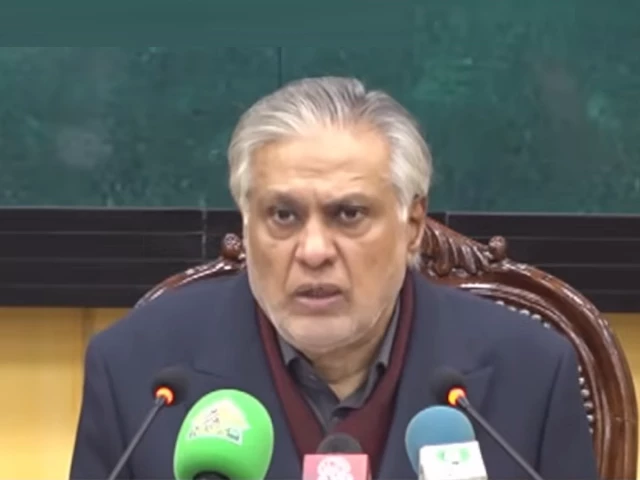
Deputy Prime Minister and Foreign Minister Ishaq Dar addresses a press conference in Islamabad on Friday to review Pakistan’s diplomatic performance in 2025.
Deputy Prime Minister and Foreign Minister Ishaq Dar reiterated on Saturday that Pakistan is willing to participate in an international force aimed at restoring peace in Gaza, as long as its mandate does not include the disarmament of Hamas.
At a press conference in Islamabad to review Pakistan’s diplomatic performance in 2025, Dar described the issue of participation in the proposed International Stabilization Force (ISF) as “highly sensitive”.
“That’s why we have consistently used the term peacekeeping and never peace enforcement, whether in New York, Istanbul or here,” he said.
He added: “I have made it very clear that Pakistan will happily be a part of it if the mandate does not involve the imposition of peace or the disarmament of Hamas. This is the responsibility of the Palestinian Authority or whatever government is in power. Our role will be limited to supporting them in maintaining the peace.”
The Gaza peace agreement, negotiated with the mediation of the United States, provides for the establishment of the ISF, which would be composed mainly of troops from Muslim-majority countries.
Global position and foreign policy priorities
Pakistan’s Deputy Prime Minister and Foreign Minister Senator Ishaq Dar on Saturday said that Pakistan, once considered “diplomatically isolated”, has now achieved a strong and prominent position in the international community politically, diplomatically and economically, thanks to the proactive policies of the current government.
“Pakistan’s active, firm and principled stance on major global issues has been appreciated and recognized on international platforms,” he said, adding that these positions had enhanced Pakistan’s global credibility.
“When the PDM government came to power, Pakistan was considered diplomatically isolated. Today, however, our key role in global affairs is being recognized,” he added.
On regional security, Dar cited the four-day standoff with India and said New Delhi’s efforts to project itself as a security provider had failed. “India tried to assert its dominance in the region and present itself as a security provider, but failed. After the Pulwama incident, India made false allegations against Pakistan, but the Ministry of External Affairs remained active and our national defense is now strong and resilient. Pakistan showed responsibility during the Indian aggression as we have always advocated peace.”
He also highlighted Pakistan’s defense capabilities and said, “Our nuclear and missile force has made the country’s defense virtually invincible.”
Dar emphasized the government’s focus on economic growth, adding: “Our focus now is on transforming Pakistan into an economic powerhouse, and achieving this position will enable leadership within the Muslim world. Pakistan is rich in natural resources, minerals, precious stones and gas, and foreign investment is coming through projects like Reko Diq.”
Referring to the UAE President’s recent visit, he said: “The UAE will acquire shares in a military group, which is expected to pay $1 billion in installments, while the repayment period of the $2 billion loan may also be extended.” He thanked Saudi Arabia, the United Arab Emirates and China for supporting Pakistan’s financial stability.
On the Kashmir issue, Dar said: “Sustainable peace in the region is impossible until the Jammu and Kashmir dispute is resolved. Pakistan has strongly protested India’s illegal actions in occupied Kashmir and has highlighted the issue internationally. Human rights violations were discussed at UN Security Council meetings and as per Council resolutions, a referendum involving Kashmir remains the only solution.”
Dar also addressed the water disputes and said, “With regard to the Indus Waters Treaty, Pakistan is actively raising this issue at the OIC, International Court of Arbitration and the UN, and reports support our position.”
He cited improved relations with Bangladesh as “significant progress” and detailed meetings with government officials and political and student groups during his visits. “A climate of goodwill has been created and relations will be further strengthened after the February elections,” he added.
Talking about Pakistan-US relations, Dar said: “Our ties have seen ups and downs. During the previous Biden administration, relations were limited, but the current administration has moved trade, investment and bilateral relations in a positive direction, with strong counter-terrorism cooperation.” He praised the Trump administration for its role in mediating a ceasefire between Pakistan and India, and noted that Trump was nominated for the Nobel Peace Prize for his contribution to peace. He added: “Bilateral trade with the United States has reached $13.28 billion and tariffs applied to Pakistan remain among the lowest in South Asia.”
The DPM highlighted Pakistan’s engagement with Turkey, OIC member states, China, EU, ASEAN, UN, SCO and Russia, where multiple agreements on economic, defense and investment cooperation were signed. He underlined Pakistan’s principled stance to promote peace in Gaza and resolve the Palestine issue, saying: “Dialogue, compromise, regional stability, economic cooperation and promotion of peace are the pillars of Pakistan’s foreign policy, aligned with our national interests.”
Regarding the domestic protests, he commented: “The PTI protests in the UK were purely provocative and involved death threats, which are completely unacceptable. The British government must act to prevent such incidents, and issuing a demarche was the right step.”
He also expressed concern about terrorism emanating from Afghan territory. “The Taliban government’s response has been unsatisfactory and no concrete measures are being taken against the militants.” He concluded by noting that “India remains the only country obstructing the effective role of SAARC, which is unfortunate.”


