
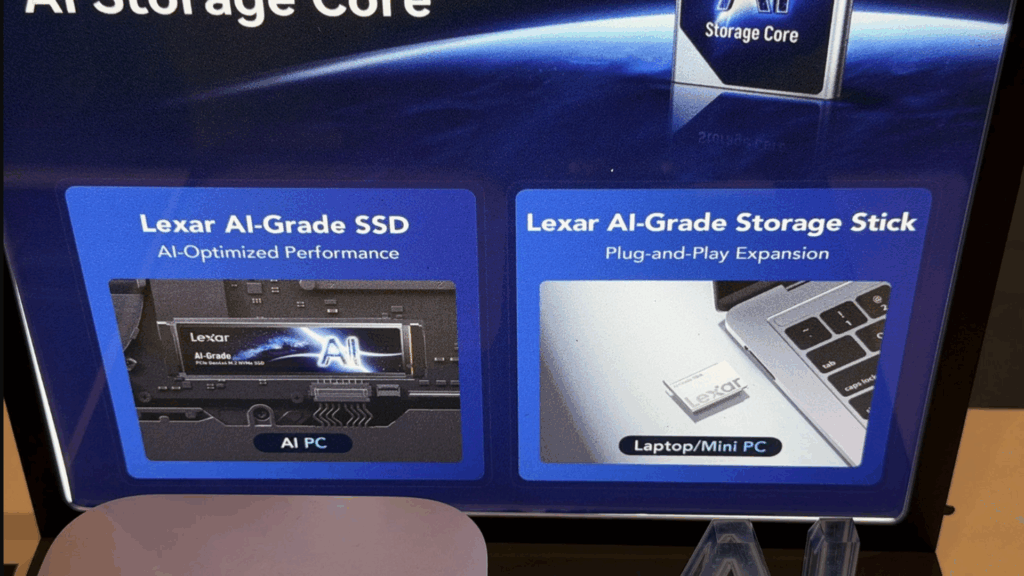
- Lexar AI-Grade Storage Stick Introduces Hot-Swappable AI-Grade Device for High-Performance AI Laptops
- Modular design promises instant storage expansion without shutting down systems
- Practical adoption remains uncertain due to unknown pricing and vendor support.
Lexar has introduced a modular AI-grade Storage Stick designed to instantly expand next-generation storage capacity in compatible enterprise laptops and mobile workstations.
Revealed at CES 2026, the storage device supports hot swapping, allowing users to expand storage capacity instantly without powering down the devices.
While this approach is technically attractive, pricing and adoption by device vendors remains unclear, leaving questions about its practical relevance in real-world scenarios.
Designed for AI workloads
The AI-Grade Stick is designed for high-performance computing tasks and promises incredible speeds suitable for AI-driven applications.
Its compact, modular design emphasizes portability and immediate accessibility, suggesting potential value for professionals who require flexible storage solutions while traveling.
When plugged in, this device integrates directly with the host system rather than behaving as a passive external device.
Lexar says it is not an alternative to internal SSDs, but it offers a new level of expansion for systems where integrated capacity is increasingly limited.
What sets it apart from conventional SSDs is its focus on AI workloads. It is designed to deliver consistent, sustained performance during long-duration tasks.
“First and foremost, the AI-Grade Storage Stick is not a single finished product or SKU, but rather a new storage form factor built on Lexar’s AI Storage Core,” a company spokesperson told Techradar Pro.
“Because of this, final performance, capacity and pricing will vary depending on deployment and target device and will be shared closer to launch.”
Without benchmark data, practical performance under sustained workloads remains unknown.
Security features are a notable aspect of Lexar’s 2026 devices, and the device is expected to indirectly benefit from the company’s focus on encrypted storage.
Lexar’s TouchLock portable SSD reveals that dual NFC encryption and smartphone-based unlocking are feasible in a compact form factor, suggesting similar possibilities for the device.
In addition to the device, Lexar also launched its AI-Grade SSD, designed to handle heavy AI workloads with sustained performance and low latency.
While the SSD supports larger capacities and traditional form factors, the modular device aims to provide flexibility and swappability.
That said, the real-world relevance of the device is difficult to assess because no manufacturer announcement indicates support for the device.
Compatibility, cost and reliability will be critical factors in determining whether it will be widely used or remain a niche experiment.
TechRadar will cover this year’s edition extensively CESand will bring you all the important announcements as they happen. Go to our CES 2026 News page for the latest stories and our hands-on verdicts on everything from wireless TVs and foldable screens to new phones, laptops, smart home devices and the latest in artificial intelligence. You can also ask us a question about the show on our CES 2026 Live Q&A and we will do our best to answer it.
And don’t forget follow us on tiktok and WhatsApp For the latest from the CES fair!


