
.
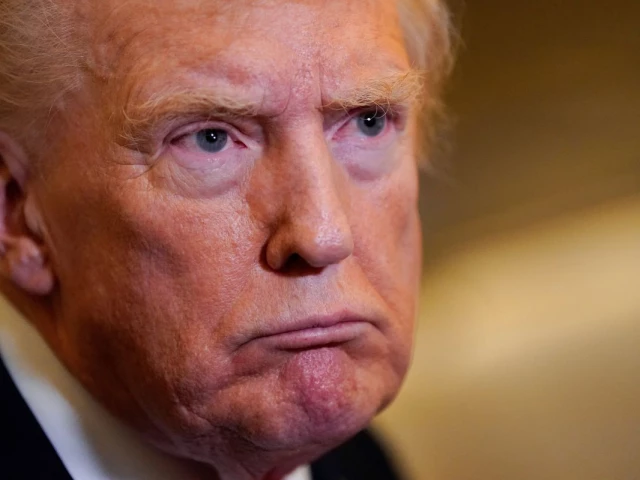
U.S. President Donald Trump looks on as he speaks to members of the media as he flies from Florida to Joint Base Andrews en route to Washington, aboard Air Force One, U.S., Oct. 19, 2025. PHOTO: REUTERS
KARACHI:
“I don’t need international law. My own morality. My own mind. It’s the only thing that can stop me,” US President Donald Trump declared on Friday in an interview with the New York Times. The comments came after a daring US special forces operation that kidnapped Venezuelan President Nicolás Maduro, raising alarm bells among international law experts, political commentators and foreign policy analysts around the world.
Trump’s forceful statement underscores a broader pattern of unilateralism in American foreign policy, which challenges not only constitutional and legal norms but also the entire post-World War II international system.
According to Trump, the operation in Venezuela was intended to allow the United States “to use oil and… take oil,” with the revenues under its direct control. Those statements, reminiscent of the ambitions of the colonialist era, signal a profound departure from standard diplomatic practice and raise concerns about the erosion of the international legal order.
Stephen Collinson, writing for CNN, described the kidnapping as a blatant violation of Venezuelan sovereignty and international law. “The operation probably went beyond the president’s constitutional prerogative in using military force. But the president’s morale was not affected, so he went ahead,” Collinson observed.
Geneva Solutions’ Michelle Langrand called the operation “the latest blow to international law,” warning that a system already weakened by selective enforcement is struggling to respond effectively.
The jurists have been unequivocal in their condemnation. Vincent Chetail, a professor of international law at the Graduate Institute, described the raid as a clear violation of international law and the prohibition on the use of force.
Kate Vigneswaran, director of the International Commission of Jurists’ Global Accountability Initiative, called the operation an “act of aggression,” highlighting the dangerous precedent it sets for other states.
The ramifications extend far beyond Venezuela. Europe, historically a partner of the United States in defending multilateral norms, has been frozen in response, perplexed by Washington’s aggressive unilateralism. As Tim Ross writes for Politico, the EU’s reaction to Trump’s action in Venezuela was like “a cold slap of arctic air,” reflecting growing disillusionment with US leadership.
Trump’s subsequent threats to NATO, Cuba and Iran, as well as his interest in Greenland, point to a pattern in which American foreign policy increasingly prioritizes executive discretion over alliances and shared global norms.
Experts warn that ignoring international law could have catastrophic consequences. International law – codified through United Nations conventions, treaties and multilateral agreements – has historically provided the framework to prevent unilateral aggression and ensure global stability.
Margaret Satterthwaite, UN Special Rapporteur on the independence of judges and lawyers, told Al Jazeera that US rhetoric is “extremely dangerous”, warning that it may herald a return to an era of imperialism. By undermining international legal norms, Washington risks encouraging other states to pursue aggressive policies under the guise of national interest.
Yusra Suedi, assistant professor of international law at the University of Manchester, echoed these concerns. “It signals something very dangerous, as it gives permission to other states to follow suit: states like China, which looks at Taiwan, or Russia, with respect to Ukraine,” he said.
Ian Hurd, a political science professor at Northwestern University, put Trump’s actions in historical context, noting that U.S. interventions in Latin America over the past century — including coups and invasions in Panama, Haiti, Nicaragua and Chile — have repeatedly produced instability, repression and human rights violations.
“Trump’s Venezuela policy is in line with the historical pattern of the United States trying to decide governance in the Americas. In each case, Washington ultimately came to regret its intervention,” Hurd said.
Jiang Feng, a researcher at Shanghai University of International Studies, explained that Trump’s approach exposes a long American tradition of self-centered supremacy in global affairs. The current administration’s open rejection of international norms is not an anomaly but a continuation of a pattern in which international law is selectively invoked—when it serves American interests—and discarded when inconvenient. The result is a destabilization of the liberal international order, once anchored in Western-led institutions and norms.
Analysts say the broader consequences are serious. Tim Ross observes that Trump’s policies threaten not only specific agreements like the Paris climate agreement but the broader architecture of the European Union, historically a major producer of international law.
By privileging unilateral decision-making over multilateral consultations, the United States risks undermining decades of collective effort to establish rules that prevent war, protect human rights, and promote sustainable development.
The Trump administration’s actions exemplify a dangerous resurgence of power politics: “might makes right.” Legal and political experts warn that if major powers ignore international law, they risk setting off a global chain reaction. Other states may feel justified in pursuing aggressive or expansionist policies, eroding decades of progress in conflict prevention and multilateral cooperation.
The operation in Venezuela also highlights the domestic dimension of Trump’s foreign policy. By presenting himself as the sole arbiter of morality and law, Trump centralizes decision-making in the executive, setting aside constitutional constraints and institutional oversight. This concentration of power, combined with disregard for international norms, creates systemic risks, both at home and abroad.
In short, the United States’ kidnapping of Nicolás Maduro and the president’s subsequent rejection of international law is more than a geopolitical maneuver: it is a symbolic and practical assault on the international order.


