
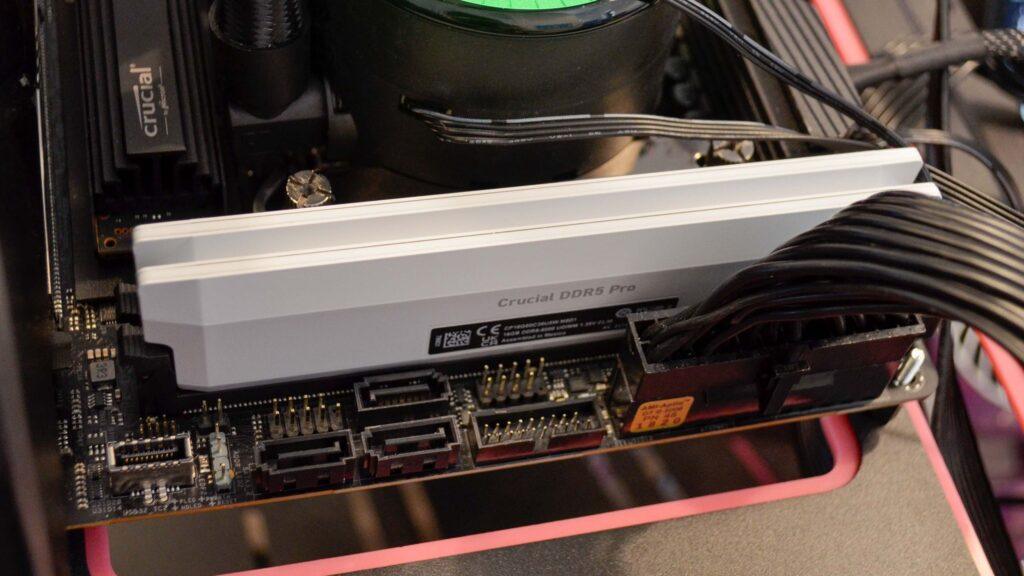
- Micron has defended its decision to close the Crucial brand of consumer RAM
- One marketing executive said: “Our view is that we are trying to help consumers around the world. We just do it through different channels.”
- This refers to the majority of Micron’s consumer business supplying RAM for OEM PCs, and the executive is right to a point, but so are those who complain.
The RAM crisis continues and some consumers are still angry, unhappy with Micron’s abandonment of its Crucial brand last month, but the memory maker has just defended this decision.
Wccftech interviewed Christopher Moore, vice president of Micron’s marketing, mobile and customer business unit (tip to VideoCardz). The tech site asked the executive a series of questions about the current RAM shortage as it relates to consumers and demand for AI (since the profits made due to the latter are the reason system memory is getting thinner on shelves for consumers).
The first and main question Wccftech posed was about the reaction and negative sentiment surrounding Micron’s decision to close its Crucial consumer brand in favor of selling RAM to data centers for AI use.
Specifically, the tech site asked “whether memory vendors are inclined to cater to the AI sector, leaving consumers behind,” and Moore took what might initially seem like a surprising angle.
The vice president said, “Well, first I’d like to try to help everyone understand that the perception may not be exactly correct, at least from our point of view. So I would never want to tell someone what to think or that they are wrong, but our point of view is that we are trying to help consumers around the world. We are just doing it through different channels. We still have a very important business in the client and mobile markets. We are also, of course, serving our data center customers.
“And what is happening now is that the TAM [total addressable market] and the data center is growing tremendously. And we want to make sure that, as a company, we help meet that TAM as well.”
Of course, Micron portraying its closure of Crucial as “an attempt to help consumers” has not gone down well, as at first glance this little statement might seem like doublespeak or PR nonsense.
However, there’s a lot to dig into behind what Moore means here and Micron’s broader presence in the consumer RAM market.
Analysis: The crucial thing here is not a big deal, but it is still a psychological blow
When Moore says Micron is “trying to help consumers” but “does it through different channels,” what the VP is referring to is the memory maker that supplies PC manufacturers (OEMs) with RAM modules for their desktop and laptop computers (the “very important business in the client and mobile markets”).
Micron is one of the largest suppliers of RAM in this regard, so what Moore argues is that this continues to support consumers, rather than abandoning them, even though the Crucial brand, RAM that people can buy outright (as opposed to a PC), is disappearing.
Of course, the argument then is that average consumers still want to buy themselves directly, from retail shelves, and that only supporting OEMs (for consumer PCs, which of course still benefits ordinary people) is depriving them of this ability, so this is still an “abandonment” of support for the average PC owner.
What we can’t forget, however, is that Micron also sells memory chips to other third-party consumer RAM brands, and in theory there may now be more supply available for them (instead of appearing under Micron’s Crucial label, it will simply have a different badge).
Are you not convinced of any of that? Well, what is indisputable is that a certain amount of RAM will be produced for consumers in 2026 (I am referring to the memory modules that end up on retailers’ shelves, whether in online stores or physical stores). This year it will be less, because there is a shortage of RAM supply and AI is a much more profitable sector to sell than consumers (for everyone, not just Micron); that’s a fact. And, more importantly (ahem), whether Crucial exists or not, it arguably won’t (significantly) affect those availability levels (and therefore consumer prices). As noted, any supply of RAM available on retail store shelves (not much) will come out, whatever label you put on it.
Also, remember that Micron hasn’t said it’s favoring OEMs. further (about consumers) now – it always has anyway – although we don’t know what is really happening behind closed doors in the meeting rooms and on the production lines of big factories (and whether there has been any change in that regard).
A little clarity on RAM please.
Am I trying to defend Micron here? It may seem that way, but I’m just trying to clarify where the company is coming from and make it clear that the departure of the Crucial brand is not really the main issue we should be focusing on.
These general RAM problems are being caused by the runaway success of AI, which shows no signs of slowing down, but is also partly the fault of memory manufacturers (Micron, along with its rivals) for their past actions in terms of cutting production too much in more difficult times (when there was an oversupply). Let’s not forget it. That’s a big factor, in addition to the rise of AI itself, as the RAM industry started out on the defensive with too little inventory.
Ultimately, as with any business, decisions are made largely on the basis of profit, and with a limited amount of RAM to go around (i.e. not enough), the AI will take the lion’s share as there is a lot more money in it, and consumers will get the short end of the deal. This is the cold world of business.
All that said, I can see why Moore’s comments aren’t going over well with some people (see this Reddit thread, for example), and why the closure of the Crucial brand seems like a huge blow, as it’s a very negative sign about how Micron it feels on its consumption stock and its sales. This is undeniable, hence the negative reaction towards Micron from those consumers, who are seriously (and rightly) frustrated with the current system memory (or even VRAM) situation.
Meanwhile, Moore notes that Micron has taken steps to increase its production capacity, but those expansion plans won’t see any significant impact on RAM supply until 2028. Again, that’s another warning sign that memory issues could last not only through this year, but could still be a big problem next year. In fact, that seems more and more likely every day.

The best computers for all budgets
Follow TechRadar on Google News and add us as a preferred source to receive news, reviews and opinions from our experts in your feeds. Be sure to click the Follow button!
And of course you can also follow TechRadar on TikTok for news, reviews, unboxings in video form and receive regular updates from us on WhatsApp also.


