
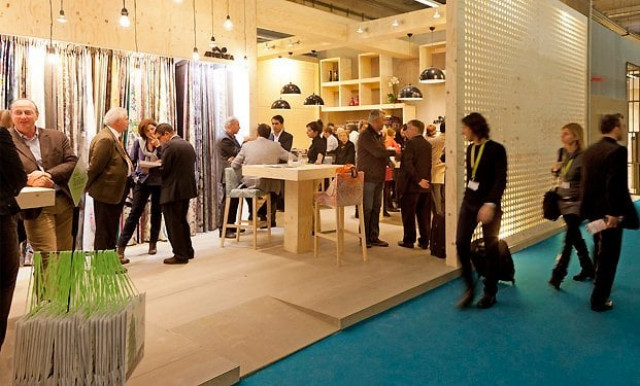
Sarfraz from Quetta receives the Discover Natural Fiber Initiative award at the competition held during the Heimtextil exhibition
A research project by Mohammad Sarfraz, a student of Balochistan University of Information Technology, Engineering and Management Sciences, has received global recognition. The young researcher from Quetta won the Discover Natural Fiber Initiative (DNFI) award for producing fiber from banana stems.
The award, which celebrates efforts to promote eco-friendly fibers, was awarded at the global research competition held during the International Home Textiles Exhibition, Heimtextil, in Frankfurt, Germany.
More than 100 research institutions, companies and educational organizations from around the world participated in the competition. Sarfraz’s achievement highlights the remarkable potential of Pakistan’s young minds, showcasing the country’s growing presence in the field of sustainable research.
Receiving the award, Sarfraz dedicated the recognition to his teachers and the talented youth of Balochistan. He shared with the Express that he had spent four years researching the process of producing high-quality fiber from banana stems.
The project has received praise on various international platforms. However, Sarfraz is especially proud of the success of his project compared to projects from European research institutions and developed countries.
Dr. Mohammad Qasim, head of the Department of Textile Engineering, Balochistan University of Information Technology, Engineering and Management Sciences and supervisor of the Sarfraz project, emphasized that the global recognition of the research proves that the youth of Balochistan possess capabilities on par with any other nation. He believes that with the right opportunities, Pakistan’s name can stand out on the world stage.
He said this project has three stages: extraction of natural fiber from banana waste, manufacturing of a composite and yarn, and then production of fabrics or other products.
Mohammad Fawwad Supriya, director of Natural Fiber Company that provided industrial support to the project, said the award is an honor for Pakistan.
He noted that European companies attending Heimtextil have shown great interest in the project. There are plans to collaborate with a German company to manufacture and market products made from Pakistani banana waste fiber in Germany and other European countries, and a partnership agreement is already in place.
Fawwad explained that the project will play a key role in poverty reduction and employment generation in the marginalized areas of Sindh and Balochistan, thereby improving the quality of life of the local communities. Production of fiber from banana stalks has already started in Sukkur and Lasbela, and the next phase will involve expanding production to include 4,000 households. To do this, Sarfraz has locally designed specialized machines.
He further explained that the cost of a unit consisting of two machines would be between Rs 700,000 and Rs 800,000. This unit can produce up to 1,000 kilograms of fiber per acre of banana waste. Skilled artisans from Sindh, Balochistan and Punjab will then use the fiber to make handmade items and traditional products.
According to Fawwad, Pakistan has the potential to produce 500 million kilograms of natural fiber from banana waste annually, with an estimated global market value of $1 billion. Furthermore, the production of fiber-based products could generate significant foreign exchange earnings for the country.
Pakistan is among the largest banana-producing countries, and millions of tons of banana waste are generated each year, much of which is burned or dumped into rivers, contributing to air and water pollution. The efforts of this student from Balochistan not only promise to alleviate poverty and create economic benefits, but will also play a vital role in environmental conservation.


