
Health Minister says the scheme will provide free and cashless healthcare to nearly 10 million residents of Islamabad, AJK and GB.
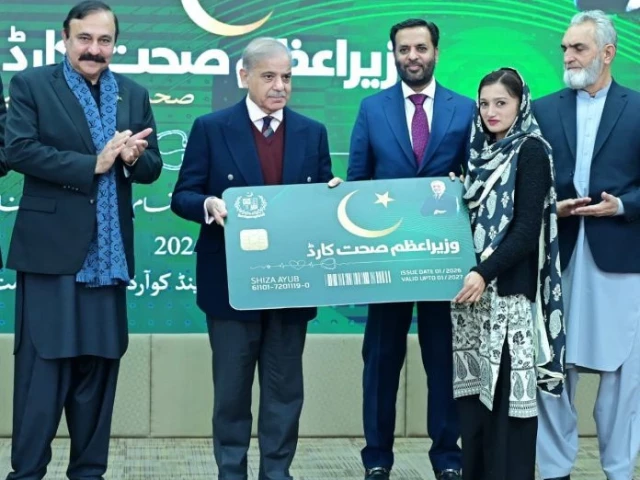
Prime Minister Shehbaz Sharif relaunches and expands ‘Sehat Card programme’ to Islamabad, AJK and GB on January 16, 2026. Photo: APP
Prime Minister Shehbaz Sharif on Friday revived and expanded the Prime Minister’s Health Card scheme to Islamabad, Azad Jammu and Kashmir (AJK) and Gilgit-Baltistan, while reaffirming the federal government’s commitment to providing quality healthcare as a fundamental right to all citizens.
At the launch ceremony, the Prime Minister said the initiative marked another important step towards providing healthcare services at the doorsteps of the people.
The prime minister recalled that the health card scheme was first introduced in 2016 under the leadership of former prime minister and PML-N president Nawaz Sharif and then rapidly expanded across all provinces.
Prime Minister Muhammad Shehbaz Sharif presents a symbolic health card to a resident of Azad Jammu and Kashmir to mark the launch of the Prime Minister’s health card scheme, Islamabad, January 16, 2026.@CMShehbaz pic.twitter.com/F76DGsqb1M
– PTV News (@PTVNewsOfficial) January 16, 2026
He said there was nothing more valuable in life than health. “If there is health, there is education; if there is health, there is decent employment; if there is health, there is progress in all fields of life,” he remarked.
The prime minister said the rich segments of society could afford expensive treatment anywhere in the world, but the real test of the state lay in protecting the poor, widows, orphans and daily wage earners struggling to make ends meet.
“If a worker falls ill and leaves this world without treatment, his children are left in permanent darkness. Health care is the right of every Pakistani, whether he is a prime minister or a street vendor,” he said.
وزenstein جموں وکشمے وزیراعظم وزیراعظم teen سہولیات کا حصول عوام کا… pic.twitter.com/gUPMsuJsSg
– PTV News (@PTVNewsOfficial) January 16, 2026
The Prime Minister congratulated Health Minister Mustafa Kamal, Health Secretary and his entire team on the launch, urging them to ensure transparent implementation through third-party monitoring so that the treatment is provided at the right facilities and to the right standards.
He expressed confidence that the honest execution of the program would benefit the people.
Expressing hope that the plan would be implemented quickly and effectively, he said he would personally supervise the program through visits and inspections in collaboration with health leaders in Islamabad, parliamentarians, the Prime Minister of the United Kingdom and the Prime Minister of AJK.
Responding to a demand to extend the program to Sindh, he said the proposal was valid and assured the audience that he would personally take up the matter with Sindh CM Murad Ali Shah. He noted that the program was already advancing rapidly in Punjab, with billions of rupees spent on healthcare, and congratulated the Punjab government for its efforts.
He added that while other provinces had their own health initiatives, efforts would be made to ensure similar facilities were available across the country.
Prime Minister Shehbaz expressed hope that the Prime Minister’s Health Card scheme will gain momentum across the country, providing relief to millions of families.
Earlier, Kamal said that the revival of the card system would provide free and cashless healthcare to nearly 10 million residents of Islamabad, AJK and GB. He said the program ensured that citizens received treatment without worrying about affordability in times of pain and distress.
The Minister stated that in four or five weeks a program that had been inactive was fully reactivated, calling it a “great administrative achievement.” He stressed that health care should not be limited only to the treatment of diseases.
“Health care means preventing people from becoming patients, ensuring safe delivery, vaccinating children, providing clean water and strengthening preventive care,” he said.
Sharing operational details, Kamal said around 70 hospitals were being included under the Prime Minister’s Health Card in Islamabad, AJK and GB, including 20 additional hospitals in Islamabad alone. He added that card holders from these regions living in Karachi would also be able to access treatment at 16 designated hospitals in the city.
He noted that Sindh remains the only province where the health card is not yet operational, while Punjab, Khyber-Pakhtunkhwa, Balochistan and federal territories are already covered.
Referring to the proposals discussed earlier, he said a plan covering 10 rural and urban districts of Sindh with an estimated cost of Rs 24 billion had been prepared.
“If funding is provided for only two years, the program can become self-sustaining from the third year onwards,” he said, expressing hope that healthcare deprivation in Sindh can also be addressed.


