
ISLAMABAD:
Pakistan is yet to decide whether to join President Donald Trump’s proposed Gaza Peace Board even as a signing ceremony to formally establish the body is scheduled for Thursday (tomorrow) in Davos, diplomatic sources told The Express PAkGazette here on Tuesday.
Foreign Ministry sources said Islamabad has so far not made a final decision on whether to be part of the controversial initiative, which is spearheaded by the US president and linked to his administration’s 20-point peace plan in Gaza.
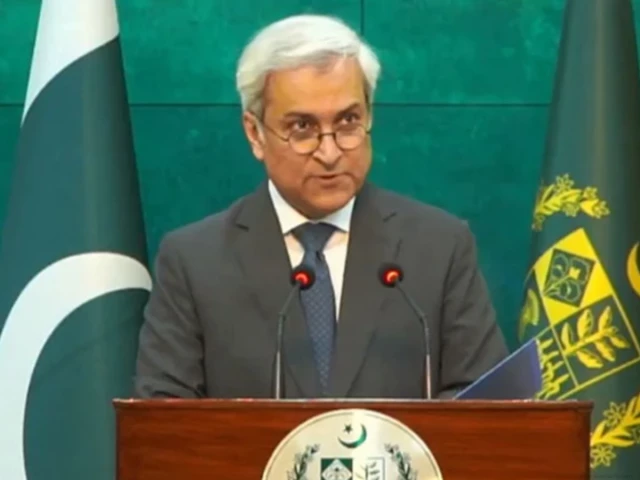
When contacted, Foreign Ministry spokesperson Tahir Andrabi said he had nothing to add beyond what the ministry had already publicly stated on the matter. “There is nothing more to share at this time,” he told The Express PAkGazette.
The Ministry of Foreign Affairs confirmed on Sunday that President Trump had invited Prime Minister Shehbaz Sharif to join the Peace Board, which is envisioned as an oversight and implementation mechanism for the next phase of the Gaza ceasefire and post-war reconstruction.
A senior government official said the decision would be “critical in any case” given the political, diplomatic and financial implications associated with joining the junta. The official, who spoke on condition of anonymity, said consultations were being held “at the highest level” to weigh the pros and cons before making a final decision.
Prime Minister Shehbaz Sharif traveled to Davos to attend the World Economic Forum (WEF). However, it is not yet clear whether he will participate in the signing ceremony of the Peace Junta Charter, which is expected to be held on Thursday (tomorrow) morning.
Pakistan was one of eight Arab and other Muslim countries that previously endorsed President Trump’s 20-point peace plan for Gaza, a factor that has led some observers to believe that Islamabad’s eventual decision to join the Peace Board may not come as a surprise.
“A signing ceremony to formalize President Trump’s Peace Board will be held Thursday in Davos, Switzerland,” according to the White House calendar. Trump is expected to meet with several world leaders on the sidelines of the WEF before presiding over the signing of the letter.
The board, which will be headed by Trump himself, will be tasked with overseeing the implementation of the peace plan and coordinating post-war reconstruction of Gaza. The initiative has attracted global attention and criticism, particularly for its composition and funding model.
Trump has extended membership offers to several heads of state, including Russian President Vladimir Putin, according to US officials. The leaders of the United Kingdom, Israel, Canada, France, Brazil, Egypt, Turkey and Argentina also received invitations, although it is unclear how many countries in total were approached.
Israel’s inclusion on the guest list has proven particularly controversial, given that the board would oversee a ceasefire process in which Israel is a direct party. Israeli Prime Minister Benjamin Netanyahu has not yet publicly accepted the offer, and Israeli officials have previously indicated that the body does not align with Israel’s stated policy on Gaza.
France has already expressed its reluctance to participate. An official close to French President Emmanuel Macron said Paris has no intention of joining the council “at this stage.” Trump responded with disdain to the development, telling reporters Monday that “no one wants him anyway because he’s leaving office very soon.”
He also threatened to impose a “200% tariff” on French wines and champagne, suggesting that such pressure would eventually force Macron to accept the invitation. “But you don’t have to join,” Trump added.
According to the White House, other executive members of the board include US Secretary of State Marco Rubio, Special Envoy Steve Witkoff, Trump’s son-in-law Jared Kushner, former UK Prime Minister Tony Blair, World Bank President Ajay Banga, and billionaire investors Robert Gabriel and Marc Rowan.
The initiative has also drawn attention due to reports that the US administration has tied a $1 billion membership fee to countries seeking permanent seats on the board. The funds would be used to support reconstruction efforts in the Gaza Strip. However, the three-year appointments would not carry the mandatory fee, a U.S. official familiar with the statutes told The Associated Press.
For Pakistan, analysts say the decision involves balancing diplomatic alignment with Washington, solidarity with the Palestinian cause and regional sensitivities. As the Davos signing approaches, Islamabad’s final stance continues to be closely watched both at home and abroad.


