
He says macroeconomic indicators are reassuring, adding that Pakistan must pursue export-led growth to achieve sustainable growth.
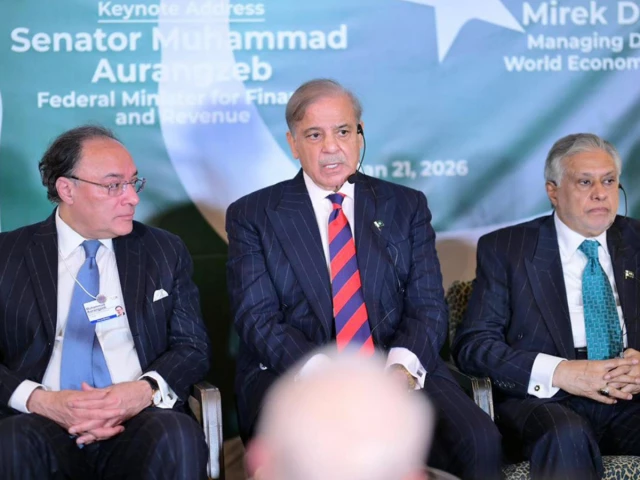
Prime Minister Shehbaz Sharif addresses the Pakistan Pavilion on the sidelines of the 56th Annual Meeting of the World Economic Forum on Wednesday. Photo: APP
Prime Minister Shehbaz Sharif on Wednesday said Pakistan was moving forward with a renewed sense of “achievement and progress”, while underlining the need to pursue export-led growth to ensure sustainable economic development.
Speaking to members of the Pakistani community and business leaders on the sidelines of the World Economic Forum, the prime minister said recent economic indicators reflected improving stability.
“Our macroeconomic indicators are reassuring,” he said, noting that inflation had dropped from 30% to 5.5%, while the policy rate had dropped from 22.5% to 10.5%.
He added that Pakistan’s IT exports had shown encouraging progress, although exports continued to face multiple challenges and social indicators still required improvement through sustained collective efforts.
The prime minister said the direction ahead was “clear” and emphasized that Pakistan must move towards “export-led growth”. He said the government had introduced fundamental structural reforms to strengthen the economy.
Highlighting the milestones achieved by his administration, the prime minister said the revenue collection system had undergone major reforms and was being completely digitalised. He added that the tax-to-GDP ratio had risen to 10.5% from 9% a couple of years ago, which he called a significant achievement.
The prime minister said agricultural exports had shown promising growth and Pakistan had entered the mines and minerals sector “in a big way.” He said agreements and MoUs had been signed with American and Chinese companies, adding that Pakistan was endowed with vast natural resources in Gilgit-Baltistan, Azad Jammu and Kashmir, Khyber-Pakhtunkhwa and Balochistan.
Prime Minister Shehbaz said the government had decided to move “at lightning speed” and was also making rapid progress in emerging sectors such as cryptocurrencies, artificial intelligence and information technology.
“Our IT exports have shown remarkable progress in recent years and now officially stand at $3 billion annually,” he said, adding that several policy instruments had been introduced to facilitate growth in the sector.
Referring to Pakistan’s large young population, the prime minister said it posed both a challenge and a significant opportunity. He added that the federal and provincial governments had launched several initiatives to empower youth through vocational training and skill development programs.
Regarding China, he said: “We have strong economic connections and now we have built relations with the United States and, as said earlier, in the field of mines and minerals, there is great hope that we will have to cooperate with each other in a big way.”
He also said that Pakistan would cooperate with both countries on counter-terrorism efforts, along with IT and artificial intelligence.
“I think Pakistan is at a time where we are going to take off rapidly in agriculture, industry, mining, artificial intelligence and IT, and I think our future is progressing a lot, I have no doubt about that.”
The prime minister added that his government is moving forward with “total transparency.” He noted that Pakistan International Airlines, a national asset, was recently privatized.
“Unfortunately, in recent decades it has suffered setbacks and has now been bought by the private sector in Pakistan.
“Its privatization has been completely transparent. Every aspect of the process was shown live to the world, so everyone could see in real time how transparent this transaction was,” he said, calling it a hallmark of his government.
The prime minister said the government was moving forward with new privatization measures, including outsourcing of airports and privatization of the power sector, distribution companies and transmission lines, noting that these measures were adopted within the framework of a strict IMF program implemented “in letter and spirit.”
“That is why the IMF is cautiously using Pakistan’s success story as a model for developing countries, and now we need to move towards growth.”
Referring to the closure of state entities such as Public Service Stores, Pakistan Works Department and Pakistan Agricultural Warehousing and Services Corporation, he said these institutions were closed to save billions of rupees for the country’s poor as they had been bleeding the national economy dry.
“Utility shops, which were offering substandard products to the common man, were completely closed and this hemorrhage ended forever and only saved billions of rupees to the public exchequer,” he said.
The Prime Minister said the government remained unwavering in its resolve and emphasized that failure to take such difficult decisions would have been unfair to both itself and the people of Pakistan. “Unless we stop this hemorrhaging of our economy through these measures, as challenging as they are, our economy will not be on solid footing, no matter what we do.”
Calling for a sense of ownership and understanding among stakeholders, he said Pakistan was at a critical juncture and ready to take off. “We are a country of 240 million inhabitants, a country with a young population, which is a great challenge as well as an opportunity and we are absolutely committed to turning this into an opportunity by providing them with all those opportunities and tools that will make our country great,” he concluded.
Aurangzeb praises the progress of the reforms and describes privatization as “a huge breather”
Earlier, speaking at the Pakistan Pavilion, Finance Minister Muhammad Aurangzeb said Pakistan had made significant progress in stabilizing its economy over the past year, and described privatization as a “huge breather” that would pave the way for future reforms.
Aurangzeb said the country had consolidated its macroeconomic gains and was moving in the right direction. He noted that this progress had been externally validated, with three global rating agencies upgrading Pakistan’s prospects during the period.
Terming these developments as a result of structural reforms, the Finance Minister said there was often a debate whether reforms were taking place in Pakistan, with some describing them as “elusive”. However, he said the reality was that the country was receiving more and more external and international recognition for the reforms that were currently being implemented.
While acknowledging that some progress had been made, Aurangzeb stressed that there was still much to be done. “Our tax-to-GDP ratio is now in double digits, but we still have a long way to go before declaring fiscal sustainability,” he said.
Emphasizing the need to broaden the tax base, he said economic sustainability depended on bringing previously untaxed sectors into the network. He added that the government was focusing on broadening the tax base while improving compliance and enforcement through the use of technology.
Terming the state-owned enterprise (SOE) reforms as critical, Aurangzeb said circular debt had been reduced and improvements in governance had been introduced. However, inefficiencies in state-owned enterprises continued to cost the country close to a trillion rupees a year.
He said 24 state-owned companies had been handed over to the Privatization Commission and noted that after decades, Pakistan had managed to privatize its national airline. The measure, he added, would serve as a catalyst for other privatization processes.
The finance minister said that before attracting foreign direct investment, the government needed to provide the same level of confidence to local investors.
Referring to Pakistan’s inaugural panda bond, Aurangzeb said the focus was on the issuance of the country’s first such bond. “This is the first time Pakistan will access the Chinese capital market, which is the second largest and deepest capital market in the world,” he said.
However, he warned against complacency, saying Pakistan still had a long way to go to escape boom-bust cycles and must be patient to avoid repeating past mistakes.
He added that the necessary pillars have already been established to move the country forward and stated that “the ball is in our court.”
Also speaking at the forum, Deputy Prime Minister Ishaq Dar said Pakistan’s economic path is now firmly geared towards growth. He argued that a country with a population growth rate of 2.5 percent could not sustain itself with economic growth of 2.5 or 3 percent.
“The Prime Minister and the finance team are actively pursuing this goal, and I am confident that it is not unattainable as the country has demonstrated its resilience,” he said.
Recalling past performance, Dar said Pakistan had achieved 6.3 per cent growth in 2017, recorded its highest foreign exchange reserves and maintained low inflation at 3.59 per cent, demonstrating the country’s ability to achieve those targets again.
He said Pakistan, which had been diplomatically isolated three years ago, was now fully integrated into the international system. “In 2021, we won the UN Security Council elections by a single vote; this time we have 182 votes against five,” he said, calling it a reflection of the growing global confidence in Pakistan.
Dar said the country was going through a transformative phase and was proactively engaging at regional and global levels to contribute to peace and stability. “We are committed to our neighboring partners, we are committed globally and we are committed to international forums. I am sure that you will have a lot of good news in due time,” he added.


