
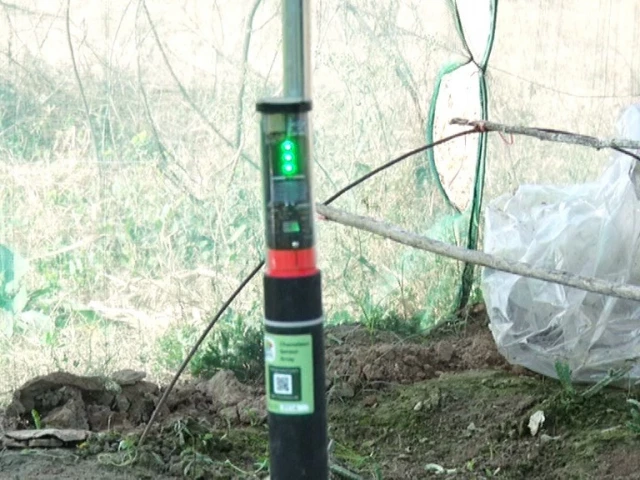
Real-time data from soil sensors helps KP farmers take the guesswork out of irrigation, saving water by 30% and reducing fuel costs.
PESHAWAR:
Farmers in Khyber-Pakhtunkhwa (KP) are beginning to save significant amounts of water and improve agricultural productivity with the help of modern soil moisture sensor technology.
Experts believe that scaling up such technology across the KP could help make agriculture more resilient to climate change while easing pressure on Pakistan’s dwindling water resources. Early findings, based on experiences from Punjab, indicate substantial benefits.
The technology, known as a soil water moisture sensor array, has been installed at the Tarnab Research Farm and selected agricultural areas in the province. 50 sensors have been installed in Charsadda district and 60 in Mansehra. The sensors provide real-time data to farmers, allowing them to water crops only when necessary, rather than relying on guesswork or traditional calendars.
Speaking to The Express PAkGazette, Dr Gulzar Ahmed, Research Officer, Pakistan Scientific Research Centre, said the initiative is a joint effort with the International Water Management Institute (IWMI). He explained that the sensor system works with three signals, similar to traffic lights, making it easier for farmers to understand irrigation needs.
“The sensors are connected to a mobile application that provides real-time data. Farmers can check soil moisture levels from their homes and decide if their fields really need water,” he said. This approach not only prevents over-irrigation but also helps conserve scarce water resources.
“This project aims to promote water-related research and significantly reduce the amount of water used in agriculture,” said Dr. Ahmad, adding that consultations are also underway with international water-saving institutions.
Kifayat Zaman, the project-in-charge in KP, said the initiative is part of a UK-funded program titled Water Resources Responsibility in Pakistan. “The program was launched in Punjab in 2021, while in KP it started in 2024,” he said.
Read: Punjab farmers earn millions in months with super seeder technology
“Farmers who previously watered their crops four to six times during a season now do so only three to four times,” Zaman said. “This has resulted in 25 to 30 percent water savings.”
According to Zaman, soil moisture sensors are designed to improve water demand assessment, supply management and overall governance in the water sector. “One of the central objectives of this program is to strengthen coordination between government institutions and improve the general water management system,” he added.
He highlighted that climate change and its impacts are increasingly visible to farmers throughout the province. “Irregular rainfall, rising temperatures and water scarcity are directly affecting agriculture. With the help of this technology, farmers can not only optimize water usage but also increase crop productivity,” he said.
Furthermore, research reports suggest that the use of these sensors has led to a 15 to 20 percent increase in crop yields. The economic benefits are also significant, particularly for farmers who rely on tube wells powered by electricity or solar energy. “These farmers faced high operating costs and the reduced need for irrigation has helped them save a considerable amount of money,” Zaman said.


