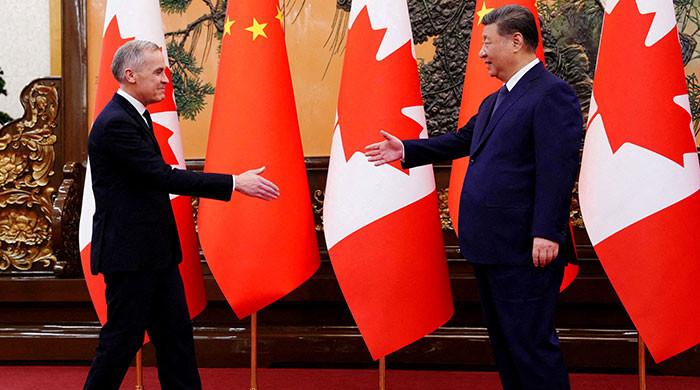
- Trump warns that the deal with Prime Minister Carney could endanger his economy.
- Carney urges citizens to buy national products.
- Tensions arise after Carney criticized Trump’s plans for Greenland.
WASHINGTON: US President Donald Trump said on Saturday he would impose a 100% tariff on Canada if it goes ahead with a trade deal with China and warned Canadian Prime Minister Mark Carney that such a deal would endanger his country.
“China will eat Canada alive, devour it whole, including destroying its businesses, social fabric and overall way of life,” Trump wrote in Truth Social.
“If Canada reaches an agreement with China, it will immediately be hit with a 100% tariff on all Canadian goods and products entering the United States.”
In a video on Saturday, Carney urged Canadians to buy domestic products, but did not directly mention Trump’s tariff threat.
“With our economy threatened from abroad, Canadians have chosen to focus on what we can control,” Carney said. “We can’t control what other nations do, we can be our best customer.”
The Canadian prime minister traveled to China this month to reset the strained relationship between the countries and reached a trade deal with Canada’s second-largest trading partner after the United States.
Immediately after Carney’s trip to China, Trump appeared to support him. “It’s good for him to sign a trade deal,” Trump told reporters at the White House on January 16. “If you can make a deal with China, you should.”
“A free trade agreement with China is not sought. What was achieved was the resolution of several important tariff issues,” Dominic LeBlanc, minister responsible for trade between Canada and the United States, said in a post on X on Saturday.
China’s embassy in Canada said in a statement to Reuters that China was willing to work with Canada to implement the important consensus reached by the leaders of the two countries.
Tensions between the United States and Canada have increased in recent days following Carney’s criticism of Trump’s search for Greenland.
More pressure on Canadian industries
On Saturday, Trump suggested that China would try to use Canada to evade US tariffs.
“If Governor Carney thinks he is going to make Canada a ‘delivery port’ for China to ship goods and products to the United States, he is sorely mistaken,” Trump said, using a title for Carney that refers to Trump’s previous calls for Canada to become the 51st state of the United States.
In a second post on Saturday, Trump said: “The last thing the world needs is China taking over Canada. It’s NOT going to happen, it won’t even come close to happening!”
If Trump carries out Saturday’s threat, the new tariff would sharply increase U.S. tariffs on its northern neighbor, adding pressure on Canadian industrial sectors such as metal manufacturing, automobiles and machinery.
Relations between Carney and Trump seemed relatively placid until the Canadian leader spoke out forcefully this week against Trump’s occupation of Greenland.
Later, Carney, at the World Economic Forum, called on nations to accept that a rules-based global order was over and pointed to Canada as an example of how “middle powers” could act together to avoid falling victim to American hegemony.
Carney, during his speech in Davos, Switzerland, did not directly mention Trump or the United States by name. However, the prime minister stated: “The middle powers must act together because if you are not at the table, you are on the menu.”
Many world leaders and industry titans present at the Swiss conference responded with a standing ovation.
Trump responded in his own Davos speech, saying Canada “lives because of the United States,” a statement Carney rejected on Thursday.
“Canada and the United States have built a remarkable partnership in economics, security and rich cultural exchange,” Carney said in Quebec. “Canada does not live because of the United States. Canada prospers because we are Canadians.”
Since then, Trump has entrenched himself against Canada, revoking his invitation to its Peace Board that he wants to address international conflicts and the future of Gaza.
After Carney’s election last year, Trump and Carney shared a pleasant tone. “I think the relationship is going to be very strong,” Trump said at the time.
But this month Trump dismissed the mega trade deal between the United States, Canada and Mexico (which will be renegotiated in July) as “irrelevant.”
Trump has made many tariff threats since returning to the presidency, although in several cases he suspended them during negotiations or relented entirely. This week, Trump backtracked on his recent threat to impose strict tariffs on European allies after the NATO chief and other leaders pledged to bolster security in the Arctic.
“We hope the two governments can quickly reach a better understanding that can alleviate further concerns for businesses facing the immediate consequences of growing uncertainty,” Matthew Holmes of the Canadian Chamber of Commerce said in a statement.