
The framework will initially be implemented in 25 public universities and it is planned to extend it to all public universities.
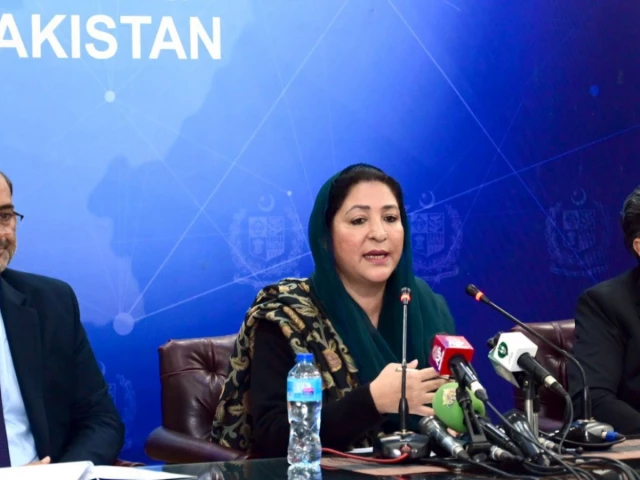
Minister of State for Federal Education Wajiha Qamar speaking at a press conference in Islamabad PHOTO: EXPRESS
ISLAMABAD:
Pakistan has launched the maktab system to maintain complete digital records of students, tracking their enrolment, grades, academic records and degrees, Minister of State for Federal Education Wajiha Qamar said on Monday.
Addressing a press conference in Islamabad, the minister said the system, launched under the Higher Education Commission (HEC), will be initially implemented in 25 public universities, with plans to extend it to all public universities in the country.
“Under this system, complete data of each student, from enrollment to degree, will be available. This will save time and ensure transparency,” he said. He added that the platform will include grades, academic records and degree issuance records, allowing the entire academic journey of students to be tracked on a single platform.
Qamar said the government also plans to use artificial intelligence to manage the education system and store all processes securely. “Ensuring the quality of education for students is extremely important,” he said, adding that the Federal Directorate of Education (FDE) and HEC are playing a central role in implementing these reforms. He said monitoring at the FDE is already done through digital portals, while an artificial intelligence-based portal is in the final stages of completion.
The minister said that digitalization has strengthened the monitoring, accountability and scrutiny of tenders. “The control of tenders is now carried out digitally. This system is extremely important for transparency,” he stated.
He also highlighted that there are mechanisms for students and parents to register complaints directly, through digital platforms and e-katcheries. “HEC, FDE and other institutions are working to further improve the education of young people,” he added.
Read: Beyond budgets: structural crisis in Pakistan’s universities
Wajiha Qamar said the initiative aims to improve transparency, improve the quality of education and strengthen Pakistan’s international standing. He said a central e-portal has been introduced in the FDE for bachelor’s programmes, which will initially benefit about 4,000 students seeking admission. “In the first phase it will be applied to BS admissions and then to other programs,” he said.
He also spoke about the reforms in the Inter-Board Coordination Commission (IBCC), which has introduced a 24-hour online system for equivalence and verification through a single ID. He said this has also accelerated the registration process for international boards.
The minister described the Directorate General of Education as “very close to our hearts” and highlighted the recent inauguration of a Center of Excellence for Autism by the prime minister. He said the government is organizing e-seminars to allow students and parents to lodge complaints directly.
Wajiha Qamar said these measures are part of a broader effort to modernize the education system and make it more accountable, efficient and student-centered. He added that while results take time, these reforms are designed to ensure consistent improvements in educational outcomes and service delivery.


