
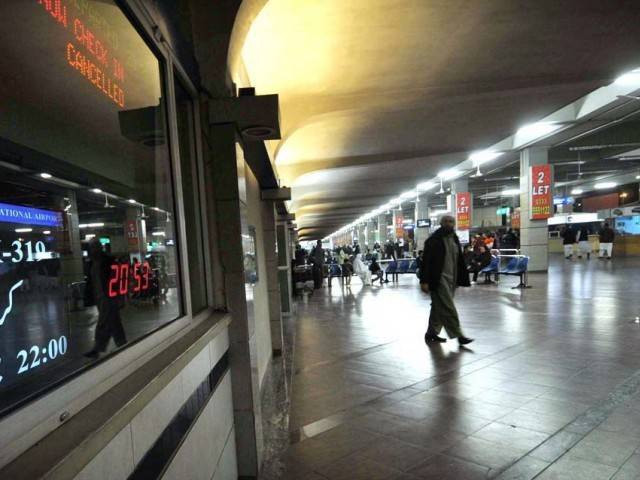
Muhammad Riaz was trying to travel abroad. PHOTO: ARCHIVE
ISLAMABAD:
The Finance Ministry said on Tuesday that more than 762,000 Pakistanis left the country in the last year, becoming part of the group that is helping the nation stay afloat economically, amid a sharp reduction in foreign direct investment and exports.
In calendar year 2025, the Bureau of Emigration and Overseas Employment recorded 762,499 workers leaving Pakistan, according to the Finance Ministry’s monthly outlook report. There was an increase of more than 5% or almost 37,000 more souls who left the homeland in search of better job opportunities.
The Finance Ministry said that in December 2025 alone, the Emigration and Overseas Employment Bureau recorded 76,207 workers leaving Pakistan, an increase of 18.7% year-on-year.
Of the total, 530,000 people went to Saudi Arabia in search of a good future. From unskilled to highly skilled and highly skilled people are leaving Pakistan amid a prolonged period of low economic growth and a period of increased political instability.
Money sent by Pakistanis abroad is now the largest source of non-debt-generating foreign inflows keeping the country afloat. During the first half of this fiscal year, Pakistani workers sent $19.7 billion in remittances, an increase of 11%.
The government receives around $40 billion annually from these workers without any support for them. Compared to this, the entire state machinery is focused on improving exports and foreign direct investment, but it is failing.
Foreign remittances were 23 times larger than the $808 million in foreign direct investment that Pakistan received during the first half of this fiscal year. It was also $4.2 billion higher than the $15.5 billion in exports during this period.
Despite efforts on multiple fronts, foreign direct investment declined by almost 44% during the first half of this fiscal year. The Finance Ministry said foreign direct investment fell from $1.4 billion to just $808 million during the July-December period of this fiscal year.
Pakistan’s inconsistent economic policies, high taxes and energy prices, and unrealistically high interest rates are keeping foreign investors away. Authorities are still struggling to resolve interprovincial issues that also hamper foreign investment.
The Finance Ministry report indicated that the current account is expected to remain in deficit in January, but this would be supported by higher foreign remittances.
“Strong remittance flows and stable performance in information technology and services exports are likely to cushion external pressures,” the ministry said. Improved fiscal management is also expected to continue supporting macroeconomic stability, the ministry said.
The current account recorded a deficit of $1.2 billion during the July-December period of this fiscal year, compared to a surplus of $960 million recorded last year.
But the Finance Ministry said that despite these challenges, the government achieved a fiscal surplus during the July-November period due to a growth in revenue and a significant reduction in margin payments. Gross federal revenue recorded 8% growth during the first five months of this fiscal year, contributed by growth in both tax and non-tax revenue of FBR.
The government achieved a consolidated fiscal surplus of 0.8% of GDP or Rs 982 billion during the first five months of this fiscal year. Similarly, a primary surplus of 2.8% of GDP or Rs 3.7 trillion was recorded.
The central bank said on Monday it would be a challenge to meet the annual primary budget surplus target set by the International Monetary Fund. FBR taxes are far behind the target.
Against the downwardly revised seven-month target of Rs 7.5 trillion, the FBR raised Rs 6.8 trillion as of Tuesday evening. During this week, it needs another Rs 715 billion just to meet the downwardly revised target.
Inflation
The Finance Ministry said inflation would remain stable this month within the current range of 6%. However, despite the stable outlook, the central bank did not reduce interest rates this week, helping to fatten already fattened commercial banks.
Last month, inflation registered 5.6%.
The ministry said Pakistan’s economy is well positioned to sustain its growth momentum in the current fiscal year, supported by the encouraging performance of large-scale manufacturing and other high-frequency indicators. This positive trajectory reflects the impact of prudent policies, ongoing structural reforms and the easing of monetary conditions due to easing inflationary pressures, it added.
Pakistan’s economy has completed the first half of this fiscal year with continued macroeconomic stability, reflected in contained inflation, recovered LSM growth and strengthened foreign exchange reserves with a stable exchange rate.
The sustained growth momentum has been complemented by fiscal discipline that has led to fiscal and primary surpluses. LSM has gained momentum, indicating better growth prospects for the rest of the fiscal year. Remittances remained strong, supporting the external account.
The ministry said LSM recorded 6% growth during the first five months of this fiscal year, reaching its highest level since fiscal 2016. In November 2025, LSM grew 10.4% year-on-year as automobiles, coke and petroleum products and garments remained the main contributors to the overall growth.


