
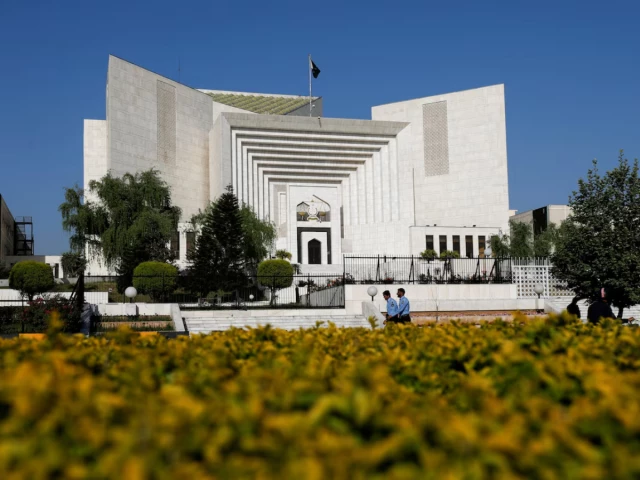
Police officers walk past Pakistan’s Supreme Court building, in Islamabad, Pakistan, April 6, 2022. REUTERS
ISLAMABAD:
In a landmark ruling aimed at dismantling colonial-era language and restoring dignity to citizens, the Supreme Court banned the use of the phrase “Bakhidmat Janaab SHO” in petitions addressed to police officials, declaring it incompatible with constitutional values and democratic governance.
The verdict, written by Justice Salahuddin Panhwar, observed that such language reflects an outdated mindset and is inconsistent with the role of public servants in a modern democratic system, where police officers are meant to serve citizens, and not the other way around.
The issue arose during court proceedings when court registrar Muhammad Subhan Malik, at the court’s request, highlighted the widespread use of the phrase while addressing police station officers.
He explained that “Bakhidmat” translates as “at the service of,” adding that “it is not the citizen at the service of the SHO, but the SHO at the service of the citizen.”
The judicial assistant further pointed out that the terms “plaintiff” and “informant” are often used interchangeably, even in FIR matters, a practice which the court termed as incorrect.
According to the submission, the judgment written by Justice Salahuddin Panhwar observed that henceforth, to address the SHO, “Janaab SHO” is sufficient.
The SC further ruled that the term ‘complainant’ would apply only to a person filing a private complaint under Section 200 Cr.PC, while a person filing an FIR would be considered an informant.
The 19-page verdict also banned the use of the term “Faryaadi” in police proceedings, observing that it conveys the impression of a citizen seeking mercy rather than exercising a legal right.
He pointed out that the word, of Persian origin, refers to one who cries out for help.
“The description of a citizen as ‘Faryaadi’ is legally erroneous and constitutionally impermissible as it demeans the citizen by presenting him as a favor-seeker instead of an individual with rights who invokes the protection of law. Such terminology attacks the very dignity of the citizen, which is inviolable under Article 14 of the Constitution, and undermines the concept of equal protection of law provided for by the constitutional framework,” the judgment observed.
“Police officers are public servants entrusted with constitutional and statutory duties. They are obligated to protect life, liberty and security of the person, values that are at the heart of Article 9 of the Constitution,” the SC said, adding that police officers are obligated to serve the public and are remunerated from public funds.
“Citizens therefore approach the police as if they have the right to do so, and not as a matter of charity, grace or leniency. Any institutional practice that reverses this relationship erodes public confidence in the rule of law and weakens constitutional governance.”


