
Total prohibition of the display and use of weapons, as well as the use of passengers on motorcycles; Covering your face in public is also prohibited.
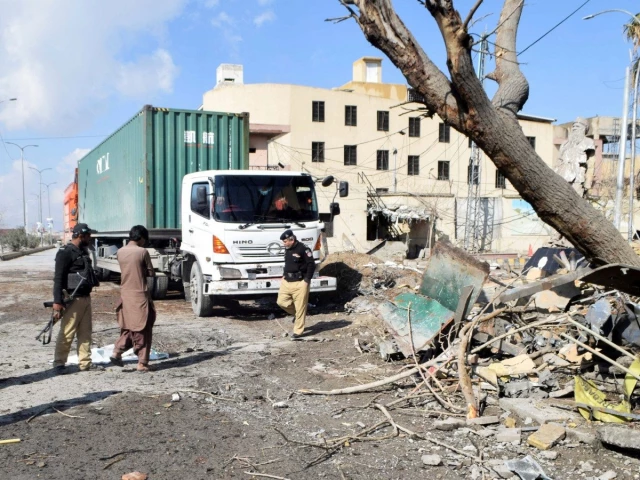
Police officers inspect the scene after the terrorist attacks in Quetta on February 1. Photo: Reuters
QUETA:
The Balochistan government has imposed Section 144 across the province for a month, citing heightened security concerns, recent terror attacks and the overall law and order situation.
The decision came into effect immediately and will remain in force from February 1 to the end of February, according to an official notification issued by the Balochistan Home Department on Sunday.
The move came after a series of coordinated attacks in multiple locations in Balochistan that occurred a day earlier. According to Inter-Services Public Relations (ISPR), 92 terrorists were killed as security forces repelled attacks across the province on Saturday, while 15 security personnel were also martyred in combat.
“Terrorists from Indian-sponsored countries Fitna al-Hindustan “He attempted to disturb the peace of Balochistan by carrying out multiple terrorist activities around Quetta, Mastung, Nushki, Dalbandin, Kharan, Panjgur, Tump, Gwadar and Pasni,” the ISPR said in a statement.
Balochistan Chief Minister Sarfraz Bugti described the developments as a great success. At a news conference today, he said forces remained alert in other parts of the province where incidents subsequently occurred, adding that more than 5,800 intelligence-based operations were carried out over a 40-hour period.
According to the notification, the display and use of weapons is completely prohibited. Brandishing weapons, performing aerial shots or carrying weapons in public or private places will be considered serious infractions.
The order also prohibits riding with a passenger on motorcycles, although authorities said exemptions for women and children are being considered, in line with previous notifications.
“The circulation of vehicles with tinted or darkened windows has been prohibited, as has the use of unregistered vehicles and motorcycles. Gatherings of five or more people, including rallies, processions, protests or public gatherings of a political, religious or social nature, have also been prohibited. Any such activity will require prior approval from the concerned district administration,” he said.
Covering your face in public places with masks, scarves or cloths is prohibited, except for medical or other legitimate reasons. The notification warned that violators will face strict legal action under section 188 of the Pakistan Penal Code and other relevant laws, which may include imprisonment of up to six months or fines.
The police, tax, Border Force and other law enforcement agencies have been given full authority to enforce the restrictions.
Officials said the measures were essential to protect lives and property, strengthen ongoing counter-terrorism efforts and prevent any untoward incidents. The provincial government has urged citizens in all districts to fully comply with the restrictions and cooperate with authorities to help maintain peace.
Also read: 92 terrorists killed, 15 security personnel martyred
Earlier, Defense Minister Khawaja Asif said Pakistan’s findings show that “all links point towards India” in the recent attacks in Balochistan that were claimed by the banned Balochistan Liberation Army (BLA).
Speaking to reporters in his hometown of Sialkot, Asif said the BLA “is an internationally recognized and internationally banned terrorist organization,” adding that it seeks to maintain its visibility “to obtain foreign funding from India.” He said the group had carried out attacks against civilians, including kidnappings of civilians and government employees.
He alleged that the group had tried to mask its activities by adopting a human rights stance. “They have also used a veil in the form of human rights activism, a kind of disguise in the form of BYC and the missing persons narrative,” he said.
Recalling his previous tenure as defense minister, Asif said he had stated eight years ago that many people described as missing were actually members of terrorist organizations like the BLA.
“They are agents of these terrorist organizations that attack our offices and homes,” he said. According to him, when these people are murdered, they are identified as terrorists, while a “false narrative” is created around the missing people.
The BLA claimed responsibility for the attacks in a social media post, describing them as the second phase of “Operation Heroof.”
Security sources also claimed that Indian media and social media accounts linked to India amplified support for Fitna al Hindustan during the attacks, which they described as part of a coordinated hostile information campaign.


