
Decision taken after consultations between the Prime Minister and the PCB chief; The team will not take the field in the game on February 15
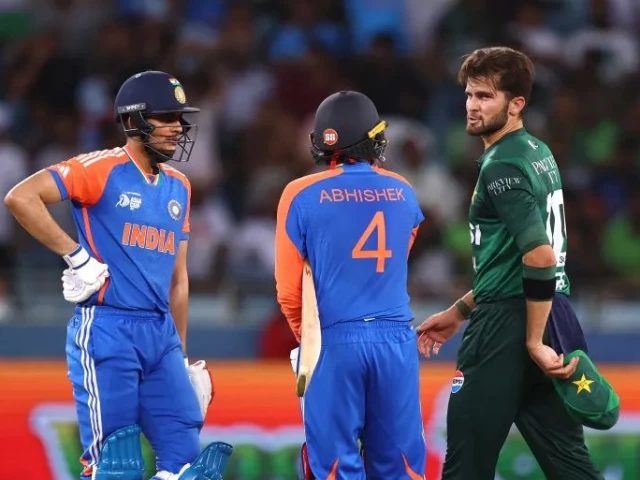
Pakistan’s Shaheen Shah Afridi, right, talks with India’s Abhishek Sharma and India’s Shubman Gill during the Asia Cup match between India and Pakistan at the Dubai International Stadium on September 21, 2025 in Dubai, United Arab Emirates. Photo: AFP
ISLAMABAD:
Pakistan will participate in the 2026 ICC Men’s T20 World Cup but will not take the field in the much-anticipated match against India on February 15, the government announced on Sunday, confirming a politically sensitive decision ahead of the global tournament.
The announcement on the government’s official X account comes after extensive deliberations between Pakistan Cricket Board (PCB) Chairman Mohsin Naqvi and Prime Minister Shehbaz Sharif. He did not elaborate on the reasons behind the boycott of the India party.
“The Government of the Islamic Republic of Pakistan grants approval to the Pakistan Cricket Team to participate in the ICC World T20 2026, however, the Pakistan Cricket Team will not take the field in the match scheduled for February 15, 2026 against India,” the statement said.
The announcement also did not clarify the implications if both Pakistan and India advance to the knockout stage and have to play each other, leaving the organizers and broadcasters in a state of uncertainty.
Observers noted that despite withdrawing from the match against India (and losing match points), Pakistan’s participation in the rest of the tournament indicates a calibrated approach, avoiding a full boycott while also asserting a political stance.
Experts said boycotting India’s match reflects both long-standing geopolitical tensions and recent developments in the organization of the tournament, which will be co-hosted by India and Sri Lanka from February 7 to March 8, 2026.
The mega event is already under pressure following the replacement of Bangladesh by Scotland in the competition. Bangladesh had requested a change of venue for its matches from India to Sri Lanka, citing security concerns.
However, the International Cricket Council (ICC) rejected the request, prompting Pakistan to express solidarity with Dhaka. Bangladesh’s withdrawal and Scotland’s inclusion intensified the debate over governance, fairness and security arrangements in international cricket.
Pakistan’s T20 World Cup campaign will now begin against Netherlands on February 7 in Colombo, followed by matches against the United States on February 10 and Namibia on February 18.
The cricket rivalry between India and Pakistan has historically been the sport’s main event. Their fixtures are traditionally the ICC’s most commercially important, and Pakistan’s refusal to play in this tournament could have both financial and competitive ramifications.
Analysts warn that the ICC may need to review point allocation, scheduling or even contingency plans for knockout stage scenarios should the two sides meet later in the tournament.
Since 2012, India has refused to play bilaterally with Pakistan. The two sides now face each other only in multinational events. Pakistan last toured India for the 2016 T20 World Cup and a three-match ODI series in 2012, while India have not toured Pakistan since 2008.
The most recent Asia Cup, held in 2025, further illustrated the tensions: India defeated Pakistan in three matches, including the final, but rejected the usual handshakes and trophy presentations.
To accommodate political sensitivities, the ICC approved a hybrid model for matches between India and Pakistan, stipulating that matches hosted by either country during the 2024-2027 rights cycle would be played at neutral venues.
This agreement applies to the Men’s Champions Trophy in Pakistan, Women’s ODI World Cup in India, Men’s T20 World Cup 2026 and Women’s T20 World Cup 2028 in Pakistan. For the current tournament, Pakistan’s matches are shifted to Sri Lanka.
The decision to boycott the match against India was influenced by Pakistan’s broader protest against inequalities in ICC decisions, particularly regarding Bangladesh. PCB president Mohsin Naqvi criticized the governing body’s handling of the hosting dispute and Bangladesh’s elimination from the tournament.
Financial considerations are important. The India-Pakistan match is the highest-revenue game of the tournament, and Pakistan’s withdrawal could result in loss of points as well as loss of commercial revenue.
ICC response
The ICC issued a statement saying Pakistan’s decision to selectively participate in the World Cup “is difficult to reconcile with the fundamental premise of a global sporting event”, noting that it awaits formal communication from the PCB.
“Tournaments are based on sporting integrity, competitiveness, consistency and fairness. Selective participation undermines the spirit and sanctity of the competitions,” he said, urging the PCB to consider the long-term implications for cricket in Pakistan and its role in the global cricket ecosystem.
“While the ICC respects the role of governments in matters of national policy, this decision does not benefit the global game or the well-being of fans around the world, including millions in Pakistan,” the governing body added.
The ICC emphasized that the successful conduct of the T20 World Cup is a shared responsibility of all member boards. The ICC encouraged a mutually acceptable resolution that protects the interests of all interested parties.
Meanwhile, Pakistan’s squad, announced in late January, remains unchanged for the tournament and players are preparing for matches in Colombo. The Group A schedule includes the Netherlands, the United States and Namibia, with the top two teams advancing to the Super Eight stage.
PCB and government sources highlight that team preparation and participation in these matches remain a priority, with the hope of a strong campaign and a potential fight for the title.
The tournament, which features 20 teams and will be held from February 7 to March 8, is co-hosted by India and Sri Lanka for the second time, following similar agreements in 2016 and 2012. Previous winners include India (2007, 2024), England (2010, 2022), Pakistan (2009), Sri Lanka (2014) and Australia (2021).
(WITH CONTRIBUTIONS FROM AGENCIES)


