
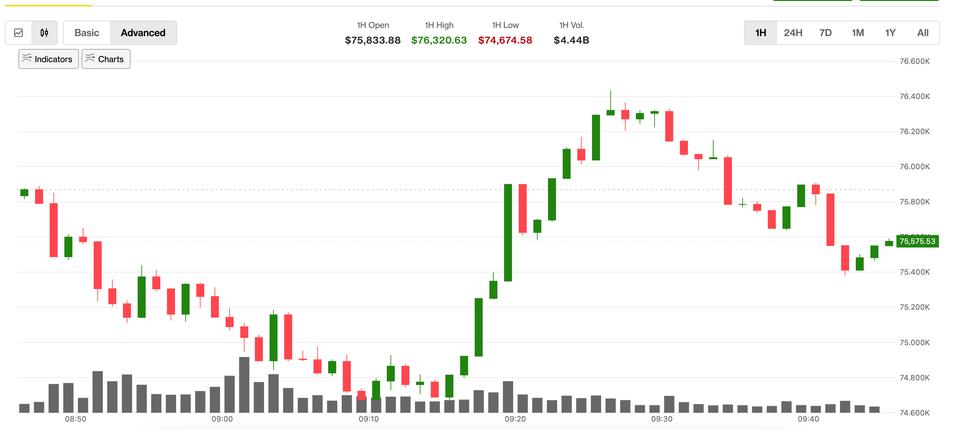
bitcoin traded back above $76,000 after a brief break of support, where it tested $74,000, highlighting the fragile balance between dip buyers and forced sellers in a market still short on “depth.”
The rapid V-shaped movement arose from order book dynamics where liquidity has dried up, allowing buy/sell trades to have a huge impact on the current market rate. This shallow market depth allowed a relatively small wave of selling to break support at $75,000 and trigger waves of leverage, but equally shallow bids allowed dip buyers and short covering orders to push prices up just as quickly.
Meanwhile, China is providing context but not acceleration. A private manufacturing survey in January showed factory activity moving toward a slight expansion, while the official indicator fell to a contraction, underscoring the uneven momentum in the world’s second-largest economy.
Beijing’s strict yuan policy means the country’s influence over bitcoin passes less through direct capital flows and more through global dollar liquidity cycles. Slightly better factory data may ease recession fears at the margins, but without an increase in monetary volatility or stimulus-driven liquidity, it theoretically acts more as a background stabilizer than a catalyst for crypto markets.
The weekend trading window added another layer to BTC’s fragility. With traditional markets closed and large institutional desks largely idle, order books tend to shrink further, reducing the amount of capital needed to drive prices through key technical levels.
Under such conditions, bitcoin often behaves less like a macro asset and more like a leveraged derivative of its own positioning, where funding imbalances and pooled stop orders can dictate direction for hours at a time.
For now, the rally above $70,000 suggests that the sell-off worked more like a leverage reset than a structural price revision.
Depth remains shallow compared to earlier in the cycle, indicating that both bearish wicks and bullish pressures may extend further than the fundamentals alone would justify.
Until deeper liquidity returns or macroeconomic factors such as dollar strength and real yields shift more strongly, bitcoin price action will likely continue to be driven by market positioning and sentiment rather than decisive economic catalysts.


