
The three-day festival marking the arrival of spring will begin in Lahore on Friday.
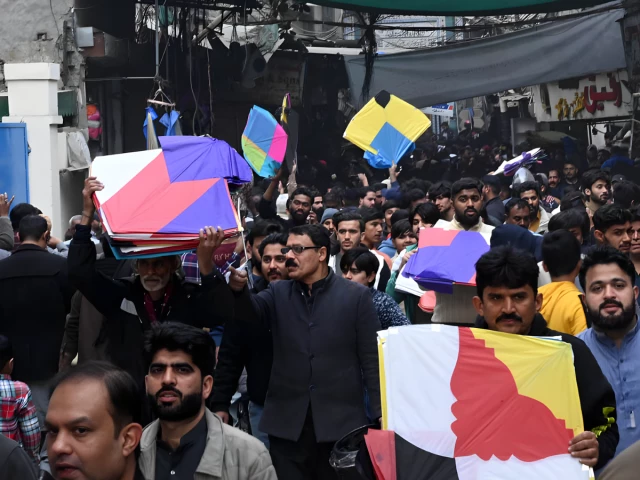
A large number of people buy kites on the occasion of the upcoming Basant festival in the provincial capital. PHOTO: APP
On a cold and misty morning, hundreds of kite-flying enthusiasts lined up at Mochi Gate in the walled city of Lahore, waiting for their turn to buy kites ahead of this week’s Basant festival, which returns after a year-long hiatus.
Hundreds of people swarmed the adjacent streets as kite sales began at some 300 designated locations and vendors throughout the city.
A frenetic energy surged through the crowd as everyone fought for a kite, and every time a lucky few managed to catch one, the air was filled with jubilant cheers and applause.
The three-day festival, traditionally celebrated with the arrival of spring, will begin on Friday.
“My friends and I reached here six hours before the shop opened,” said Kashif Shah, a kite flying enthusiast. anadolu.
“We have waited years for this moment and to see the skies of Lahore full of comets again.”
Shah hosted a party on the rooftop of his house on the first day of the festival.
Old Lahore, or the Walled City, is the epicenter of Basant, where residents even rent out their rooftops to fly kites.
Meanwhile, in the north, or what some call the new Lahore, home to luxury towns and dazzling skyscrapers, several streets and squares have been decorated with elegant lights for the festival.
Giant billboards and models have been placed at various points to highlight the festival’s theme: cultural revival with responsibility.
“I am seeing this kind of festival after a long time. It reminds me of old days when Basant was actually celebrated,” said Javed Malik, another kite lover, in his 60s.
“It will also be a good opportunity for Generation Z to learn about Basant, which was once an integral part of Lahore’s culture.”
Security restrictions to avoid victims.
Kite flying is the centerpiece of Basant, a festival traditionally celebrated in Indian and Pakistani Punjab to welcome spring.
Music, barbecue and traditional dhol, or drumming, rhythms were also highlights of the event that began in the evening and continued throughout the day.
The festival, however, suffered a series of bans over the past two decades due to deaths caused by sharp glass or metal-coated strings used to release kites during competitive kite fights.
The double temptation of money and praise drives children and young people to run after wayward kites, which sometimes turns out to be a dangerous pursuit.
In addition to fatal road accidents and stampedes during the race, there have been bloody clashes between groups demanding kite landing rights.
Basant was first banned in Pakistan in 2007 following multiple deaths and injuries caused by kite strings.
The ban was briefly lifted in 2018, but was immediately reimposed after dozens of victims.
However, successive governments did not fully implement the ban, leading police to pursue and arrest violators.
This year, Punjab Chief Minister Maryam Nawaz allowed the festival to be celebrated only in Lahore.
The provincial government has issued a series of restrictions to prevent casualties, including a complete ban on unsafe ropes and the use of safety bars on motorcycles, while each kite and rope will have a unique QR code.
There will also be a complete ban on displaying weapons or conducting aerial shooting. A violator could be sent to prison for up to five years or face a fine of up to 5 million rupees.
Rising prices dampen enthusiasm
Basant was taken to its zenith by former military ruler General Pervez Musharraf, who turned it into an international event in the early 2000s.
It promoted Lahore as a cultural capital and was popular to the extent that citizens rented the rooftops of their houses for events throughout the month.
The more kites you lower, the more praise you receive from your colleagues, and revelers often buy the “looted” kites at a good price.
However, skyrocketing kite and string prices have dampened enthusiasm among many.
Kite prices fluctuate between 400 and 700 rupees, while a “pinna” (ball of kite thread) sells for between 12,000 and 16,000 rupees.
“The kite prices are fair, but the cost of the auricle is unbearable. We can’t afford that,” said Rana Saim, a member of a local kite flying group. anadolu.
Owners, he added, also demand between Rs 200,000 and Rs 1 million to rent their rooftops, depending on the size and location.
“The government must control the prices, otherwise low and middle income groups will not be able to enjoy the festival,” Saim said.
Entertainment and economy
For Zohaib Saleem Butt, a television host and writer who frequently writes about Lahore’s culture, Basant has long been the city’s identity.
In addition to entertainment, he said, it also generates enormous economic activity, which benefits various segments of society.
“Kite sellers, caterers, tailors and others have huge orders for Basant. Dhol players are booked and hotels are making arrangements for additional guests,” Butt said. anadolu.
Yellow roses and marigolds, which symbolize the arrival of spring, are also in high demand.
Some, however, remain skeptical and warn that kite flying can cause damage again.
“No festival or economy is more important than human lives. It is a blood sport that has killed hundreds of people, including children and women,” said Qaiser Sharif, a Lahore-based writer and political activist.
talking to anadoluSharif said stray kite strings have killed and injured several people across Punjab in recent months.
“Governments have failed to prevent deaths and injuries with their so-called restrictions in the past, so how are they going to do it now?” said.
It will be impossible for the government to implement safety protocols in a city taller than 14 metres, Sharif argued, suggesting that kite flying could be allowed in open terrain to avoid casualties.
“If there are deaths or injuries, Maryam Nawaz should be held responsible,” he said.
Agreeing with the arrests, Butt urged revelers to strictly follow safety protocols to avoid any incident that could lead to another ban.
CM Maryam, however, insists that her government’s preventive actions and citizens’ cooperation will help restore Lahore’s cultural image. “Let us celebrate a safe Basant,” he said in his message.


