
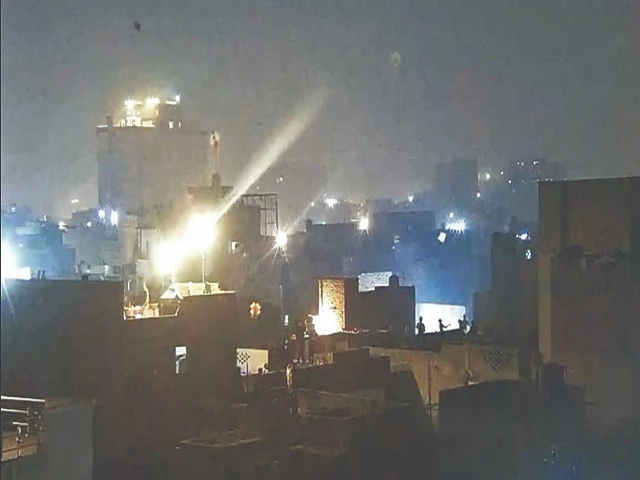
People on their rooftops enjoy flying kites at Bhati Gate in Lahore. PHOTO: SCREEN CAPTURE/X/MARYAMNSHARIF
LAHORE:
The provincial capital did not sleep to welcome Basant on Thursday, as fireworks burst into the night sky past midnight, kites soared from rooftops and music floated through the Walled City and beyond in the city long known as the home of ‘patang-baaz’ (instinct kite flyers), marking the return of the festival after nearly two decades.
At Liberty Chowk, crowds gathered with pent-up anticipation and burst into cheers as the city went into celebration.
With the three-day festival officially beginning today (February 6), Lahore has entered full festive mode, its skyline pierced by kites and its streets bathed in colour, anticipation and tightly managed order.
Major intersections, underpasses and public spaces sparkled with bunting and oversized kite installations, while the rooftops inside the old city bristled with preparation and promise.
“These colors spread across the skies of Lahore are a reflection of our vitality and ancient culture,” Punjab Chief Minister Maryam Nawaz wrote on social media as the clock struck 12.
“Basant is not just a festival; it is part of the tradition of Punjab. Wishing the citizens a day full of joy and celebration.”
Markets traditionally synonymous with Basant, such as Mochi Gate, Delhi Gate, Shah Alam Market and Anarkali, remained packed late into the night as shoppers stocked up on kites, reels, fairy lights and festive decorations.
Traders said enthusiasm grew steadily as there was cautious curiosity on February 1 and unbridled enthusiasm followed once people realized the resurgence was real.
Meanwhile, Liberty Chowk emerged as the symbolic center of the festivities, transformed into a civic celebration space adorned with kites and giant lights. Families, young couples and groups of friends gathered to participate.
Enthusiasts say the fundamental change is that this is the first Basant that is neither whispered nor hidden, but sanctioned, visible and public with confidence.
“Joy has returned as permission. People want to believe in good and despite the increase in prices, Lahoris did not hesitate to participate,” said a citizen of Johar Town. “At least now there’s entertainment.”
Similarly, Basant is not just limited to the rooftops but has returned to public life.
Earlier, the sense of openness deepened on Thursday when Maryam Nawaz Sharif made a surprise visit to Liberty Chowk and then Mochi Gate, making her way through the crowd and interacting directly with citizens. He spoke to residents, posed for selfies and ordered his security staff to step aside so he could move freely among the people.
The children, dressed in festive yellow, especially attracted attention. The prime minister was seen shaking hands with a little girl, exchanging greetings with others and blessing a baby carried by a citizen.
Residents praised his performance, some commented on the political significance of Basant’s return and others expressed hope that similar scenes would soon unfold in other cities.
During the visit, he addressed safety concerns by stopping a motorcyclist riding without a safety bar, explaining that the measure was intended to protect the public and could be installed free of charge at designated campsites.
He clarified that motorcycles were not banned during Basant, but warned that vehicles without safety bars would be confiscated. “The people of Lahore are celebrating and their happiness is a source of satisfaction for me,” he said, noting that festivities had returned to the city after a long hiatus.
‘Bo-kata’
Rooftops were adorned with fairy lights, colorful bunting and makeshift lanterns, while powerful light bulbs were installed to keep the kite battles alive well into the night. Grills were fired up, playlists were dusted off, and family members were invited, turning rooftops into temporary living rooms suspended above the city.
Women prepared traditional yellow and white costumes, often paired with floral jewelry, while children and elders alike sorted kites and reels with practiced familiarity. After the Maghreb prayers, the lights were switched on throughout the interior of Lahore, turning entire neighborhoods into luminous terraces stacked on top of each other.
For many Lahoris, Basant is not just a festival but a family ritual. The shouting of ‘bo-kata’, the pulling of a rope and the sound of folk songs floating over rooftops are long-established practices, passed down over time despite interruptions.
However, for Generation Z, this Basant has a different meaning. Many are celebrating for the first time, entering a culture they inherited through stories told by parents and older siblings. For them, the emotion is twofold: it combines discovery with an inherited nostalgia.
Meanwhile, beauty salons across the city reported a rush of customers, with women saying they intended to celebrate Basant in traditional style after years of absence. Clothing outlets and accessories stores saw strong demand for bright yellows, greens and reds, as Lahore leaned unapologetically into color.
“Overwhelmingly positive”
According to Malik Faizan Ahmed, legal advisor at the Kite Flying Association, the revival of Basant has earned the government considerable political goodwill, reducing the likelihood of future bans. “The public response has been overwhelmingly positive and it now appears difficult for any future government to reverse this decision,” he said.
He said public appreciation had been so strong that the festival now seemed to have regained social legitimacy.
He recalled that kite flying equipment began selling as soon as the clock struck midnight on February 1, while sales increased dramatically on the third day, once people were convinced that the resurgence was genuine.
He added that strict security and compliance measures had been implemented, and expressed confidence that the three-day celebrations would pass without incident.
“God willing, the three days of Basant will pass safely and peacefully,” he said.
Administratively, the festival takes place under a strict security framework. The Punjab Home Department has confirmed that ‘Safe Basant’ will be observed from February 6 to 8, and Section 144 will be enforced to maintain public order. The use of metal and nylon ropes has been banned, safety bars have been made mandatory for motorcycles and emergency services have been put on high alert.
More than 10,000 police officers have been deployed throughout the city, with checkpoints, surveillance and zero tolerance for violations.
Officials insist that the measures are not intended to stop the celebration, but rather to ensure that it lasts.


