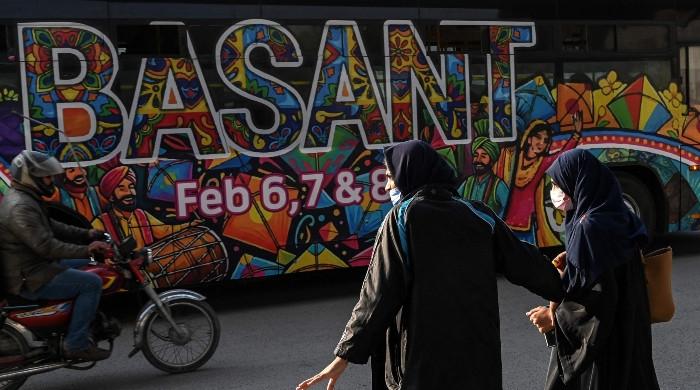
After almost two decades, the Punjab government’s decision to allow Basant celebrations and declare local holidays has sparked excitement among the public. Reports suggest that not only residents from across the country but also Pakistanis living abroad travel to Lahore to participate in the festivities. According to media reports, kites and strings worth approximately Rs 3.4 billion have already been sold in Lahore.
In ancient Hindu philosophy, the concept of Ritu Chakra is considered one of the most comprehensive and reliable frameworks for understanding the natural relationship between time and seasons. According to this system, Vasant (spring) is known as Ritu Raj (the king of seasons), which symbolizes the return of life and the awakening of the earth. It also marks the season of sowing seeds, preparing for new harvests and listening to the joyous song of birds.
In the ancient Rig Veda, Vasant is described as a joyful and sacred phase of natural transformation. In the Hindu Vikrami calendar, the central Basant day is Vasant Panchami, observed annually on the fifth day of the month of Magh, which usually falls in January or February according to the Gregorian calendar. This day is dedicated to Goddess Saraswati, the deity of knowledge, wisdom, art and music.
Basant, in my opinion, is one of the notable festivals of our region that, over time, evolved in the Snent into a vibrant socio-cultural celebration. Historically, it enjoyed royal patronage in the Delhi Sultanate. Amir Khusrau, renowned Indo-Persian singer, musician, court poet and Sufi scholar, is said to have celebrated Basant with yellow clothes, yellow flowers and Sufi melodies to please Hazrat Nizamuddin Auliya, symbolizing spiritual joy beyond religious boundaries.
Similarly, several Mughal emperors, including Akbar the Great, Jahangir and Shah Jahan, decorated their courts in yellow to mark the occasion. The flying of kites from the roofs of the royal palace to welcome spring later spread among the people.
During British rule, Basant continued to be celebrated enthusiastically in several cities including Lahore, Delhi and Agra. During the festival, Hindus, Muslims, Sikhs, Christians and Parsis dressed in yellow and celebrated together. The rooftops were filled with music and food and guests traveled from far and wide to join the festivities. Even after partition, Basant continued to be zealously celebrated as a symbol of religious harmony, social cohesion and collective joy.
The people of Lahore, known as Zinda Dilan-e-Lahore, have always been at the forefront of Basant celebrations. In areas like the Walled City, Anarkali, Shah Alami and around Data Darbar, Basant was never a one-day event but rather a multi-day event.
Unfortunately, at the turn of the century, certain antisocial elements stained this peaceful festival with innocent blood. The use of metallic and chemically treated ropes caused serious casualties, especially among motorcyclists. Such tragedies were a result of irresponsible practices that eventually forced the government to impose a complete ban on Basant.
Some extremist voices today oppose Basant by trying to give him a purely religious label. They overlook the fact that basant and kite flying have never been the exclusive domain of any religion or sect in our region. Although the concept of Vasant emerged in the ancient Vedic era, it was more cosmic and natural. Spring carries a universal message of hope, not for the followers of a particular belief, but for all of humanity. This universal foundation transformed Basant into an invaluable element of the shared culture of the subcontinent, fostering tolerance, pluralism and interfaith harmony.
Today we have a golden opportunity to responsibly revive Basant in its true historical, cultural and social context. Under no circumstances should anti-social elements be allowed to exploit the festival or spread their hate agenda. If we succeed, Lahore can emerge not only as the cultural capital of Pakistan but also as a cultural hub for the entire region. More importantly, Basant can help project the gentle image of our dear country as a peace-loving and human-friendly nation on the global stage.
The writer is a member of the National Assembly and patron-in-chief of the Pakistan Hindu Council. He tweets/posts @RVankwani
Disclaimer: The views expressed in this article are those of the writer and do not necessarily reflect the editorial policy of PakGazette.tv.
Originally published in The News