
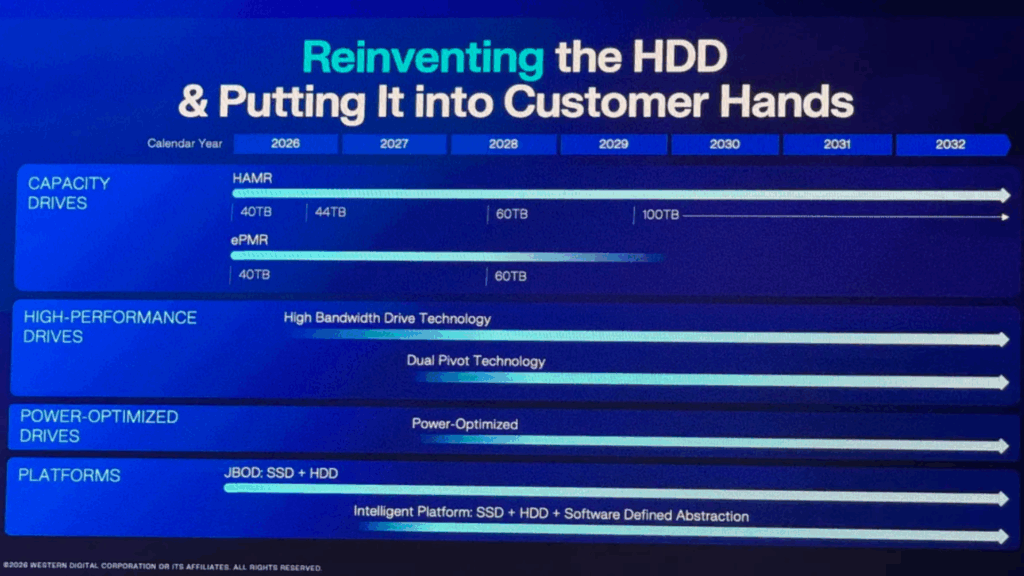
- WD has 40TB hard drives already in the qualification process with hyperscale customers
- UltraSMR and ePMR enable higher platter density without changing disk form factors
- Dual Pivot adds a second actuator without sacrificing usable drive capacity
Western Digital has revealed plans to scale hard drives well beyond current commercial limits, starting with a 40TB model that is already in customer qualification.
The company says its 40TB UltraSMR ePMR drive is already in the hands of hyperscale customers, with volume production expected in the second half of 2026.
This 40 TB model uses UltraSMR and ePMR technologies, which allow more data to be written per platter while maintaining the reliability levels expected in large data centers.
Dual Pivot: a key technology for scaling hard drives
Central to WD’s roadmap is Dual Pivot technology, which introduces a second independently controlled actuator within the same 3.5-inch enclosure.
Unlike previous dual-actuator approaches, this design avoids capacity trade-offs and requires no software modifications by the customer.
By reducing the space between drives and allowing additional platters per drive, WD says the design supports higher capacity and better performance.
When combined with high-bandwidth drive technology, sequential input and output performance could scale up to 4 times current levels.
High-bandwidth drive technology enables simultaneous reading and writing to multiple heads and tracks, increasing performance without increasing power consumption.
This approach supports WD’s claim that it can scale to 100TB hard drives by 2029 without forcing customers to replace existing infrastructure or shift workloads entirely to SSDs.
According to WD’s roadmap, after shipping the 40TB ePMR drives this year, it will begin working on 40TB and 44TB HAMR-based drives.
In 2027, ePMR capacity remains at 40 TB while HAMR increases further, but by 2028, ePMR increases to 60 TB and HAMR reaches the same capacity as it moves towards broader production.
Next year, 2029, HAMR-based drives will reach 100TB, and that capacity will extend to 2030 and beyond.
As capacities increase, power consumption becomes a limiting factor for data centers deploying thousands of units.
WD has recognized this by developing power-optimized hard drives that trade some random input and output capacity for higher density and lower power usage.
These units focus on training and inference workloads and reduce power usage by approximately 20% while maintaining sub-second access times.
It is aimed at large data sets that need to be accessed quickly, but are too expensive to store entirely on SSD.
WD expects these power-optimized drives to enter customer ratings in 2027, aligning with the timeline for higher-capacity models beyond 40TB.
Whether these technologies can scale smoothly to 100TB while maintaining reliability and cost advantages will only become clear once broader deployments begin.
“Over the past year, WD has remained focused on executing and accelerating innovation, allowing us to reimagine the hard drive to meet AI requirements,” said Irving Tan, CEO of WD.
“Today, we are showcasing innovation that reflects our deep connection with our customers and how we meet demand for capacity, scale, quality, improved performance and ease of technology adoption.”
Follow TechRadar on Google News and add us as a preferred source to receive news, reviews and opinions from our experts in your feeds. Be sure to click the Follow button!
And of course you can also follow TechRadar on TikTok for news, reviews, unboxings in video form and receive regular updates from us on WhatsApp also.


