
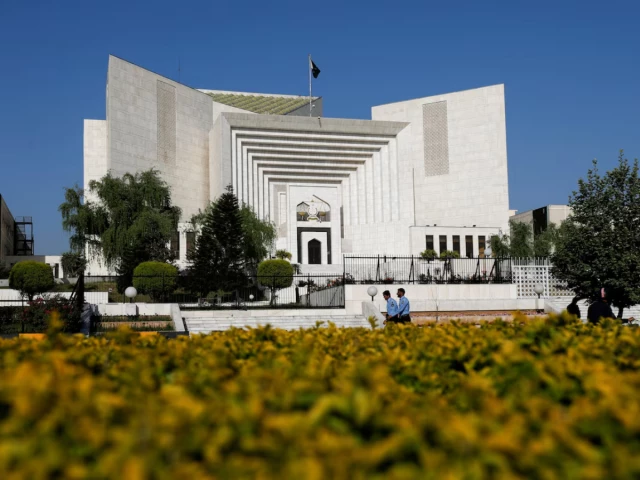
Police officers walk past Pakistan’s Supreme Court building, in Islamabad, Pakistan, April 6, 2022. REUTERS
ISLAMABAD:
After months of restrictions on legal access, Pakistan Tehreek-e-Insaf (PTI) finally managed to force the Supreme Court to intervene, resulting in a meeting between jailed PTI founder Imran Khan and his senior lawyer in Adiala jail.
Following the SC’s intervention, senior advocate Salman Safdar met Imran Khan on Tuesday inside Adiala jail. The meeting lasted more than three hours and marked the first such engagement after a prolonged ban on consultations between the jailed PTI leader and his legal team.
Speaking briefly to reporters after the meeting, Safdar said the interaction was carried out in accordance with the SC’s directions. He added that details of the meeting will be shared in a report to be submitted to the court on Wednesday (today).
The SC had appointed Safdar as a “friend of the court” to visit the Adiala jail and ascertain the living conditions of Imran Khan. However, Safdar clarified that Imran’s health was stable.
Sources said that while Imran’s morale remained high, he was deeply concerned about restrictions on meetings with his family and lawyers. It was also learned that his wife, Bushra Bibi, had conveyed a message to the PTI leaders, urging them to focus solely on demanding permission for Imran’s doctors to examine him.
The development comes amid a changing political landscape and followed the SC’s decision to list 13 cases related to Imran Khan for hearing earlier this week, a move that surprised many, including PTI’s own legal team.
A division bench of the SC, headed by Chief Justice of Pakistan Yahya Afridi and comprising Justice Shahid Bilal Hassan, heard the matter. While hearing a case pending for almost three years, the court sought a fresh report from Pakistan’s Attorney General on Imran Khan’s living conditions in prison.
Pursuant to the court’s order, Attorney General Mansoor Awan appeared before the court on Tuesday and informed it that an extensive report detailing Imran Khan’s living conditions had already been submitted for consideration by the court in 2023, and that the same report had now been submitted again.
After reviewing the report, the court observed that it related to the period when Imran Khan was confined in Attock District Jail during 2023.
“In order to judicially close the order passed by this court, it is considered appropriate for the Superintendent of Rawalpindi Central Prison to submit a report on the present ‘living conditions of the petitioner in prison’,” the order said.
The order further stated that advocate Salman Safdar had been appointed friend of the court to visit the petitioner in Rawalpindi Central Prison and submit a written report on the “living conditions of the petitioner in the jail”.
“In this regard, the Attorney General of Pakistan undertakes that Advocate Salman Safdar, ASC, is given full access to meet the petitioner and inspect his living conditions.”
The court also directed Safdar to submit his report for reading in chambers on February 11, while adjourning the hearing till Thursday (February 12).
The SC’s intervention has since sparked a debate within political and legal circles over the timing and implications of the move.
Several analysts maintain that such intervention could not have taken place without the acquiescence of the executive, noting that the government retained the option of challenging the order before the Federal Constitutional Court (FCC) on jurisdictional grounds.
Former PTI advisor Chaudhry Faisal Hussain described the events surrounding Safdar’s meeting with Imran Khan as a positive step and “a kind of breaking of the ice”.
“After the attacks in several cities of Balochistan, the distance between the PTI and the powerful sections has definitely narrowed. Chief Minister Sohail Khan Afridi’s meeting with Prime Minister Shahbaz Sharif, followed by a high committee meeting and lackluster approach towards the February 8 agitation call by the current PTI leaders, reflects a lot,” he said.
Hussain added that there were no visible preparations in the constituencies of senior PTI leaders in Punjab before February 8.
“None of the preparations witnessed in the constituencies of Punjab’s top leaders, MPs and ticket holders created a fever by engaging in door-to-door campaigning on February 8. Even Mahmood Khan Achakzai himself preferred to attend the Asma Jahangir Conference in Lahore on February 8 after calling for a strike.”
However, he said there were chances of a meeting between Mahmood Khan Achakzai and Imran Khan before or after Achakzai’s meeting with the prime minister.
“These events are not without rhyme or reason, so as far as Imran’s release is concerned we will have to wait. During Ramzan the family reunion may also resume. Since the PTI has not given any extension of the agitation,” he added.
A section of lawyers believe that while the Supreme Court proceedings do not directly challenge the current regime, Chief Justice Afridi may have been forced to intervene amid growing concerns over the judiciary’s alleged inability to ensure fair treatment to Imran Khan.
There are also reports that PTI lawyers met privately with Chief Justice Afridi to seek fair treatment for the jailed leader.
Earlier, on January 30, PTI staged a protest outside the SC premises demanding access to Imran Khan, particularly for meetings with his personal doctors. PTI General Secretary Salman Akram Raja had also met the then Chief Justice Isa in this regard.
In a statement, the SC said that during the interaction, concerns were conveyed over access to the jailed PTI leader, including access to family members and medical professionals.
“As the matter raised did not directly relate to a proceeding pending before the Supreme Court, the concerns were referred to the relevant executive authorities for consideration in accordance with the law, after which the meeting was peacefully dispersed.”
The statement added that in the absence of response for a week, a delegation including opposition leaders from the Senate and National Assembly again approached the Supreme Court on February 6, 2026 and submitted a signed memorandum which was formally received by the registrar.
He further said that the SC had also issued Standard Operating Procedures (SOPs) to address such situations in future.
“The SOPs emphasize ensuring accessibility, facilitation and provision of necessary services, including emergency medical coverage, without compromising institutional decorum, judicial functions or access rights of other litigants.”


