
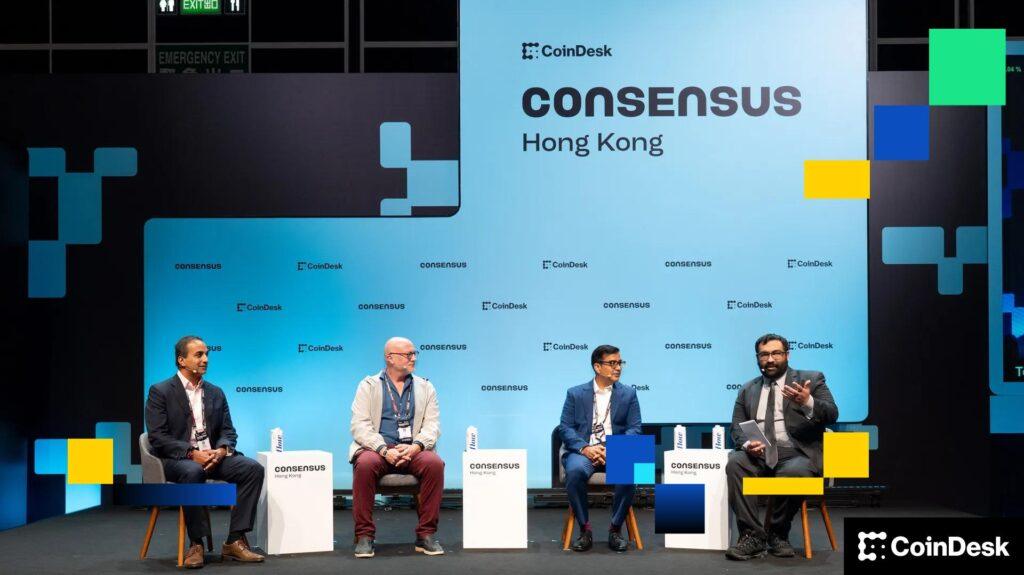
Tokenized money market funds and digital bank deposits are moving from experimental pilots to early-stage financial infrastructure, executives from Franklin Templeton, SWIFT and Ledger told Consensus Hong Kong 2026 on Wednesday.
“Taking existing traditional financial instruments, making them cheaper and better faster, putting them natively on-chain,” said Chetan Karkhanis of Franklin Templeton.
The asset manager has focused on tokenizing money market funds, a roughly $10 trillion global asset class made up of Treasuries and short-term repos. By issuing fund shares natively on-chain and making them accessible through self-custodial wallets or exchanges, Franklin Templeton aims to provide 24/7 liquidity and reduce operating costs, such as shareholder servicing fees, which can range from five to 15 basis points.
On the banking side, SWIFT is exploring how tokenized deposits (digital representations of bank liabilities) could modernize payments without disrupting balance sheets.
“There are fiat balances that banks have on their balance sheet… but as they move towards the new digital form of value, tokenized deposits represent them on-chain,” said Devendra Verma of SWIFT’s digital assets unit.
SWIFT, which connects more than 11,500 institutions worldwide, is building a blockchain-based orchestration layer designed to interoperate with central bank digital currencies (CBDCs), tokenized deposits and other regulated digital assets. While 75% of SWIFT payments already reach beneficiaries within 10 minutes, Verma said the ambition is to eliminate cut-off times and delays during holidays in favor of “24/7 availability at all times”.
However, adoption remains modest relative to global capital markets. Karkhanis noted that roughly $300 billion in stablecoins and about $40 billion in tokenized Treasuries and other real-world assets are now on-chain — “a drop in the bucket” compared to more than $200 trillion in global wealth.
Regulation is a key limitation. “Regulatory clarity is very, very important,” Verma said, noting the need for consistent standards around accounting, compliance and balance sheet treatment before institutions scale more aggressively.
Security and governance are another sticking point. “How do we do it securely? With trust, with confidence, is the key question,” said Ledger’s Jean-François Rochet, arguing that managing private keys and institutional controls remains a cultural and technical obstacle.
Despite cryptocurrencies’ origins in disintermediation, panelists said the future is likely hybrid. “You can have it both ways,” Karkhanis said, suggesting that decentralized access and traditional intermediaries will coexist. Some intermediaries may disappear, Rochet added, but those that remain will have to justify their role in a redesigned financial set.


