
No narrative can weaken the bond between the army and the people; Our only narrative is Pakistan, say security sources.
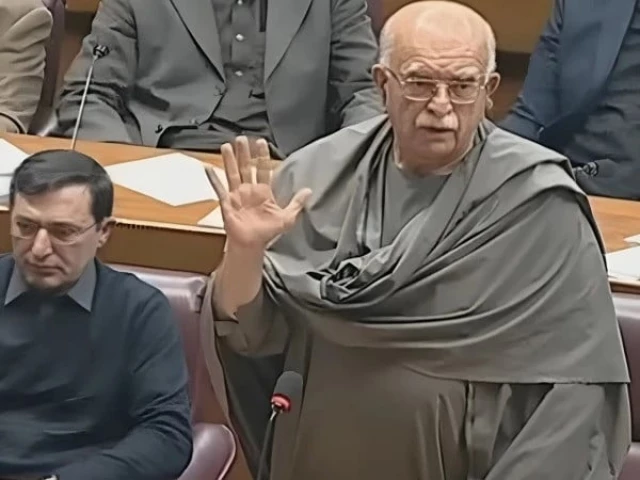
Mahmood Khan Achakzai delivers his first speech at the National Assembly as leader of the opposition on January 19, 2026. Screen recording
Security officials on Wednesday categorically rejected the military’s role in politics and called the opposition leader’s recent statement in the National Assembly (AN) against the armed forces “regrettable and based on falsehoods.” “The opposition leader’s recent statement against the Pakistan Army is very unfortunate. No narrative can weaken the bond between the army and the people. Our only narrative is Pakistan,” said a statement issued by security sources.
“The statement comes in response to remarks by Opposition Leader in the National Assembly Mahmood Khan Achakzai, who reportedly said that the army belongs to only four districts. Defending the statement, Defense Minister Khawaja Asif said: ‘While Mahmood Achakzai may maintain his views, he should not attack the military. The Pakistan Army is not the army of any province or district. Its character is national.'”
During a briefing in Lahore with media representatives, security officials emphasized that Pakistan’s fight against terrorism requires national unity and collective resolve beyond security forces alone. However, they stated that dialogue between political parties is their democratic right, but that the military has no role in politics.
Security sources added that the campaign against terrorism is not limited to the armed forces, the police or the Border Forces, but is a fight that involves the entire nation. They stressed that lasting success depends on the full implementation of the National Action Plan (NAP), which they described as the cornerstone of counter-terrorism efforts across the country.
Read more: Army is a national force, not of any district, Asif tells Achakzai
The sources maintained that India is behind what they called “sponsored terrorism” inside Pakistan, claiming that external support continues to fuel militant activities. They further claimed that the attacker involved in the recent Tralai Imambangah incident had received training in Afghanistan.
Security officials called for decisive action against internal and external elements involved in terrorism, urging Pakistanis to overcome political, ethnic, linguistic or sectarian divisions. “Regardless of political or religious affiliation, the nation must remain united against terrorism,” the sources said, adding that unity is essential to defeat all forms of extremism.
Referring to Balochistan, the officials stated that militant groups operating under the guise of narratives of deprivation are, in fact, enemies of the Baloch people and the development of the province. They said that the public of Balochistan is increasingly recognizing this reality.
The report also highlighted progress against smuggling networks, with sources noting that the illegal smuggling of between 15 and 20 million liters of Iranian gasoline and diesel per year (previously used to finance militant activities) has now been restricted.
Also read: Daesh-linked Afghan mastermind of Imambagah attack in Islamabad arrested
Good governance was described as a decisive factor in rooting out terrorism. Security officials added that the recent meetings in Khyber-Pakhtunkhwa (KP) aimed at addressing security challenges were encouraging, and reiterated that the NAP remains key to controlling terrorism in the province as well.
Drawing parallels with past national unity, security officials said Pakistan would defeat the terrorists just as it had united during “Marka-e-Haq” to overcome external threats.
They also cited outreach visits to educational institutions as proof that the public, especially the youth, strongly supports the Pakistan Army. The security officials concluded by stating that all legal and court-related matters must be decided by the judiciary strictly in accordance with the Constitution and the law.
Also read: UN Security Council report backs Pakistan’s claims of increased TTP attacks from Afghan soil
Pakistan is currently facing a wave of terrorism, and last week a suicide attack in Imambangah in Islamabad claimed the lives of 36 people. Furthermore, a series of coordinated terrorist attacks in Balochistan led to the death of 36 civilians, including women and children. In addition, 22 security and law enforcement personnel were also killed.
Security forces successfully concluded ‘Operation Radd-ul-Fitna-1’ in Balochistan, carrying out a series of intelligence-driven coordinated operations against Indian-sponsored terrorist elements. As a result of these well-coordinated engagements and subsequent clearance operations, 216 terrorists were killed, significantly degrading the leadership, command and control structures and operational capabilities of the terrorist networks.
Pakistan accuses Afghanistan and India of supporting terrorism
Pakistan has repeatedly pointed to an Afghanistan-India nexus behind terrorism in the country. The Interior Minister said earlier this week that the mastermind behind the attack was an Afghan national linked to Daesh.
In November 2024, Director General of Inter-Services Public Relations Lieutenant General Ahmed Sharif Chaudhry had issued a warning that the Afghan regime was a threat not only to Pakistan but to the entire region and the world, citing the abandonment of US military equipment worth $7.2 billion during the US withdrawal.
Lt. Gen. Chaudhry reiterated that the Afghan regime was harboring “non-state actors” that posed a threat to several countries in the region, and pointed to the Taliban’s failure to establish an inclusive state and government after 2021. He stressed that Pakistan’s problem was with the Afghan Taliban regime, not the Afghan people.
Read more: Afghan regime represents a threat to the region and the world: DG ISPR
After the conflict with India in May 2025, Field Marshal Asim Munir had said that Pakistan would never be coerced and that all hostile attempts to derail the country’s counter-terrorism efforts would be “completely defeated.”
In August last year, the annual report of the follow-up team to the UN’s 1988 Taliban sanctions committee said that the illegal terrorist groups – BLA, including its Majeed Brigade, and TTP – had “close coordination”.
The report said that regional relations remained fragile and that “there was a risk that terrorist groups would exploit these regional tensions.” He added that the TTP had approximately 6,000 fighters and continued to receive significant logistical and operational support from the de facto authorities (the Taliban).
“Some member states reported that the TTP maintained connections at a tactical level with ISIL-K or Daesh,” he said. “The TTP continued to carry out high-profile attacks in the region, some of which resulted in mass casualties,” the report added.
Also read: The breeding ground for terror
The UN Security Council report states that “some BLA attacks showed a high degree of complexity and brutality,” citing the Jaffar Express hijacking in Balochistan on March 11, 2025, in which 31 people were killed, including 21 hostages.
In 2023, a UN report also revealed that the illegal TTP had established a new base in KP in mid-2023. The report sheds light on the close links not only between the TTP and the Afghan Taliban but also with anti-Pakistan groups and Al Qaeda.
The report further revealed that some Taliban members had also joined the TTP, perceiving it as a religious obligation to provide support. Interlocutors reported that TTP members and their families regularly received aid packages from the Taliban.
Importantly, the UN report noted a significant increase in Afghan citizens in the ranks of the TTP. This supported Pakistan’s position that a growing number of Afghan nationals were involved in suicide attacks in the country.


