
- SSD concept without FTL transmits data sequentially with addresses assigned by the device
- StreamFast claims to reduce memory needs for large SSDs by a thousand times
- The design aims for cooler drives, lower power usage, and simpler high-capacity storage.
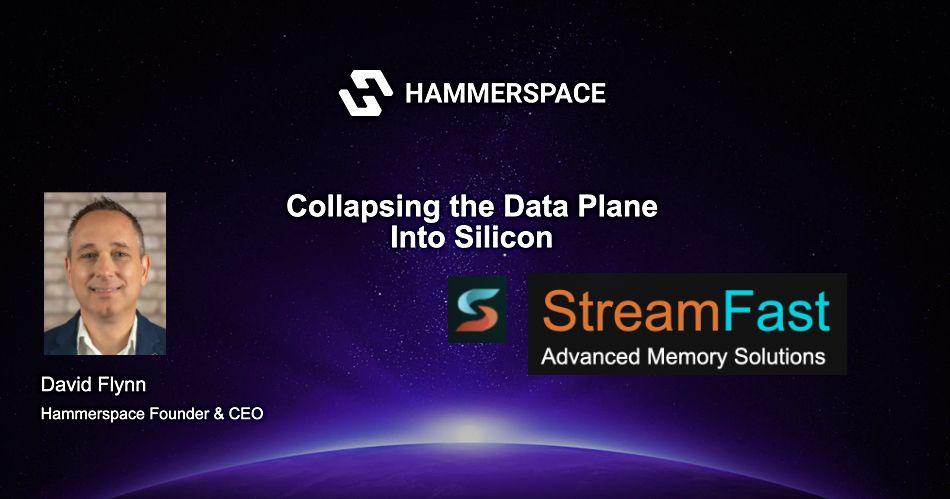
Hammerspace founder David Flynn is launching a new SSD architecture that eliminates Flash Translation Layer and its DRAM controller, replacing them with a file system-centric design called StreamFast.
According Blocks and filesThe concept is being developed under a new StreamFast business working with the Open Flash Platform group, while Hammerspace will continue to focus on its system-level software.
Flynn says the current SSD model burns memory and power because the controllers rely on an FTL stored in DRAM to track data locations.
The DRAM crisis
“You need one byte of RAM for every kilobyte of flash memory on the SSD,” Flynn said. Blocks and files. “Think about that. If you’re going to have a petabyte of flash on an SSD, that means you have to have a terabyte of DRAM with it.”
He ties those overheads to the broader DRAM crisis, where manufacturers are shifting capacity toward high-bandwidth memory for GPUs from companies like Nvidia and AMD.
The proposal is to remove the FTL completely and let the file system interact with flash directly.
“We need to get rid of the block abstraction and move to something that’s more native to flash,” says Flynn.
Instead, StreamFast uses sequential addresses assigned by the device. The SSD writes incoming data streams one after another and then returns those addresses to the host file system.
“The magic is that the device assigns sequential addresses to arbitrary strings of data that are transmitted to the device,” Flynn said.
Because writes are sequential, the host can replay the stream after a failure, rather than tracking each address in memory.
“With the StreamFast file system, it’s one byte of RAM for every megabyte of flash,” he said.
That’s a thousand-to-one improvement over the usual ratio. By Flynn’s own calculations, a 1PB SSD would need about 1GB of host memory instead of 1TB inside the drive.
Removing the FTL also cuts write amplification and reduces heat, since the controller’s DRAM often forms the thermal hotspot.
“This simplifies the construction of the SSD to the point that it is much more reliable,” Flynn said.
The company is working with partners across the flash ecosystem, although when Blocks and files mentioned SK Hynix, Flynn was cautious.
“I can’t talk about specific details of our partnerships yet, but stay tuned. And I was in Korea just a couple of weeks ago,” he said.
Flynn also says that cooler, simpler drives could adapt to power-limited environments, including sealed or even orbital data centers.
Follow TechRadar on Google News and add us as a preferred source to receive news, reviews and opinions from our experts in your feeds. Be sure to click the Follow button!
And of course you can also follow TechRadar on TikTok for news, reviews, unboxings in video form and receive regular updates from us on WhatsApp also.


