
.
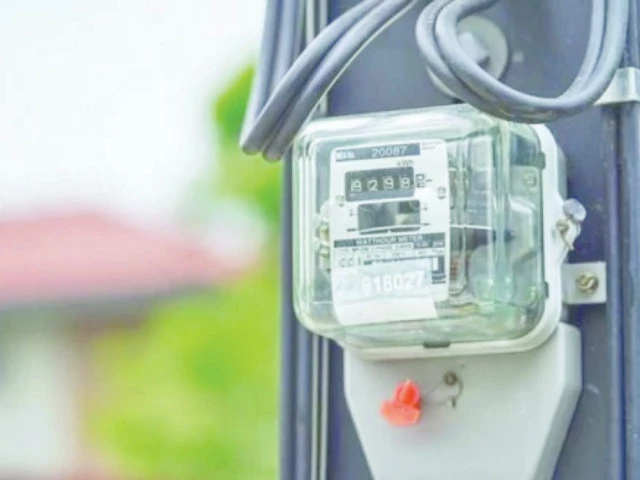
Nepra officials warned Gepco about illegally installing Advanced Metering Infrastructure (AMI) on small meters. They said the company was installing AMI without regulator approval and even without data backup. Photo: archive
ISLAMABAD:
The National Electric Power Regulatory Authority (Nepra) has allowed the federal government to impose fixed charges of up to Rs 350 per month on domestic consumers (including protected users) consuming up to 300 units, and increase existing fixed charges by up to 100 per cent for consumers using up to 600 units.
At the same time, the regulator approved reductions of up to Rs 4.58 per unit for various industrial categories and up to Rs 1.53 per unit for certain domestic consumers.
In its decision on the federal government’s motion for tariff rationalization for
The authority noted that the current tariff design is largely volumetric, with more than 93 percent of system costs recovered through unit charges, while only 7 percent are collected as fixed charges. Instead, major cost components (including generation capacity payments and NTDC/HVDC charges) are fixed and payable regardless of electricity consumption, creating a mismatch between cost recovery and spending.
Nepra noted that the National Electricity Plan provides for a gradual shift towards a tariff structure based on fixed costs, in which fixed charges represent at least 20 percent of total fixed costs. The rapid expansion of rooftop solar and other renewable sources has reduced demand on the grid, reinforcing the need to move away from consumption-based tariffs.
Under the revised structure, fixed charges for domestic consumers, excluding vital utility users, have been fixed between Rs 200 and Rs 675 per kW per month. For consumers using more than 300 time-of-use (ToU) units and connections, increases in fixed charges have been offset by reductions in variable rates. Revenue generated through fixed charges has been used to reduce cross-subsidies for industrial consumers, resulting in per-unit tariff cuts ranging from Re1 to Rs4.58.
Nepra said the revised tariff will allow the government to collect an additional 132 billion rupees annually, raising revenue from fixed charges to 355 billion rupees from the current 223 billion rupees. As a result, the total annual subsidies and cross-subsidies (currently estimated at Rs 629 billion) are expected to decline to Rs 527 billion.
The decision effectively eliminates a cross-subsidy of Rs 102 billion previously paid by industrial consumers to domestic users. To cover the gap, fixed charges have been extended to previously exempt residential consumers, including shielded households.
As per the approved structure, protected consumers using between 1 and 100 units will pay Rs 200 per kW per month, while those using between 101 and 200 units will pay Rs 300 per kW. For unprotected consumers, the fixed charges have been fixed at Rs 275 per kW for 1 to 100 units, Rs 300 per kW for 101 to 200 units and Rs 350 per kW for 201 to 300 units.
Fixed charges for unprotected consumers using 301 to 400 units have been doubled to Rs 400 per kW per month, while charges for units of 401 to 500 have been raised to Rs 500 per kW. Consumers using up to 600 units will pay Rs 675 per kW.
However, relief has been provided to higher-end consumers. Fixed charges for users consuming between 601 and 700 units have been reduced by Rs 125 per kW to Rs 675, while those using more than 700 units will see a reduction of Rs 325 per kW, which will also reduce their fixed charges to Rs 675.
Nepra also approved reductions in variable tariffs. Consumers using up to 400 units will get relief of Rs 1.53 per unit, those using up to 500 units, Rs 1.25 per unit and consumers of 600 units, Rs 1.40 per unit. For users who consume 700 units, the reduction will be Rs 0.91 per unit, while those who exceed 700 units will get a relief of Rs 0.49 per unit.
The decision has been sent to the federal government for notification within 30 days. Nepra said that if the government does not notify the tariff within the stipulated period, the authority will publish it in the Official Gazette itself.


