
As institutional adoption of digital assets matures, a new corporate playbook is emerging: treating ether not just as an investment, but as productive financial infrastructure.
The change comes amid strong downward volatility in the market. SharpLink Gaming (SBET), whose shares soared last May after adopting an ether treasury strategy – has since collapsed (along with all the other digital asset treasury companies hastily formed in 2025). It’s a reminder of the turbulence that continues to define the asset class.
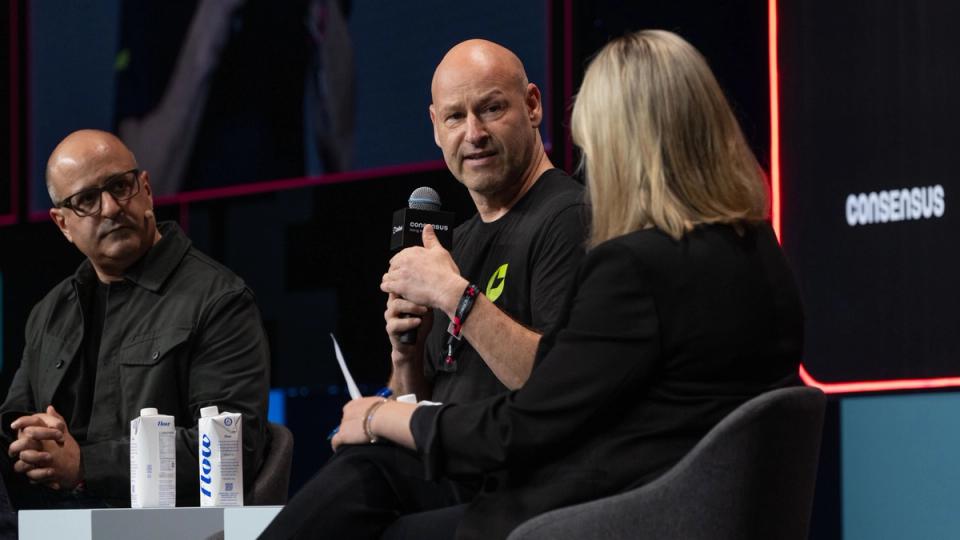
In a panel discussion at Consensus Hong Kong 2026 featuring Sharplink Chairman Joe Lubin and CEO Joseph Chalom, the two executives described how DATs are evolving into a distinct institutional strategy.
“I have never seen such a time of differentiation where the real macro tailwinds for Ethereum have never been better in its 10 and a half year history,” Chalom said, pointing to the growth of stablecoins and tokenization. “Listen to Larry Fink in Davos, when he tells you that $14 trillion in BlackRock assets will be tokenized, and over 65% of that to date is happening on Ethereum.”
While recent ether price developments and ETF flows have raised concerns, Chalom framed them as part of a broader macroeconomic risk reduction. “It was very easy to de-risk Bitcoin and Ethereum,” he said, adding that liquid asset rotations are typical during volatility. “The biggest players in institutional finance are telling us out loud: They are reaching the ether.”
SharpLink’s strategy differs, he argued, because it deploys permanent capital. “An ETF is a great passive exposure vehicle, but it needs to provide daily liquidity… We hold permanent capital,” he said. “The third stage, which is actually the most important, is to make your ETH productive.”
Lubin highlighted the distinctive feature of ether – performance.
“Ether would be a much better asset… because it’s a productive asset. It produces. It has a risk-free rate,” he said, referring to returns of about 3%. SharpLink has staked almost all of its holdings and plans to continue accumulating. “We will continue to buy ether. We will continue to stake ether and add new returns to ether.”
Beyond staking, Chalom described what he called “good institutional DeFi,” which uses long-term locked capital to earn risk-adjusted returns rather than chasing risk-style upside. “We are not looking for 10x VC convex results: we are looking for the best risk-adjusted return for our investors. And, in fact, we are confident that by doing so, we will improve the DeFi ecosystem by raising its standards.”
For Lubin, the change resembles the beginnings of the Internet era. “A long time ago… there were Internet companies. Now every company is an Internet company. Soon, every company will be a blockchain company,” he said, predicting that companies will have more and more tokens on their balance sheets and will require sophisticated on-chain treasury tools.
Read More: Ethereum Treasury Firm SharpLink Stakes $170 Million ETH on Linea Network


