
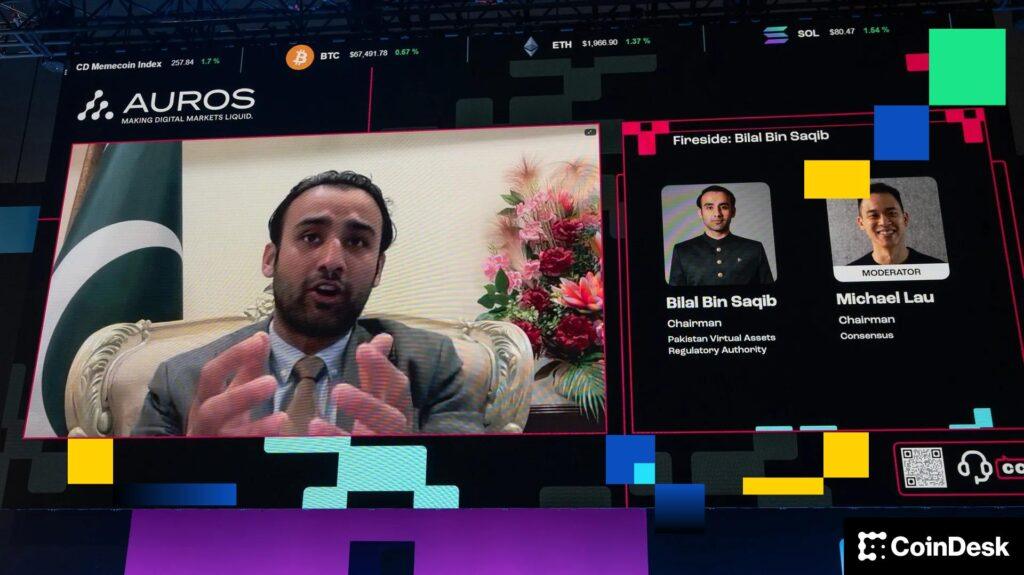
Pakistan didn’t wake up one morning and decide it loves cryptocurrencies, said the chairman of the country’s Virtual Asset Regulatory Authority (PVARA).
The country was in the unusual position of having one of the largest crypto markets on the planet, but without security barriers, PVARA president Bilal Bin Saqib told Consensus Hong Kong 2026 on Thursday.
“In 2025, Pakistan realized that we have approximately 40 million of its citizens who are already trading digital assets without rules, without protection and without benefits returning to the State,” Bin Saqib said through a virtual link. “The market existed, but the regulations did not. Basically, we tried to move from a gray market to a governed market.”
In fact, Pakistan boasts the third-largest crypto market by retail activity, ahead of places like Germany and Japan, Bin Saqib said. This is because Pakistan is not only an emerging economy but also a young country in terms of demographics. Around 70% of the 250 million inhabitants are under 30 years old.
“We are one of the most tech-savvy young populations on the planet,” said the PVARA president. “We have more than 100 million unbanked citizens, people who have no savings tools, no investment tools, no way to get out of their economic class. And hence cryptocurrencies and blockchain are not a luxury for Pakistan. It is a ladder for the masses.”
Pakistan’s strategic bitcoin reserve and national mining plans
One area of interest for the crypto industry was Bin Saqib’s announcement last year at Bitcoin Las Vegas that Pakistan was planning to establish a strategic reserve of $68,087.00 of bitcoin BTC and support bitcoin mining.
Bin Saqib noted that this was not simply “an announcement,” but added that “when it comes to something as strategic as the Bitcoin reserve or national energy allocation, speed without structure can be dangerous.”
Regarding the reserve, “the first step is to identify digital assets held by the state, move them to a formal custody framework controlled by the state, and that establishes transparency, accountability and standards. This is not about speculation; it is about treating digital assets as sovereign wealth,” Bin Saqib said.
Regarding mining, he said: “We have identified the sites where we have surplus electricity and are now assessing the economics and impacts and at the same time we are also collaborating with global miners and also AI computing operators.”
The project is about following a “responsible partnership model,” Bin Saqib said, because it is not just a standalone crypto experiment.
“It is part of a broader strategy around optimizing energy, computing capacity and our national digital infrastructure. Because Bitcoin mining and AI data centers are the two mechanisms to convert unused energy into productive capacity for our country.”


