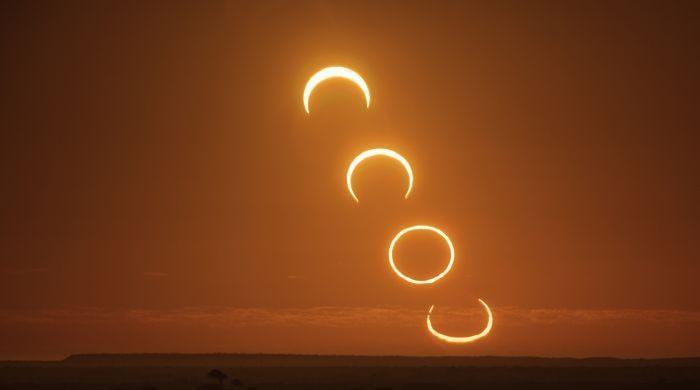
An annual solar eclipse will transform the sun into a glowing “ring of fire” over a remote corner of Antarctica.
The eclipse will be observed on February 17, when the Moon will pass directly in front of the Sun while it is at the farthest point from Earth in its elliptical orbit.
Since the moon cannot completely cover the sun, it leaves a visible halo of sunlight surrounding the moon’s dark shadow.
The ring of fire will form phase by phase.
Partial eclipse begins (4:56 am EST / 0956 GMT)
The moon will partially cover the edge of the sun, making its “first contact.” In the next few hours, lunar darkness will rapidly sweep across the solar disk, transforming the Sun into an increasingly narrow crescent.
Annulment begins (6:42 am EST / 1142 GMT)
With the second contact the ring of fire phase begins. Here, the Moon will be completely inside the solar disk. The sky will darken and only the outer edge of the sun will be visible as a golden ring.
Maximum eclipse (7:12 am EST / 1212 GMT)
The perfect halo is created when the moon reaches the dead center of the solar disk. This phase will last about two hours across Antarctica before the ring begins to break up.
Partial eclipse ends
The third contact breaks the ring when the moon touches the opposite edges of the sun. In the next hour, the lunar disk will slowly return until the fourth contact. At the fourth contact, the last silver of the moon completely leaves the sun.
Although the ring of fire is visible in remote areas of Antarctica, it is important to note that looking at the sun directly without eclipse glasses can be dangerous.
It can cause serious and permanent eye damage. Viewers are therefore advised to avoid looking at the sun without eclipse glasses or solar filters.
After the eclipse, another celestial event awaits us. A total lunar eclipse known as a “blood moon” will be visible on March 3 in North America, East Asia and Australia.