
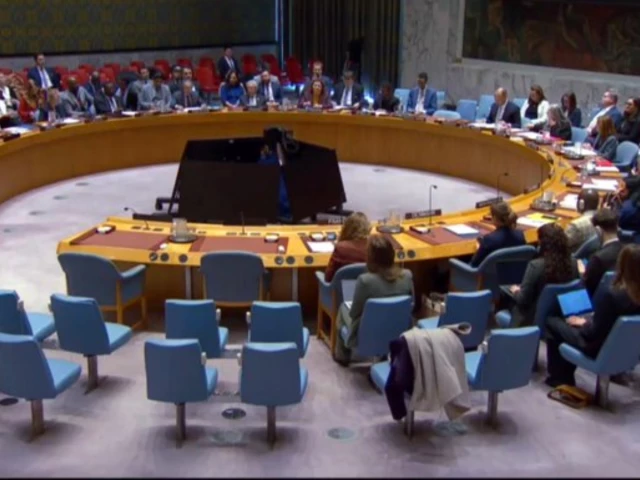
UN Security Council unanimously renews mandate of Taliban Sanctions Monitoring Team for another 12 months
United Nations Security Council PHOTO: X/Permanent Representative of Pakistan to the UN Asim Iftikhar Ahmad
Pakistan on Friday reiterated its call for Afghan territory to stop being used for terrorism against neighboring states, urging action to prevent what it described as “external saboteurs” from exploiting the situation, during a meeting of the United Nations Security Council (UNSC).
The UNSC unanimously adopted a draft resolution that renews the mandate of the Monitoring Team supporting the 1988 Afghanistan Sanctions Committee – responsible for overseeing the Taliban sanctions regime – for a further 12 months. All 15 members of the Council, including Pakistan, voted in favor of the resolution, extending the mandate until February 17, 2027. The draft was prepared and presented by the United States.
Speaking in the Council, Pakistan’s Permanent Representative to the UN, Asim Iftikhar Ahmad, expressed serious concerns over the continued presence of terrorist groups on Afghan soil, including Tehreek-e-Taliban Pakistan (TTP), Balochistan Liberation Army (BLA) and its Majeed Brigade, Islamic State Khorasan (ISIL-K) and Al Qaeda.
“With the adoption of this resolution, the Council sends a clear message to the Taliban authorities that Afghan territory should not be used to threaten or attack any country,” the ambassador said, according to highlights of his comments shared on X.
I delivered the Explanation of Vote (EOV) after the adoption of the 1988 Renewal of Mandate of the Monitoring Team for the Taliban Sanctions Regime by the UN Security Council.
Below are the highlights of my statement:
➡️ Pakistan voted in favor of this resolution that… pic.twitter.com/dgkCWL7ih9
— Asim Iftikhar Ahmad, Pakistan PR to the UN (@PakistanPR_UN) February 12, 2026
He added that the Council also expects all Member States to ensure that kidnappers, hostage takers and terrorist groups do not benefit, directly or indirectly, from ransom payments or political concessions, and to take measures to ensure the safe release of hostages.
“We call on the Taliban to prevent terrorist groups from carrying out such actions with impunity and to effectively combat terrorism,” Ahmad said, urging sustained and verifiable counterterrorism measures.
The ambassador said the Council had spoken with a “unanimous voice” in highlighting Afghanistan’s challenges and remained committed to reviewing the sanctions regime as appropriate, taking into account realities on the ground. He expressed the hope that the Monitoring Team would continue to actively report and support the work of the 1988 Taliban Sanctions Committee.
“It is up to the Afghan authorities to decide which path they wish to choose: whether the path of isolation or the path of peace and prosperity as a responsible member of the international community,” he concluded.
Read: UN Security Council conclusions support Pakistan’s TTP stance
A day earlier, Foreign Ministry spokesperson Tahir Andrabi said a recent report by the United Nations Security Council’s 1267 Sanctions Committee had “broadly supported” Pakistan’s long-standing position that terrorist groups – particularly the TTP – continue to operate from Afghan soil with operational space and support. He added that the February 4 report corroborated Islamabad’s view that the TTP re-emerged following the 2021 takeover of power by the Afghan interim government.
The comments come in the wake of some of the deadliest terrorist attacks Pakistan has faced. Last Friday, at least 36 people were killed and around 169 injured when a suicide bomber attacked Imambangah Khadijah al-Kubra. The explosion, followed by more explosions and gunshots, occurred as worshipers had gathered for Juma’a prayers.
The attack was the deadliest in Islamabad in more than a decade and the most destructive nationwide since the Peshawar mosque bombing in January 2023.
Read more: CTD arrests top terrorist commander in Bannu
On January 31, a series of coordinated attacks occurred in multiple locations in Balochistan. According to Inter-Services Public Relations (ISPR), security forces killed 92 terrorists, while 18 civilians were martyred. The military said that during the clearing operations and intense fighting, “15 brave sons of the soil, after having fought valiantly, made the ultimate sacrifice and embraced martyrdom.”
The BLA claimed responsibility for the attacks in a social media post, describing them as the second phase of “Operation Heroof.” The government has designated the BLA and other Baloch groups as “Fitna al Hindustan“, alleging that they are acting as proxies for India to destabilize Pakistan through hybrid warfare. Officials say the BLA’s suicide wing, the Majeed Brigade, has developed links with other anti-Pakistan terrorist groups operating from Afghanistan.
In 2025, Khyber-Pakhtunkhwa faced 1,588 terrorism-related incidents, reflecting a rapidly escalating militant threat in settled and tribal regions. Despite the increase in attacks, security forces managed to prevent 320 major attacks, while 137 police officers and personnel gave their lives in the line of duty. This marks an increase of almost 50 percent compared to 2024.


