
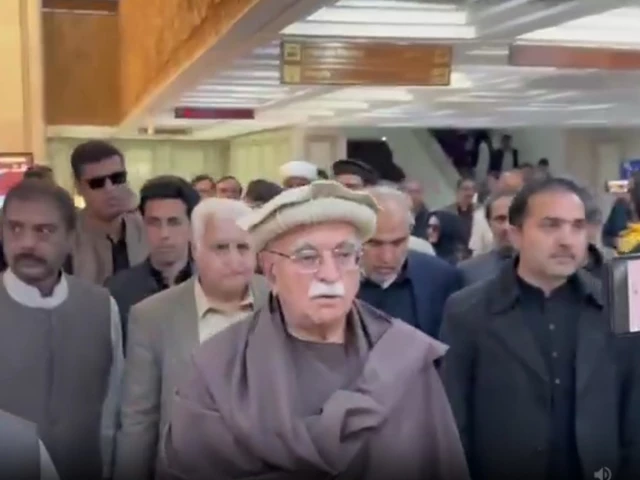
TTAP chief and leader of the opposition in the National Assembly, Mahmood Khan Achakzai, in Parliament on February 13, 2026.
ISLAMABAD:
The deteriorating health of PTI founder Imran Khan revealed in a report submitted to the Supreme Court on Friday sparked a political storm in the country, with the government defending the medical treatment schedule and the opposition alleging negligence and constitutional violations.
The government side appeared to be on the defensive after voices were raised from both sides of the divide, demanding better treatment for the jailed prime minister.
Parliament became a rallying point for the opposition alliance to agitate the issue – both inside and outside – when the Tehreek Tahafuz-e-Ayeen Pakistan (TTAP) laid siege to its gates, vowing not to budge until the PTI founder is taken to a hospital for urgent eye treatment.
In the Senate, the session witnessed heated exchanges between the Treasury and the opposition after a resolution expressing concern over Imran’s health was rejected in a voice vote, sparking protests and sloganeering from opposition lawmakers.
The move came just 24 hours after the Supreme Court was told that the jailed former prime minister had only 15 percent vision left in his right eye, a revelation that has sparked a fresh confrontation between the government and the opposition.
The announcement of the sit-in transformed an already tense capital into a theater of protests, with opposition lawmakers accusing authorities of negligence and the government rejecting the “politicization of a medical issue.”
Following lawyer Salman Safdar’s submission to the Supreme Court over Imran’s deteriorating eyesight, TTAP announced that it would protest until the jailed former prime minister was transferred to Al-Shifa Hospital for treatment under the supervision of his personal medical team.
In a post on
The alliance made it clear that there would be “no compromise” on the PTI founder’s health, and all PTI MPs were ordered to join the protest.
In the afternoon, around 7:40 pm, TTAP announced that the sit-in had moved to the Parliament House corridor under the leadership of National Assembly Opposition Leader Achakzai and Senate Opposition Leader Allama Raja Nasir Abbas.
However, the protest remained concentrated at the main entrance of Parliament, where opposition leaders reiterated that it would continue until Imran was taken to hospital.
Hours earlier, Achakzai had promised to continue the sit-in “until all demands are met.”
TTAP leader Mustafa Nawaz Khokhar claimed that the government had “cordoned off all roads leading to Parliament” and claimed that “the doors of the parliamentary lodges have been closed, trapping MPs and senators inside.”
According to him, these measures were aimed at preventing opposition members from protesting and demanding medical access. “This does not reflect strength, but rather weakness,” he said.
Meanwhile, Awaam Pakistan leaders Shahid Khaqan Abbasi and Miftah Ismail announced that their party would join the TTAP sit-in.
Speaking before the protest, Parliamentary Affairs Minister Dr Tariq Fazal Chaudhry maintained that the opposition had the right to protest, but denied that the government had imposed a blockade.
He reiterated that the government had “repeatedly” assured that “no negligence regarding Imran’s health will be tolerated.” Calling it a medical issue rather than a political one, Chaudhry said the PTI founder would be taken “wherever he prefers” for treatment.
“Wherever he (Imran) wants to go for a check-up, they will take him. If he wants to go to Al-Shifa Eye Trust, then they will take him there. There will be no negligence in the matter,” he said, adding that any doctor recommended by the chief justice will also be admitted.
He dismissed reports of delays in treatment, noting that the issue had not arisen during family meetings on December 2, the medical board examination on December 9 or during the Toshakhana verdict on December 20.
He stressed that Chief Justice Yahya Afridi was “handling the case himself.”
Senate
The Senate session began in an unusual manner as the president, vice president and members of the panel of presiding officers were absent, prompting the House to pass a motion electing Senator Shahadat Awan to preside over the proceedings.
As the agenda began, Senate Opposition Leader and Majlis Wahdat-e-Muslimeen chief Allama Raja Nasir Abbas sought permission to speak on Imran Khan’s health and was granted the floor. However, before it could begin, PTI Senator Aon Abbas Buppi moved a resolution demanding immediate medical intervention.
The resolution called for the former prime minister to be transferred to a “first-class and high-level hospital for comprehensive medical examinations and treatment.” He further demanded that his personal doctors and private medical team be granted immediate and regular access, and that his family be kept fully informed of his state of health.
The resolution was rejected by oral vote.
The opposition’s demand for a formal recount was also rejected by the president, prompting PTI lawmakers to gather before the president’s podium and chant slogans against the “inhuman treatment” of a high-profile prisoner.
“No four-month delay”
Adviser to the Prime Minister on Political and Public Affairs and PML-N senator Rana Sanaullah told the House that claims of a four-month delay in treatment were “absolutely incorrect”.
According to him, Imran Khan first complained of an eye problem in the first week of January.
He said that after the complaint, the prison doctor prescribed him eye drops, which were used for several days. On January 15, the jail superintendent wrote to the Pakistan Institute of Medical Sciences (PIMS).
Two doctors examined him on January 16 and recommended tests. A four-member medical team, comprising Dr Usman, Dr Nauman Iqbal, Dr Arif and Dr Saman, examined him on January 19. On January 24, he was given an injection in his eye at PIMS.
“These measures are documented,” said Rana Sanaullah, adding that prompt treatment was provided without delay. He said jail doctors examine the PTI founder every two days and external medical boards had examined his condition 25 times so far.
He also noted that there was no reference to any eye ailment during the Dec. 9 medical board review.
Referring to previous meetings, he said Uzma Khan met Imran Khan on December 2 and told the media that his health was “absolutely fine”. On December 20, when the Toshakhana-II verdict was announced, Salman Safdar and other lawyers spent two hours with it, but no ocular complaint was filed.
“If the PTI has any suggestion regarding the medical care of its founding president, it should approach the Supreme Court of Pakistan,” he said, adding that the government would fully implement any directive issued by the apex court.
He further said that the report submitted to the Supreme Court indicated that the PTI founder was satisfied with the prison security and living conditions.
Ask for better treatment
Senior PML-N leader Javed Latif and JUI-F chiefs Maulana Fazlur Rehman asked that the PTI founder be allowed an immediate meeting with his family and personal doctor.
In an Express News program, Latif stated that no one has the right to play with another person’s life and criticized the idea of rejoicing over someone’s illness. He urged the government to allow urgent medical treatment of the PTI founder abroad.
JUI-F chief Maulana Fazlur Rehman demanded that former Prime Minister Imran Khan be provided with complete medical facilities in Rawalpindi’s Adiala Jail, where the PTI founder has been detained since September 2024.
“Imran Khan should be allowed to be examined by a doctor of his choice on humanitarian grounds,” the JUI-F chief said in a statement on Friday.


