
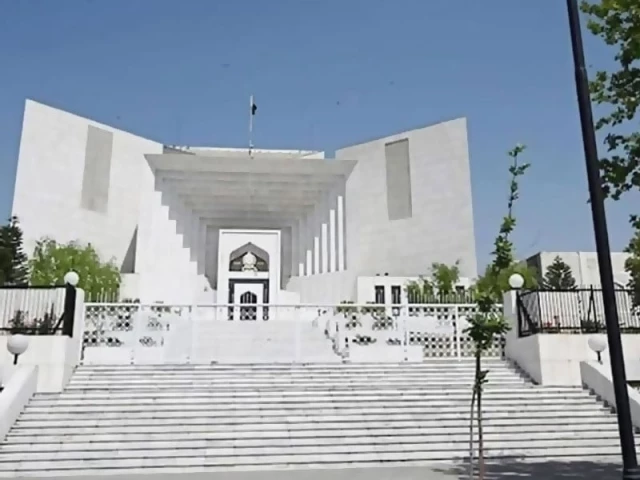
ISLAMABAD:
In a ruling that reinforces the principle of institutional responsibility, the Supreme Court held that the State must organize itself in a way that allows it to function efficiently within the prescribed legal deadlines, and cannot ask for leniency for delays arising from its own inefficiencies.
A division bench headed by Justice Ayesha Malik rejected the Finance Ministry’s appeal in a service issue due to a 20-day deadline, observing that the delay, as explained by the petitioner, did not constitute sufficient cause. “The explanation offered and presented in the petition is essentially that the petition could not be filed on time due to internal procedural requirements and administrative challenges,” said a four-page ruling written by Justice Ayesha Malik.
“Both explanations are totally unsatisfactory since internal procedural requirements or administrative inconveniences cannot nullify the legal obligation to submit the petition within the established period.”
“The petitioner is fully aware of the prescribed time frame within which the petition had to be filed, but he gave preference to the bureaucratic process without any effort to expedite the process.”
“Such conduct amounts to a conscious disregard of the requirements of the law and also reflects poor implementation within the system of government. Poor implementation, in this context, refers to the failure of the State to ensure that the deadlines set out in the law are treated as binding,” the judgment noted.
The court further noted that a system unable to ensure compliance with its own legal obligations reflects a weakness in internal accountability.
When delay is explained by reference to administrative routine rather than unavoidable circumstances, it indicates that compliance depends on convenience rather than discipline.
The ruling noted that this type of delay is inexcusable, especially when no effort has been made to reform or improve the procedure that causes so much delay.
“The State enforces the law against citizens and expects compliance within the prescribed deadlines. Therefore, it must adhere to the same standard. If the State is allowed to ignore legal deadlines due to its own internal inefficiencies, it creates an imbalance in the administration of justice and undermines the constitutional guarantee of equality before the law.”
He observed that when the State does not comply with these deadlines and requests leniency due to administrative delay, it transfers the consequences of its disorganization to the court and the opposing party, which is often in a weaker position than the State.
“Good governance requires institutions to function through clear accountability, internal discipline and compliance with the law. If compliance depends on convenience rather than structured systems, delays become routine and accountability declines,” he further noted.


