
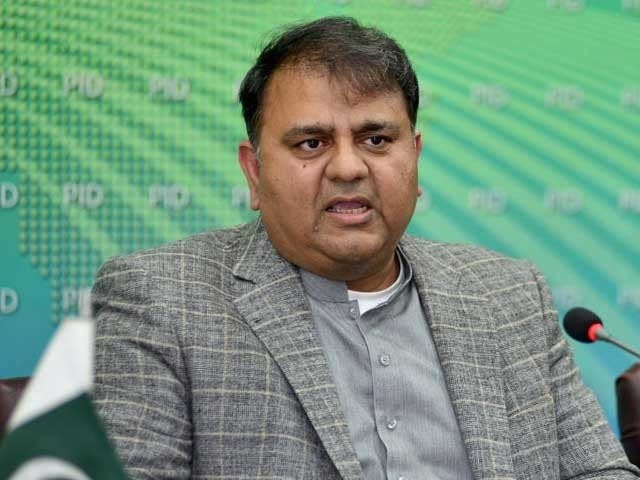
Fawad Chaudhry. PHOTO: ARCHIVE
ISLAMABAD:
The National Dialogue Committee (NDC), a platform led by former PTI leaders, on Friday proposed forming a national unity government including all political parties to lead the country out of the current political deadlock.
At a press conference, NDC members Fawad Chaudhry and Mahmood Molvi, along with former minister Muhammad Ali Durrani and PTI leader Barrister Muhammad Ali Saif, urged political parties to reduce hostility and return to the negotiating table.
The call for a consensus government came amid claims and counterclaims over a possible deal between the PTI and the government and the controversy surrounding Imran Khan’s health.
Fawad said the NDC aimed to normalize the country’s political climate, warning that continued polarization was worsening governance and economic challenges.
He claimed that economic conditions had forced numerous international companies to leave Pakistan and cited financial reports showing that citizens were facing serious economic strains.
He added that political stability could not be achieved without dialogue between stakeholders and emphasized that confrontation would only deepen national divisions.
“Pakistan needs a breather to protect itself from chaos, and the only way forward is to form a government of national unity,” said Fawad, who served as information minister during the PTI government. He added that political tensions have not decreased in the last four years.
He said that while the government had made efforts, it had failed to diminish Imran Khan’s political stature. At the same time, he added, the PTI and its leaders also failed to carry out the promised revolution, a situation that affects ordinary citizens.
“I demand, from the NDC platform, the establishment of a national government in Pakistan, formed on the advice of Nawaz Sharif, Asif Ali Zardari, Imran Khan, Maulana Fazlur Rehman and other political heavyweights,” he said.
He also appealed to the establishment, saying the powers that be should facilitate dialogue between politicians to reduce political tensions, secure the release of political prisoners and build consensus on important reforms.
Commenting on Imran Khan’s health, Fawad said the entire nation was worried and he should be given immediate access to his personal doctors.
He said that consulting doctors of his choice was Imran’s legal and humanitarian right, and that authorities should allow medical professionals to directly assess his condition.
Durrani said forming a national government could provide a way to get the country out of political gridlock. “It’s not a new concept; it has historically worked, whether in the UK, Ireland or South Africa,” he said.
Lawyer Saif highlighted two major challenges facing Pakistan: terrorism, which he said affects more than half of the population, and international developments, including the situation between Gaza and Palestine, which could have long-term implications.
“Reconciliation is essential in the current environment. Security challenges in large parts of the country make national unity more important than ever. Political tensions and hostile rhetoric must be reduced, and all political leaders must engage in constructive dialogue,” he said.
Responding to questions about his contact with Home Minister Mohsin Naqvi, Saif said: “I have been in touch with Mohsin Naqvi in the past but it has not yielded any result so far. I am still trying for Imran Khan’s release.”


