
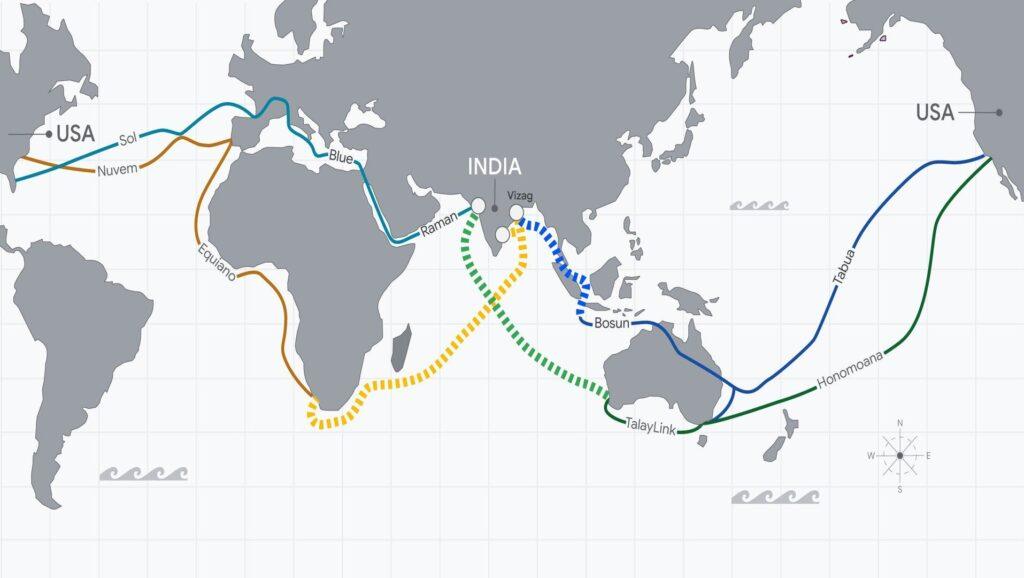
- Google’s undersea cables create resilient networks linking India, the United States and the Southern Hemisphere
- AI infrastructure expansion relies on high-capacity fiber optic networks spanning multiple continents
- Visakhapatnam becomes a key international gateway for global data traffic flows
Google is expanding its private undersea cable footprint with a new initiative linking the United States and India across multiple southern hemisphere routes.
The plan, called America-India Connect, adds new fiber routes between Mumbai and Western Australia, and between Visakhapatnam on India’s east coast and key international hubs.
When combined with existing systems such as Blue, Raman, Sol, Equiano and others, these routes expand data corridors across the Pacific, Africa and the Red Sea.
Building the missing links on all continents
“We are announcing America-India Connect, a collaborative infrastructure initiative… will establish a new international undersea gateway… three new undersea routes… and four strategic fiber optic routes that will bolster network resilience and capacity between the United States, India, and multiple locations across the Southern Hemisphere,” Google said in a blog post.
A new international underwater gateway at Visakhapatnam is expected to diversify traffic away from traditional entry points like Mumbai and Chennai.
Additional links have been designed with Singapore, South Africa and Australia to increase redundancy and capacity.
Together, these routes connect the west coast of the United States through Australia to India, while strengthening a pathway from the east coast of the United States through Africa.
Google is already one of the largest private investors in underwater fiber networks, typically financing and designing projects that extend thousands of kilometers under the sea.
These cables carry high-capacity global data traffic and form the backbone of cloud computing, digital services and cross-border business operations.
The initiative builds on a broader five-year $15 billion investment in AI-related infrastructure in India, including a planned AI center in Visakhapatnam with large-scale computing capacity and integration with the new underwater gateway.
Company executives argue that more robust infrastructure is necessary to ensure reliable and affordable connectivity as artificial intelligence systems expand.
Greater bandwidth and network resilience are often linked to higher productivity and long-term economic growth, and with deeper access to digital services, businesses and public institutions can deploy AI tools more broadly across sectors.
The stated goal is to reduce the risk of an AI split, where only certain regions or industries benefit from advanced computing resources.
Google has also committed funding through its philanthropic arm to support public services and research using AI.
Executives describe India as a complete AI opportunity, referring to its role as a user base, development hub and regulatory player in shaping future standards.
These undersea investments follow established maritime trade routes, now converted into digital highways between economies.
Whether this network truly fills the remaining gaps in global connectivity will depend on execution, regulatory stability and sustained demand.
However, the magnitude of the capital involved suggests confidence and Google appears willing to invest additional funds.
Alphabet CEO Sundar Pichai said in a press conference: “AI is the biggest platform shift of our lifetimes… It’s an extraordinary moment; we’re investing to meet the moment… (it’s) one of the most powerful tools for solving problems and improving lives on a planetary scale.”
Follow TechRadar on Google News and add us as a preferred source to receive news, reviews and opinions from our experts in your feeds. Be sure to click the Follow button!
And of course you can also follow TechRadar on TikTok for news, reviews, unboxings in video form and receive regular updates from us on WhatsApp also.


