
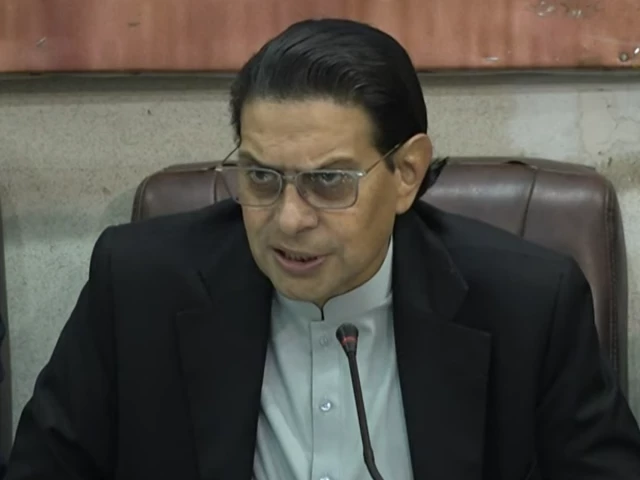
PTI Central General Secretary Salman Akram Raja addresses a press conference on Sunday. SCREEN CAPTURE
LAHORE:
Pakistan Tehreek-e-Insaf (PTI) is grappling with an escalation of internal conflicts apparently rooted in a leadership crisis, with its general secretary emerging as the latest target of criticism within the party.
Amid growing unrest, he has reportedly assured his detractors that he would ask the party’s jailed founder to relieve him of his post, according to two party leaders who hold organizational portfolios, one in Punjab and the other at the Centre.
As the aggressive stance of the decision-makers in the PTI has brought the party almost to a breaking point, a crisis of confidence has emerged in its ranks and ranks.
Several leaders told The Express PAkGazette that resistance was no longer considered a viable option for the party.
However, confusion remains over whether the option should be abandoned altogether, with some believing the threat of mass resistance should remain intact to provide leverage when the party decides to sit on the other side of the table with the powers that be.
These divergent strategic approaches have led many within the party to conclude that general secretary Salman Akram Raja was not living up to expectations, especially given his polite and composed demeanor.
According to a Punjab party official, Raja clashed with some members of an internal group who demanded his resignation over what they described as his inability to lead the party effectively.
Responding to the criticism, the source said Raja assured his detractors that he would raise the matter with party founder Imran Khan and ask him to bring in someone from the youth to exempt him from the post so he could refocus on his legal practice, which had been affected due to his political commitments.
The source further claimed that Raja, who enjoys the full support of Imran Khan’s sister Aleema Khan, has no experience in leading a political party, let alone leading it out of a crisis. “Their plan is to put out the legal fire, which will get the party nowhere,” the source said.
However, PTI central spokesperson Sheikh Waqas Akram rejected any call for the general secretary’s resignation.
Speaking to The Express PAkGazette, he said isolated voices of estranged officials should not be interpreted as infighting, adding that the entire leadership was operating according to the directives of party founder Imran Khan.
A senior party leader and key official has backed Sheikh Waqas Akram’s claim that the WhatsApp altercation was an isolated incident.
However, he noted that internally there are feelings against the acting president and the secretary general, although such demands have not yet been expressed verbally. He acknowledged that Raja’s legal practice had suffered since he joined the party and said his sacrifices should not be overlooked.
“He is a loyalist and people like him are an asset in any party,” the leader said, adding that Raja lacked the political acumen to create much-needed room for maneuver in the party.
He further alleged that the general secretary himself was “in a straitjacket” by Imran Khan’s sisters, who wanted to retain control of the party’s affairs until something went wrong, at which point they quickly transferred the burden to the leadership.
He said that resistance was no longer an option for the party and that those who tried to follow that path would be doing it a disservice.
The leaders, he added, did not take Chief Minister KP Sohail Afridi’s announcement of a “liberation force” lightly, fearing that it could put the party back on a collision course with the powers that be.
According to him, this idea led to the idea being presented to management for approval.
He added that Afridi was also seeking to control the party’s youth force, which is why he floated the idea of creating a parallel body within the party for youth members, a decision he could not make independently.
Another PTI leader claimed that internally the party was not even satisfied with the control given to the Tehreek-e-Tahafuz-e-Ayin-e-Pakistan (TTAP) as it amounted to marginalizing those who had given “their blood and sweat” for the party.
“What benefit did people like Omer Ayub get from all the sacrifices he made for the party?” he asked, noting that despite facing state brutality, Ayub had also been internally labeled a traitor.
He said PTI, as a political party, should not function according to the whims of social media followers.


