
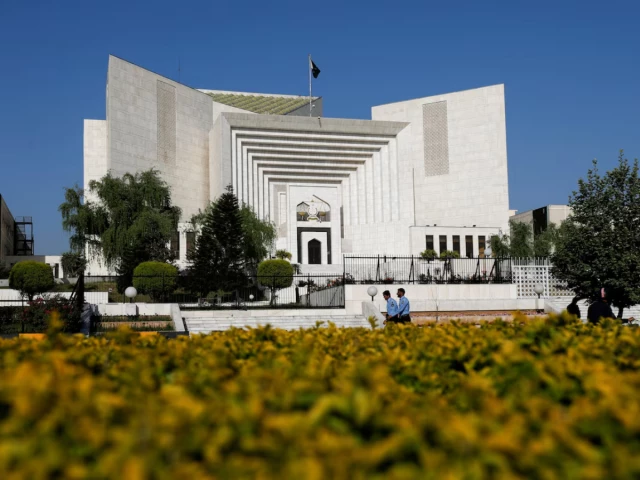
Police officers walk past Pakistan’s Supreme Court building, in Islamabad, Pakistan, April 6, 2022. REUTERS
ISLAMABAD:
The Supreme Court has held that a suspended officer is entitled to receive full salary and other service benefits during the period of suspension, declaring that suspension does not sever the employer-employee relationship or extinguish contractual rights.
In a four-page judgment written by Justice Shakeel Ahmad, upholding the decision of the Federal Service Tribunal (FST) in favor of an employee of the Federal Board of Revenue (FBR), the SC said “it is now well established that suspension is not removal, dismissal or termination of service.”
Rather, it is an interim measure, which simply suspends the performance of duties as long as the order of appointment or contract subsists, and the relationship between employer and employee remains intact, the ruling stated.
“Consequently, the official continues to occupy the position, although without performing his duties. Once the service contract remains in force, all rights derived from it, including the right to receive full salary, remain enforceable during the period of suspension.”
The employee had served as a senior officer/inspector in the FBR. After completing more than 31 years of qualified service, he requested medical retirement. However, his request was not considered by the department. Subsequently, following the instructions of the petitioner department, he appeared before a medical board for examination. The Board opined that he suffered from multiple illnesses and declared him unfit to continue providing services.
Following an investigation, he was compulsorily removed from service on July 12, 2024, with the observation that the period of his suspension be treated as extraordinary leave without pay, and that the salaries and allowances paid during the period from 06.11.2023 to the imposition of a serious penalty be recovered.
His departmental appeal remained unresolved, which led him to file an appeal with the FST, where the decision was partially in his favor.
The FBR subsequently challenged the FST order before the SC.
A division bench comprising Justice Shahid Bilal Hassan and Justice Shakeel Ahmad, while upholding the FST order, noted that the stay does not extinguish the contract; Therefore, an employee cannot be deprived of legitimate remuneration without express legal sanction.
The order observes that when the government issues an appointment order, it enters into a binding contract of service with the employee. Any unilateral withholding of salary, without the authority of law, is incompatible with the terms and conditions of said appointment.
“Depriving a suspended employee of full pay, salary, and service benefits is not only unfair and oppressive, but also contrary to the express mandate of Fundamental Rule 53(b).”
“In the case of a suspended public servant, other than as specified in subsection (a), he shall be entitled to the full amount of his salary and all other benefits and facilities provided to him under the contract of service, during the period of his suspension.”
“Allah, the Almighty, enjoins justice and forbids oppression, as enjoined in the Holy Quran
Similarly, the Holy Quran unequivocally prohibits the illegal deprivation of property and legitimate earnings, declaring that people should not devour the wealth of others and should not deny others what is rightfully theirs. In the same vein, the Holy Prophet Muhammad (PBUH) emphasized the sanctity of timely remuneration by ordering that the worker be paid his salary before his sweat dries.”
The ruling further notes that Islam requires the enforcement of contracts, the protection of legal profits, and the prohibition of exploitation and unjust deprivation. The suspension is simply a provisional agreement and does not amount to a guilty plea. The imposition of financial deprivation before ruling amounts to punishment without evidence, which is contrary to Islamic principles of justice.
“The verses of the Holy Quran and the hadiths cited above clearly establish the obligation of prompt and full payment of salaries”
The court also noted that while interpreting Rule 53 of the Fundamental Rules, the SC Shariat Appellate Court had already held that in the light of the injunctions of Islam, a suspended government servant should be allowed full salary along with all other benefits and facilities provided to him under the contract of service.
The judgment held that the court had correctly come to the conclusion that a suspended officer is entitled to receive full salary and other service benefits during the period of suspension.


