
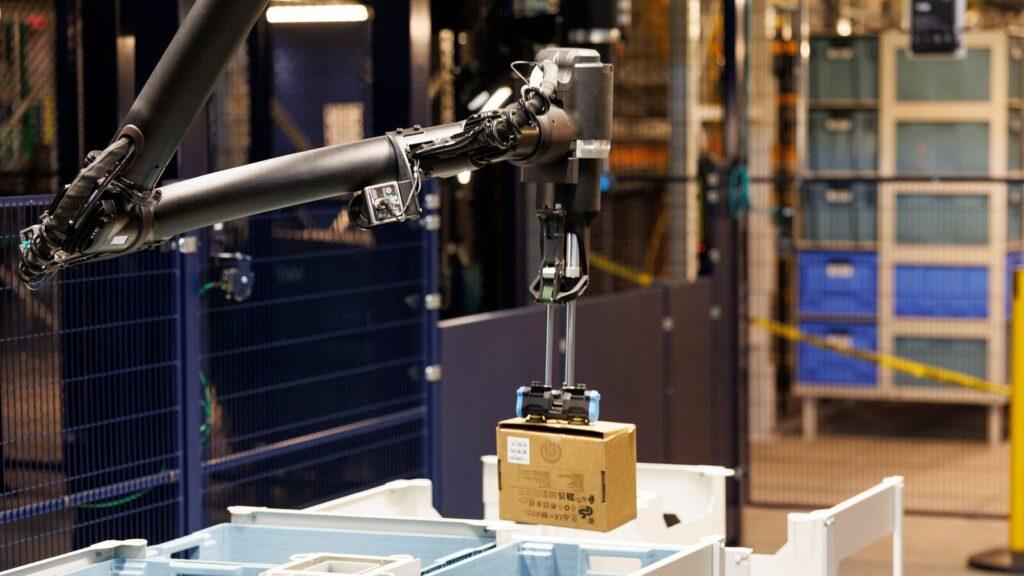
- Blue Jay lasted less than six months despite rapid development speed
- The status of the prototype was not clearly communicated during Blue Jay’s initial press announcements.
- Blue Jay Employees Reassigned to Programs Leveraging Leading Robotics Innovations
Amazon has been steadily developing warehouse robotics since acquiring Kiva Systems in 2012, creating the foundation for automated fulfillment centers.
As of July 2025, the company had deployed more than 1 million robots in its warehouses, demonstrating a strong commitment to robotics while also highlighting the operational complexity involved.
Despite this scale, not all internal robotics initiatives are successful, and the company’s latest experiment, Blue Jay, illustrates the challenges of rapid innovation.
The rise and fall of the Blue Jay
Introduced in October 2025, Blue Jay was designed as a multi-armed robot capable of sorting and moving packages in same-day delivery facilities.
Testing began at a facility in South Carolina, and Amazon noted that the development cycle was unusually fast (about a year) compared to other warehouse robots, a speed attributed to advances in AI.
Despite its rapid development, the project lasted less than six months before being stopped, demonstrating that speed alone does not guarantee operational success.
Amazon confirmed that Blue Jay was presented as a prototype, something it did not clearly state in previous press announcements.
Employees who worked on the project are being reassigned to other robotics programs that use Blue Jay’s core technology.
Amazon spokesman Terrence Clark said the company intends to accelerate the use of Blue Jay’s underlying innovations in future warehouse robotics, maintaining continuity while shifting focus toward more sustainable applications.
While Blue Jay is no longer active, Amazon continues to develop other warehouse robots, including Vulcan.
Vulcan features two robotic arms: one dedicated to rearranging and moving items within storage compartments, while the other uses a camera and suction cups to precisely pick up and place individual items.
Its sensors allow it to detect the weight, shape and orientation of packages, allowing you to handle items without causing damage.
The robot’s software continually adapts to variations in package size and density, allowing it to optimize picking sequences and reduce order fulfillment delays.
Vulcan operates within Amazon’s same-day delivery and high-density fulfillment centers, where space limitations require precise navigation and coordination with existing transportation systems.
The robot’s dual-arm configuration allows it to handle multiple items at once, increasing throughput in storage compartments without requiring human intervention for repetitive lifting tasks.
Its touch and vision sensors send continuous data to integrated processing units, allowing real-time adjustments to grip strength and movement trajectories.
Integration with warehouse management software allows Vulcan to receive task priorities.
It dynamically plans routes and communicates with other robotic units to avoid collisions or bottlenecks, supporting a more efficient automated workflow.
Through TechCrunch
Follow TechRadar on Google News and add us as a preferred source to receive news, reviews and opinions from our experts in your feeds. Be sure to click the Follow button!
And of course you can also follow TechRadar on TikTok for news, reviews, unboxings in video form and receive regular updates from us on WhatsApp also.


